
The Math Behind The U.S. Defeat in Iran
Missile-interceptor stocks are dwindling after only five months. That Memorandum of Understanding is looking pretty enticing!

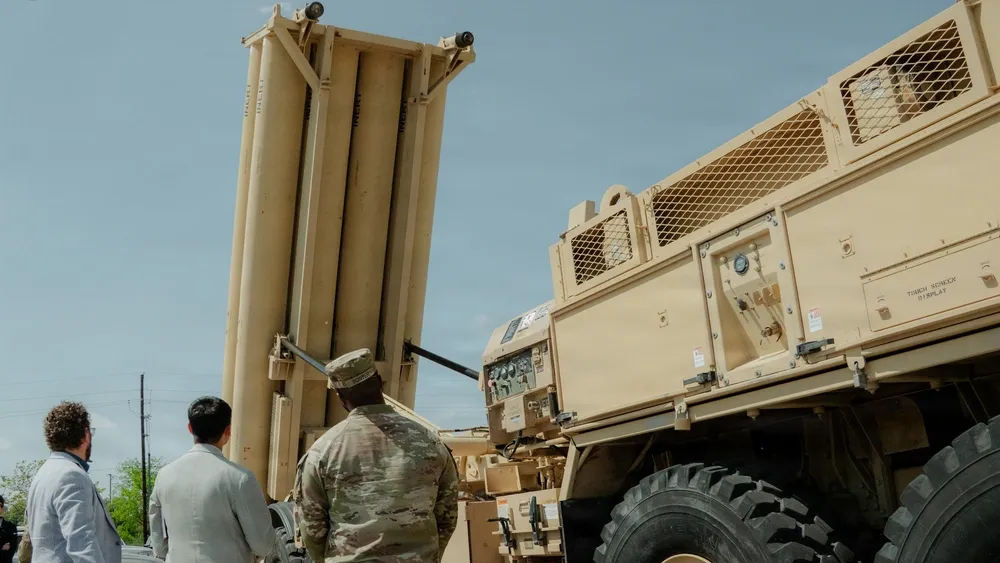
Missile-interceptor stocks are dwindling after only five months. That Memorandum of Understanding is looking pretty enticing!
Edited by Sam Thielman
FROM THE VERY first week of the U.S./Israeli aggression against Iran, this newsletter has pointed to a stark, unforgiving metric for understanding its progress: Iranian missiles and drones (cheap, plentiful, easy to produce) versus U.S. missile interceptors (expensive, limited, difficult to produce).
By spreading out missile and drone attacks across a wide arc of U.S.-used or aligned military bases and civilian infrastructure (energy, data and desalination facilities) spanning from Kuwait to the United Arab Emirates—and now spreading inland—Iran has forced the U.S. into firing off lots of its interceptors. It also successfully attacked on-base radars that the interceptors rely on for accuracy. While story after story reported that Gen. Dan Caine, the chairman of the Joint Chiefs of Staff, warned about the limited supply of interceptors, known as magazine depth, President Trump insisted that the U.S. had sufficient capability to fend off Iranian attacks.
The actual magazine depth of the U.S. military is understandably classified. But yesterday, the Center for Strategic and International Studies (CSIS), a think tank with impeccable establishment credentials—Kissinger was a trustee—published an estimate of the current state of U.S. interceptor stocks. I don't know what exactly I expected, but the burn rate of the interceptors is so extreme as to make this war look doomed from the outset.
According to CSIS, the U.S. had 2330 Patriot (smaller, short-range) interceptors and 452 THAAD (larger, long-range) interceptors at the start of the war. Five months later, it has between 759 and 827 Patriot interceptors and between 234 and 278 THAADs. Those aren't figures for the interceptors the U.S. has in the Middle East. They're the figures for all the interceptors the U.S. has, period.
In other words, the U.S. has so far used up around 66 percent of its Patriot stocks and around 40 percent, conservatively, of its THAADs. It did that in five months across a war it chose. A war that Trump said would be won in four to five weeks.
The rate of expenditure hasn't been static in those five months. Remember that there was a ceasefire declared on April 8. CSIS' figures, understandably, show the most intense period of interceptor usage occurring in just the first five weeks of the war. All this helps explain why Trump had to pursue a ceasefire in the first place. Iran, by holding the Strait of Hormuz firmly under its control, had far less to lose than the U.S. by seeing if it could consolidate its victory through diplomacy. The Memorandum of Understanding the U.S. and Iran signed—and which now seems somewhere between a dead letter and the basis for any resumed negotiated settlement—reflected it.
Interceptors take time to replace, especially for reasons of scale in production. Like other artillery, when the U.S. isn't expending it at such a rapid clip, the production lines (and everything that goes into them) decline, and it's cumbersome and expensive to spin them back up. That emerged as a major defense-industrial-base issue starting when the U.S. aided Ukraine in resisting the 2022 full-scale Russian invasion. The Pentagon has now pivoted to signing longer-term contracts with its missile producers to keep production at a steady, predictable pace, knowing it's going to need a lot of them. The thing is, the interceptors can't roll off the production lines nearly as fast as the rate of expenditure.
As CSIS recounts, the Pentagon's current budget documents cumulatively request a gargantuan $116 billion in munitions replenishment. (Not all munitions are missiles; not all missiles are interceptors—by a long shot.) Yesterday, Lockheed Martin announced a $56.6 billion addition to its Pentagon contract for more Patriot interceptors. What was in April a one-year, $4.7 billion deal is now a Gary Trent Jr.-esque seven-year contract worth an order of magnitude more. Iran isn't the only winner of this war!
This astronomical rate of interceptor expenditure forces hard choices on U.S. military planners. The Gulf allies who host U.S. military bases now recognize that the U.S. can't sufficiently defend them from Iranian attack, calling into question the viability of the U.S. regional military presence, much of which is already in ruins. While I don't expect China to seize Taiwan in the next several months or North Korea to bombard the south in a shot at peninsular reunification, U.S. allies in Asia know that the quickest way to restock the interceptor magazine in the Middle East isn't production, it's to transfer away the short and long-range interceptors that have long represented the first line of defense in the imperial patron/client bargain. U.S. defense commitments there suddenly look a lot less credible. And all Iran needs to do is to keep attacking, forcing U.S. magazine depth ever shallower, making U.S. clients more and more exposed to standoff strikes.
Beyond what the U.S. can defend, it has to find a way to change the Iranian equation. The most rational one is to return to the Memorandum of Understanding, as humiliating as that will be. Instead, there are those, like U.S. Central Command chief Adm. Brad Cooper, who propose changing it through escalation. Cooper, according to a story seemingly fed by his people to the Wall Street Journal, thinks two more weeks of highly intense bombing will win the war—something that, historically, never works, but which uniformed psychotics and yes-men frequently propose. It's kind of a pattern with this guy.
And if you have confidence in two weeks of bombing to eradicate Iranian missiles, drones and the ability to produce more, recall that Defense Secretary Pete Hegseth testified in mid-March that the U.S. had already destroyed all that. (Hegseth, March 13: "As of two days ago, Iran's entire ballistic missile production capacity — every company that builds every component of those missiles — [has] been functionally defeated [and] destroyed.") I know it won't actually happen, but lies like that from Pentagon chiefs ought to be firing offenses. Instead, they're the weather, grumbled about but ultimately tolerated.
The interceptor math doesn't even touch the strategic heart of the Iran War: Iran's control over the global economic artery that is the Strait of Hormuz. The math merely shows how overwhelmingly far the U.S. is from being able to force the strait open and keep it that way, let alone the pretextual goal of ending the Iranian nuclear program (which Teheran was already negotiating both times Trump attacked Iran in the last year). Iran won this war. Maybe the better way to look at the interceptor math is that the U.S. lost the war before Trump and Israeli Prime Minister Benjamin Netanyahu even launched it.
The hawks were right, it turns out, to focus on Iran's gigantic missile arsenal. Typically, in their fanaticism, they refused to draw the relevant lesson from it.
IT'S A MEASURE of the insanity of this war that Trump renewed U.S. bombardment of Iran last night while Netanyahu was in Washington. In eras past, when the U.S. was engaged in its wars in the Middle East, it took pains to keep whatever it was doing visibly separate from what the Israelis were doing, so as not to place its tyrannical and highly unpopular Arab governments into an untenable position with their anti-Israel publics. (It was always a fiction, but there were real diplomatic efforts to maintain it.) The Gaza genocide and then the 2025 Twelve-Day War did away with all that.
Connor Goldsmith, the telepath behind the Cerebro podcast (and one-half of The Kibitz), makes his comic debut with DID YOU HEAR ABOUT MIMI GREEN?, a fantastic thriller meditating on fame, social media and body horror! You have to read this!
WALLER VS. WILDSTORM, the superhero spy thriller I co-wrote with my friend Evan Narcisse and which the masterful Jesús Merino illustrated, is available for purchase in a hardcover edition! If you don't have single issues of WVW and you want a four-issue set signed by me, they're going fast at Bulletproof Comics! Bulletproof is also selling signed copies of my IRON MAN run with Julius Ohta, so if you want those, buy them from Flatbush's finest! IRON MAN VOL. 1: THE STARK-ROXXON WAR, the first five issues, is now collected in trade paperback! Signed copies of that are at Bulletproof, too! And IRON MAN VOL. 2: THE INSURGENT IRON MAN is available here!
No one is prouder of WVW than her older sibling, REIGN OF TERROR: HOW THE 9/11 ERA DESTABILIZED AMERICA AND PRODUCED TRUMP, which is available now in hardcover, softcover, audiobook and Kindle edition. And on the way is a new addition to the family: THE DISAPPEARED: A FATHER, A SON AND THE WAR ON TERROR.