The Iran Capitulations (with Amy Goodman and Behrooz Ghamari)
I was on Democracy Now! to discuss the U.S.-Iran Memorandum of Understanding—and what it represents historically

Edited by Sam Thielman
BEFORE WE BEGIN, we have to acknowledge the astonishing abuse of power represented by the sentences in the Prairieland ICE protest cases. Read Sam Levine in The Guardian on this. Four defendants acquitted of firearms charges received 50-70 year sentences. Benjamin Song, the defendant found guilty of firing on a police officer, received 100 years in a non-homicide case; Song said he fired because the officer already had his weapon leveled at other protesters.
I CAUGHT A COLD from my children—the type whose intensity builds through the germ-gestalt contributions of an entire school, so by the time it reaches your aged immune system, you don't stand a chance. I feel like my physical being is reduced to a throbbing, blocked nasal passage, my sinuses smashed flat by the giant mallets from Temple of Doom.
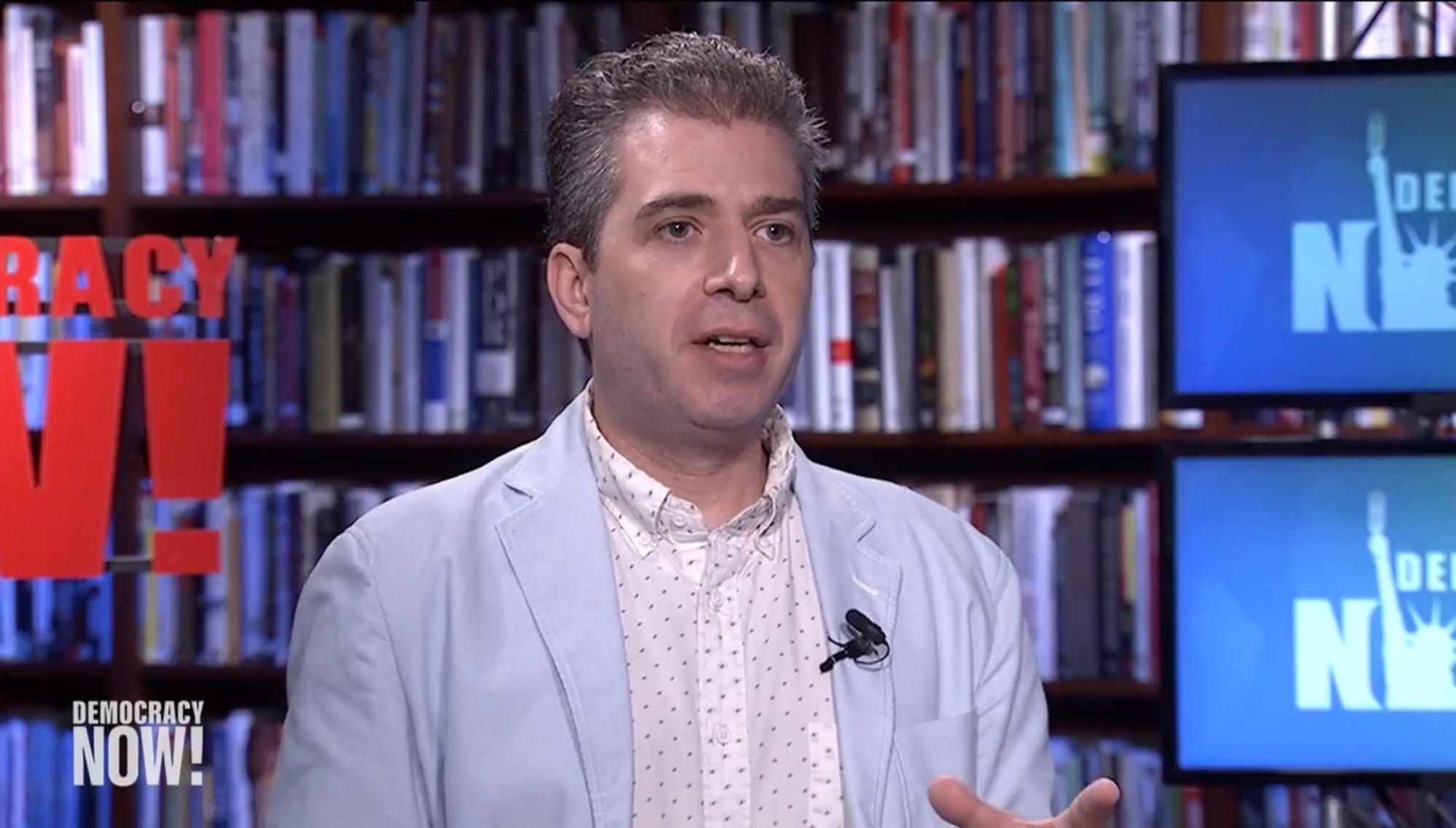
Or at least that's how I felt when I appeared on Democracy Now! Monday morning to talk with Amy Goodman and Behrooz Ghamari about the extraordinary document the United States and the Islamic Republic of Iran signed. I'm feeling better today.
As often happens, I got to the point I wanted to emphasize only by the end of our interview. I'm tempted to blame my cold, but, as mentioned, I often do this.
We shouldn’t think of this as the end of anything. We shouldn’t even necessarily think of it as the beginning of the end. What we have is an inauguration of a new period in U.S.-Iran and, indeed, global relations, because Iran, now that it knows that it can leverage the closure or the throttling of the Strait of Hormuz, will never give that up, now that they know that the Americans can’t transform that equation militarily. We should probably get used to a prolonged period of bombing, retrenchment, closure and so forth. And that’s probably going to look like the scope of the new reality going forward, whatever happens with these negotiations.
I'm grateful to Amy for having me on and for pairing me with Behrooz, from whom I so often learn.
When we spoke, the Treasury Department hadn't yet issued its sanctions waivers on the sale of Iranian oil. That happened a few hours later, and the waiver is here if you feel like reading it. Yes, the faction in American politics that successfully scandalized the 2015 Joint Comprehensive Plan of Action now accepts Iranian oil sales before a deal is even reached. If anyone doubts Trump's desperation to back away from the war of choice he began, look no further. And at the risk of belaboring the point, that faction also rejected the JCPOA for not securing Iranian regional surrender, i.e., inhibiting Iran's missile deterrent and its aid to proxy militias. The war that faction secured through rejectionism sure does provide for regional surrender this time—that of the Americans, who are on paper committing themselves to re-posturing itself in the Middle East, another point I discussed with Behrooz and Amy:
What that actually means in practice, we’ll have to await. Whether this is, you know, an insincere commitment [to military retrenchment], we’ll have to await. Or whether this is actually, you know, compelled, as is, on some level, quite likely, as it’s a material reality derivative of the fact that Iran basically destroyed a whole lot of these bases, have now made the U.S. military posture in Iran not the strength that the United States thought, not the anchor that the United States thought it had in the region, but fundamentally a point of weakness, something that the Iranians can leverage against the U.S., not vice versa. That’s a fundamental transformation.
Secretary of State Marco Rubio has been a conspicuous absence from the Iran negotiations, which makes sense given that he owes a tremendous amount of his foreign-policy profile to his early Senate rejection of the JCPOA. This week he's traveling to the United Arab Emirates, Kuwait and Bahrain, three major hosts of U.S. military and surveillance facilities, where he's likely to hear a great deal about how exposed all three are to Iranian missile and drone fire, as well as less-kinetic coercive power, undermining the central protective promise of hosting those American facilities.
Anyway, some other stuff worth reading while I get over this cold:
Gideon Rachman in the FT about traditional U.S. allies hedging against their economic entanglement with the United States, which (he might have added) used to be the selling point for allying with the United States.
The Washington Post goes REIGN OF TERROR.
Stephen Semler's deserved victory lap over correctly forecasting the cost of the Iran War at $70-80 billion. You'll recall that in late April, FOREVER WARS put the Pentagon's lowball estimates in historical context.
While I haven't finished reading this chilling piece, it's the type of nightmare Bruce sings about on Nebraska.
Daniel Larison on the Iran War ghoul Matthew Kroenig. These warmongers got their heart's desire and it was a debacle—the exact same way their prior fixation, the Iraq war, turned out. But there's a whole lot of money to be made not learning this lesson, so Kroenig and company won't learn it.
Speaking of, read Robert Malley and Stephen Wertheim, who argue that the ashes of the Iran War "may bequeath an accidental gift: a lasting aversion to military conflict with Iran and a chance to replace decades of failed policy with serious diplomacy." Among working people, sure. But among foreign policy elites? Is the incentive structure around them actually suited to produce that? Or to deter that? (To be clear, I sympathize with what Malley and Wertheim are driving at. They're on stronger ground when they talk about the material state of U.S. military power in the region and its implications for U.S. security clients.)
PUNK ISLAND 2026, the all-day, all-ages music festival on Randalls Island, will now feature 100% more me. I'll be playing drums with the Funkrust Brass Band, set time TBD. The show is from 11 a.m. to 8 p.m. on Saturday, June 27. Come say hi!
NEXT TUESDAY, June 30, at 7 p.m., I'll be at the Urbane Arts Club in Brooklyn to launch The Midnight Special, the new book by Colin Asher, one of my oldest and best friends, about incarceration through the lens of popular/roots music. It's an excellent book and I'm honored to be interviewing Colin—singer of the teenage punk band I drummed in—about it. You should join us.
Buy my friend Laura Hudson's comic book Exploit!
Buy my friend Colin Asher's book The Midnight Special! I recently finished reading this in galleys, and you're just not ready. No spoilers, but it ends with an incandescent chapter about Afeni and Tupac Shakur.
Connor Goldsmith, the telepath behind the Cerebro podcast (and one-half of The Kibitz), makes his comic debut with DID YOU HEAR ABOUT MIMI GREEN?, a fantastic thriller meditating on fame, social media and body horror! You have to read this!
WALLER VS. WILDSTORM, the superhero spy thriller I co-wrote with my friend Evan Narcisse and which the masterful Jesús Merino illustrated, is available for purchase in a hardcover edition! If you don't have single issues of WVW and you want a four-issue set signed by me, they're going fast at Bulletproof Comics! Bulletproof is also selling signed copies of my IRON MAN run with Julius Ohta, so if you want those, buy them from Flatbush's finest! IRON MAN VOL. 1: THE STARK-ROXXON WAR, the first five issues, is now collected in trade paperback! Signed copies of that are at Bulletproof, too! And IRON MAN VOL. 2: THE INSURGENT IRON MAN is available here!
No one is prouder of WVW than her older sibling, REIGN OF TERROR: HOW THE 9/11 ERA DESTABILIZED AMERICA AND PRODUCED TRUMP, which is available now in hardcover, softcover, audiobook and Kindle edition. And on the way is a new addition to the family: THE DISAPPEARED: A FATHER, A SON AND THE WAR ON TERROR.