
When Journalism Becomes Obsession
This is not a book review. This is the abyss of someone else's professional compulsion gazing back at my own

This is not a book review. This is the abyss of someone else's professional compulsion gazing back at my own
Edited by Sam Thielman
BEFORE WE GET to the main event of this edition: We've entered the sixth month of the Iran War, and so we've lived through a full quarter of revenue generation for the oil and defense giants. In the spirit of Monday's piece, Chevron reported a $9.6 billion jump to $12 billion in quarterly profits. Exxon more than doubled its own. RTX, the defense conglomerate formerly known as Raytheon, reported its quarterly net income as up 29 percent over this time last year. Trump blamed the oil companies for price gouging, although his lost war caused gas prices to skyrocket and gave the companies the opportunity to gouge. [Thanks to Saudi Arabia’s pipeline, the national oil company Saudi Aramco was up more than $10 billion: $32.69 billion this quarter, up from $22.67 billion for the same period in 2025.—Sam.]
Obviously we've covered the Lockheed-Northrop $50-plus billion upgrade to a Pentagon contract for producing missile interceptors—a contract that will take years to expand the interceptor fleet, but which sounds like President Trump misunderstood as a shorter-term fix for dwindling interceptor stocks. That prompted Trump, according to the Washington Post and NBC, to crash out on Defense Secretary Pete Hegseth, whom the Post claimed "blamed his deputy, Stephen Feinberg, for the shortages." (The administration denies both stories.) Meanwhile, Reuters reports that it's not just interceptor stocks: The Iran War has prompted the U.S. to expend most of its long-range precision missiles, which play a load-bearing role in the current American Way of War. Making up for the loss will require more piloted bombing runs over Iran, and there's already been one shootdown in the war already.
We're waiting for the outcome of Iran-Oman negotiations that will determine the parameters of Iranian control over the Strait of Hormuz. These are the negotiations that Trump claimed over the weekend was his reason for not re-escalating the war, yet their success will set U.S. interests further back than they were before he began it. With the U.S. embracing a process whose outcome will leave Iran with leverage and revenue unthinkable before the war, this is evolving into an admission of defeat, even though Trump won't make any such admission explicitly. I would expect the U.S. to spend years and quite a lot of effort trying to reverse this humiliation through expanding intervention in Omani statecraft.
On the domestic front, Edwin Lopez-Cornejo, a 41-year old man from El Salvador who lived in the U.S. for 20 years, became the 22nd person to die in ICE custody in 2026. It won't be long before we're debating whether to call its facilities death camps or whether deaths like Lopez-Cornejo's should just be considered deaths in the camps. Meanwhile, ICE spends a lot of energy attempting to intimidate people out of calling them mean names on Twitter. And while this piece from Politico is from May, I hadn't seen that an agency that calls itself merely enforcers of immigration laws passed by Congress has lost 90 percent of court cases challenging its detentions.
While the Fiscal 2027 National Defense Authorization Act hasn't passed yet—and with it the merger of key aspects of U.S. and Israeli defense industrial bases—at least one U.S. defense company, the obscure-to-me AI-and-drone firm Ondas, isn't waiting around. Its new chairman is David Barnea, who until June was the head of the Mossad. Congratulations to Ondas on hiring a war criminal!
FOREVER WARS friend Danny Bessner has a can't-miss essay on the influence of Boeing on Kurt Cobain and Nirvana. It's part of his new newsletter, tied to his new book Imperialist Realism, which I'm looking forward to reading. You can hear Danny talk about Imperialist Realism on, naturally, American Prestige, the podcast he co-hosts with our pal Derek Davison.
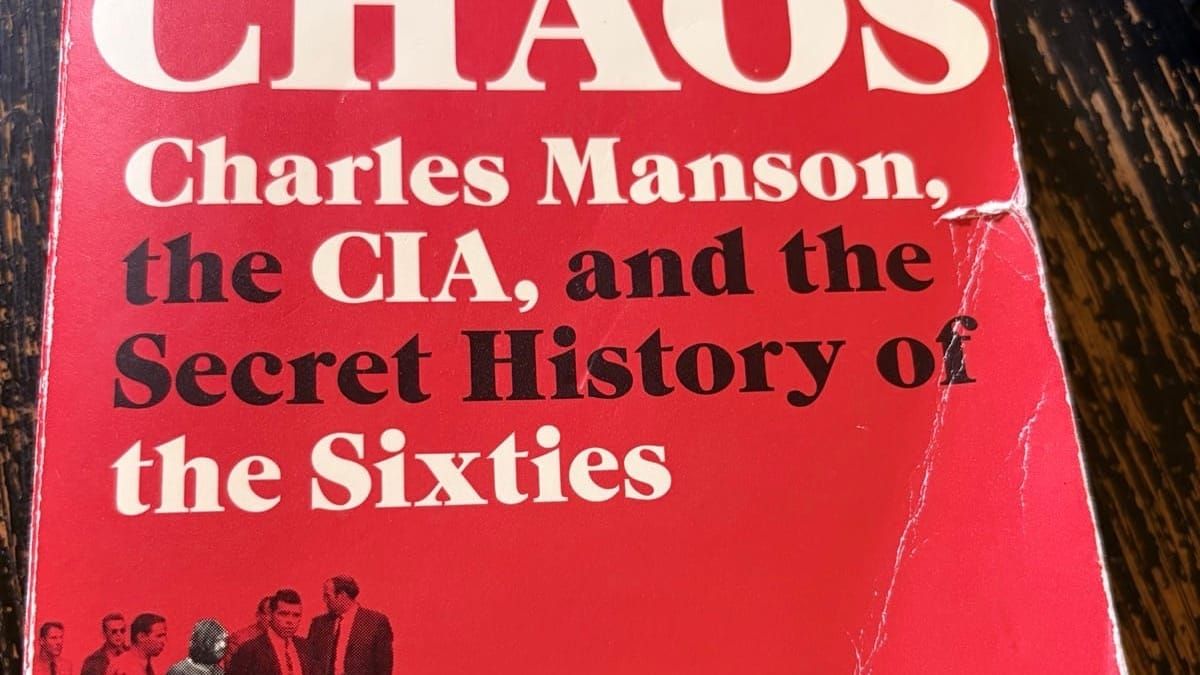
THANKS TO A used-bookseller whose taste I like, Vancouver's Brain Drain Books, I recently read a book I identified with far too strongly—a very disturbing outcome, since it's about the Charles Manson Family murders, and because it fails at its primary task.
I'm talking about Chaos: Charles Manson, The CIA, And The Secret History of The Sixties by Tom O'Neill (with Dan Piepenbring). On one level, it's a book about a sprawling, deeply strange and at times downright evil cast of characters. On another, it's a journalist's chronicle of the accumulated psychic damage that conducting the work of untangling one of the most famous crimes of the American Century does to him.
That's the part I identified with too strongly.
I want to be clear about something: O'Neill's book is not a failure. The discoveries he makes in Chaos are shocking. But seeing the way that it's not a failure requires focusing less on the Manson murders than a book with its title might suggest. The only way to make the book cohere—to make any of it make sense, narratively—is to do something I usually hate doing, which is to make the journalist the main character of the story. Chaos is about as real a picture of the indignities of investigative journalism as you'll read. It took me longer to read it than usual, because I frequently had to stop to stare out into the middle distance and contemplate my life. Here's why.