
France's Forever Suspects
When France’s cost-of-living protests turned violent, the far right blamed Arabs and Africans. But in Barbès, the heart of North African Paris, nothing was broken
Translated and edited by Joudy El-Asmar for Egab and edited for FOREVER WARS by Spencer Ackerman and Sam Thielman
SPENCER HERE. I've followed the American coverage of France's latest mass demonstrations without feeling like I understand the stakes. So we partnered with Egab—a media startup connecting 5,000+ journalists and experts across the Global South with international newsrooms and organizations that want original, on-the-ground reporting—to bring you Faten Mhadheb's reported dispatch from Paris that connects the police response to the legacy of France's version of the War on Terror. I learned a lot and I think you will as well.
PARIS — WHEN THOUSANDS OF French protestors marched through Barbès on Saturday, October 17, nothing was smashed.
Angry at Emmanuel Macron’s government, they filed down the main boulevard, past the snack counters and dress shops of Paris’s historical North African quarter, and moved on peacefully. "They bought from us, ate, and left," said Rabah, 47, who worked at a counter run by Algerians and asked to be identified only by his first name.
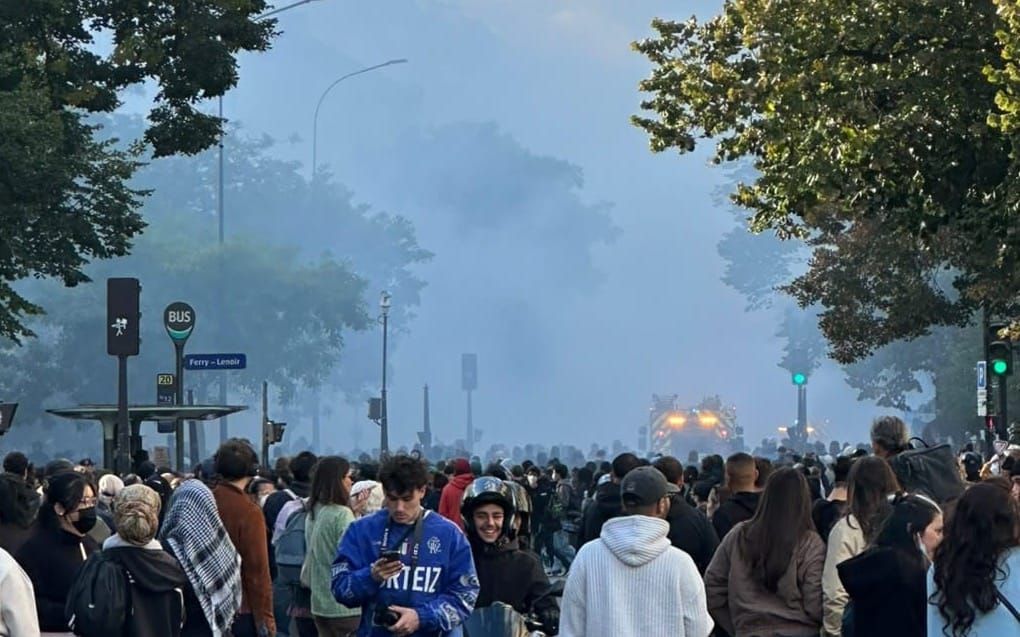
But a few kilometers south, near the Place de la République, the same demonstration ended in looting and fire. Police fired water cannons and tear gas to subdue the violence. That day, protestors had climbed the Marianne statue and hung a banner reading “1961, the police drown Algerians. 2026, the police maim high school students,” a reference to the massacre of Algerian demonstrators by Paris police. The banner invoked one of the darkest chapters in French history. On October 17, 1961, during Algeria’s war of independence, some 30,000 Algerians marched peacefully in Paris against a curfew imposed on Algerians alone. Police under Paris prefect Maurice Papon crushed the march, killing anywhere from about 30 to more than 200 protesters. Many of the victims were beaten and thrown into the Seine. Long denied by the French state, the massacre was called “inexcusable for the Republic” by President Emmanuel Macron in 2021, and in 2024 the National Assembly condemned the “bloody and murderous repression.”
Sixty-five years later, protesters again marched in the streets. About 550,000 people across France participated in the October 17 protests, according to the interior ministry. More than 1,800 people were arrested.
The violence shifted the debate from what the protestors wanted to where the rioters were from. Even though the demonstration had passed through Arab and immigrant neighborhoods in peace, prominent political figures blamed the violence on France’s immigrant communities.
"What we saw yesterday is the true face of the Great Replacement," said Éric Zemmour, leader of the far-right party Reconquête, echoing the ethno-nationalist theory that a European population is being replaced by non-European immigrants. "It has an appearance, a horde of North African and African barbarians who enter the cities."
U.S. President Donald Trump also waded in, blaming the unrest on "migrants, jihadists and communists who hate Christianity."
French President Emmanuel Macron pushed back, saying during his October 21 visit to Doha that the idea that France had been “invaded by hordes of migrants and Islamists” was “completely false.”
A week later, on October 24, another wave of protest convulsed France, bringing 410,000 out into the streets nationwide, with more than 100,000 of them in Paris alone. Most marches were peaceful, but clashes with police and some looting broke out at the end of the protests in Paris, Marseille and about a dozen other cities. Interior Minister Laurent Nuñez blamed the violence on groups of people “most of them dressed in black, activists of the radical far left, of the ultra-left.” Police made nearly 1,000 arrests.
Yet for all the scapegoating, back in the North African neighborhood of Barbès, a homeless man stopped outside a dress shop and offered a line that has become a running joke among the shopkeepers. “Did you see, madame? They didn’t break anything in Barbès.”
From the classroom to the street
The protest movement started in mid-September at the Saint-Exupéry high school in Créteil, a suburb southeast of Paris. Students blockaded their school to support teachers who were protesting staff shortages.
The shortages are a nationwide problem. According to one study, 9.8 percent of teaching hours in French public secondary schools went untaught in the 2024-2025 school year.
Rejection of the school shortages has since grown into a nationwide movement against the rising cost of living. It has been joined by unions, farmers, and the Gilets Jaunes (Yellow Vests), who came to prominence in 2018 for their demonstrations against rising energy and fuel costs.
“We need better resources so that young people are excited about their future and inspired by it, and want to get up in the morning and go to study in conditions that respect their dignity,” said Manal Benazzouz, a 21-year-old Sorbonne student. Benazzouz joined the protests, for the first time, on October 24 with a friend.
“We are the future of this country,” she said, and described “a great spirit of unity” during the demonstrations.
Ahead of the second nationwide day of protests on October 24, the French government called in soldiers from Operation Sentinelle to guard sensitive sites while police faced the crowds.
Sentinelle is an anti-terror mission launched after the January 2015 jihadist attacks on the satirical magazine Charlie Hebdo and a kosher supermarket in Paris. It has kept thousands of soldiers on French streets for over a decade, at times up to 10,000.
In March 2019, at the height of the Yellow Vest movement, its troops were redeployed to protect public buildings so police could focus on demonstrators, a move that sparked fierce political backlash.
Benazzouz, who is of Algerian and Moroccan origin, carried a sign honoring the events of October 17, 1961 “as a tribute to the martyrs of Algeria”—the same history invoked by the banner on the Marianne statue.
“Don’t go to Barbès”
Six days after the October 17 march, Barbès looked like any other Friday. Shops sold Tunisian pastries, traditional sandwiches and North African groceries, under names written only in Arabic or borrowed from back home: Bourek Annabi, O’Brick, Halal Food. In one restaurant, Tunisian, Algerian and Moroccan flags were hung side by side. Nothing showed that October 17 had happened.
“Tfadhli, okhti"—come in, sister—said Sonia, 47, as visitors stepped into the clothes shop where she works. An Algerian who asked to be identified only by her first name, Sonia moved from southern Algeria to France in December 2024 to join her two brothers and sister in search of “a better life.”
“When I arrived in Paris, the first thing everyone told me, especially since I have family here, was, don’t go to Barbès,” she said.
“I toured the neighborhood, and there was nothing exceptional for me,” Sonia said.
The warning sat oddly with Barbès’ history. Generations of North Africans have made Barbès their first address in France. After World War II, North African workers, most of them Algerian, settled in Barbès for its cheap lodgings. Over the decades, cafés, shops and family networks turned it into the place where newcomers found a room, a job and someone from home.
On October 17, Sonia and her neighbors closed early out of fear and watched from a little farther away.
“Strangely, compared to everywhere else in Paris, nothing happened here,” she said. “No tear gas, nothing. Just some barriers to redirect the protestors. The police were next to us, and nothing happened at all.”
Abdelkader Fattah, 41, a Tunisian who sells North African pastries, kept his shop open until 8 p.m. “The marchers passed by here,” he said. “Everything was within reason. They didn’t break anything.”
But the calm still cost them. The Barbès-Rochechouart metro station was closed from midday, cutting off the customers from the outer suburbs that shopkeepers rely on.
“When they close the metro here, our work drops,” Fattah said. Saturday is generally the busiest day for traders, but Sonia said she saw “almost no one.”
“We had only a few customers. We made tiny sales, like any weekday,” she said.
French authorities later imposed a curfew around République and Les Halles, areas of Paris that saw much of the violence. Barbès was not on the list.
"Arabs don’t have time for vandalism. Arabs work," Sonia said. "We need to work, especially new immigrants. You have to pay your rent, you have to earn your living."
"Protesting doesn’t mean breaking. What changes when you burn and break?" Fattah said. As for who did it, “French, Arabs, everyone took part.”
Barbès sits in the Goutte d’Or neighborhood. There, 38 percent of its 9,331 residents live below the poverty line. An estimated 18.8 percent of 16-to-25-year-olds are neither studying nor working, according to 2024 government figures.
Across the 18th district of Paris, which includes Goutte d’Or, the national statistics institute INSEE counted 44,335 immigrants, of whom 28.6 percent were born in Algeria, Morocco or Tunisia.
Watched, Not Protected
The police are a constant in Barbès. "You often see someone pressed against a wall being searched by the police. It’s common," Sonia said.
For Fattah, their presence weighs heavily on Fridays. “Police officers standing in front of the mosque, as if they’re telling you, ‘we are watching you,’” he said. “Why don’t the police stand in front of the synagogue or the church?”
That scene is the visible face of a counterterrorism system built over the past two decades. In response to the September 11, 2001 attacks in the United States, France raised national security alerts across the country. Within weeks, it expanded police powers and required telecom operators to keep users’ data. After the 2015 attacks in France, the government imposed a state of emergency for nearly two years. In 2017, a new counterterrorism law, known as SILT, moved some of those powers into ordinary law, including the closure of places of worship, and in 2021, the so-called separatism law gave the state new powers to monitor religious organizations, which the government said was meant to combat radicalization.
Fattah does not experience the police presence as protection. “Anything that happens in France, they link to Arabs and Muslims. Anything,” he said.
“Most of us are here to work, to change our lives,” Sonia added. “We are not here to create problems.”
The Accusation Arrives First
For Nesrine Ben Belgacem, a Tunisian demographer and sociologist, the stigma against migrants reaches France before the migrants do.
Most come from countries associated with poverty and unrest, and “arrive already loaded with this image,” she said. “Any event that happens is attached to them, because they are African or Arab and came from that environment.”
In her view, that means mainstream French culture portraying them as terrorists. "The irregular migrant is automatically assumed to be a terrorist or a criminal," she said. "When a terrorist attack happens, before anyone knows who did it, Arabs themselves are afraid that he is Muslim, afraid that he is Tunisian, Algerian or Moroccan."
After the January 2015 attack on Charlie Hebdo, a series of laws followed, including the 2021 “separatism” law, which Macron championed against what he called “Islamist separatism.” The law tightened state oversight of religious groups and associations, restricted homeschooling and limited foreign donations to places of worship. These measures have entrenched an idea that teaches society to fear anyone who looks, prays or dresses differently, Ben Belgacem said.
That means a migrant can easily be portrayed as "a terrorist and a criminal."
The aim, Ben Belgacem added, is to stop citizens from sympathizing with migrants. This has resulted in a divided society, with Arabs on one side, sub-Saharan Africans on another and the French on a third.
“Migration is a result of colonialism,” she said. Migrants go where they find family, social protection and a language they already speak. For Tunisians and Algerians, that is France—their former colonial overlord.
When something happens, she said, suspicion lands on neighborhoods like Barbès, and “not on an upscale neighborhood.”
“It was the French themselves who first took to the streets,” she said.
Amid the accusations, the demands for better schools and cheaper bread were forgotten.
“The talk was only about breaking and vandalism.”
SPENCER HERE. Don't miss this speech from Badr Albusaidi, the foreign minister of Oman. Speaking at Cambridge, Albusaidi calls for a Gulf security architecture without "external powers continu[ing] to define the terms of engagement," meaning the United States. Albusaidi explicitly seeks to include Iran inside a postwar regional architecture. Excluding Tehran has had "profoundly negative consequences, not just for Iran, but for the region as a whole." Iran's exclusion has been foundational to U.S. strategy in the Gulf since the 1979 establishment of the Islamic Republic, but especially since the U.S. occupation of Iraq failed to become the anchor in the region that Washington anticipated. Albusaidi called that strategy "an unstable regional system constructed on the entirely false perception that there is a fundamental regional antagonism between Iran and the Arab states of the Gulf." The Guardian's Patrick Wintour, who wrote a good piece about the Albusaidi speech, reported on Wednesday on a Gulf-wide initiative to end the Iran War and the Saudi-vs.-Ansar Allah conflict in Yemen. (Meanwhile, the Saudi defense minister went to Tehran this week to discuss Yemen, alongside security officials—not diplomats—from Pakistan and Turkey.) It's hard not to see the Albusaidi speech as linked.
SPEAKING OF REALIGNMENTS IN THE GULF, Drop Site ran a piece from longtime Yemen reporter Iona Craig yesterday that reports the United Arab Emirates is aiding Ansar Allah in repulsing the latest assault from the clients of Saudi Arabia. This is the definition of huge-if-true. The UAE, of course, was a full partner of the Saudis in invading Yemen after Ansar Allah seized power in 2014, and sponsored the dirty war of the Southern Transitional Council. Earlier this year, however, the rift between Emirati Crown Prince Mohammed bin Zayed and his former protege, Saudi Crown Prince Mohammed bin Salman became a rupture with regional implications. That said, MBZ supporting Ansar Allah during a shooting war that has put Riyadh in jeopardy is flagrant—after all, Ansar Allah is allied with Iran, which has explicitly threatened the UAE should the U.S. return to bombing it next week. There are coy denials within the piece from Ansar Allah and silence from the UAE's influential U.S. ambassador, so we'll see if this arrangement gets strengthened or weakened by follow-on reporting. But, again: huge if true.
A DISAPPOINTING PIECE FROM PROPUBLICA bends over backward to portray the occasional twinges of conscience from a Texas cop over collaborating with ICE as a moral reckoning. I encountered it repackaged in the Times, which frames the story in an egregious way—about the cop's "Misgivings"—but the original version is bad enough:
Still, [Officer Jaron Alexander] seemed to struggle with the contradictions of his role. He told us he sometimes shared his lunch with the people he detained and that he let them hold on to their phones to call loved ones from the rear seat of the Charger. He handcuffed them with their hands in the front rather than the back so they could use their hands.
When the reporters let Officer Alexander speak for himself, he doesn't seem like he's struggling with shit. "If you’re taking federal money to do a job, I think you should do the job," he told them. Throughout the piece, he keeps on collaborating with ICE through the 287(g) program that deputizes law enforcement as immigrant-hunters—and "gaining access to these unprecedented reimbursement opportunities," as ICE pitches it—even after the reporters over-emphasize his pangs of regret.
Meanwhile, the community fears Alexander in particular, discussing his black Charger on social media in terms reminiscent of the Angel of Death, as Alexander goes about his ICE-incentivized business of rounding up Latinos. He's able to say things like this: "I've deported like six of their family members, and they're still friendly to me. So I'm not the monster they make me out to be." I would instead suggest that the deference he needs to understand as friendliness is how terrified people act around someone with the power to continue destroying their lives.
It could have been a good piece had the reporters not made Alexander, instead of his targets, their central focus. Maybe read some Christopher Browning?
THE JUSTICE DEPARTMENT celebrated the Tuesday conviction of a Brooklyn woman, Halima Salman, over receiving "military-type training" from ISIS. Yet judging from Nina Pullano's write-up of the trial for Courthouse News, it seems like Salman was trafficked as a minor by her father to be an ISIS bride; spent years afterward in one of the giant U.S.-backed prison camps for both ISIS functionaries and refugees from ISIS; and the United States, which doesn't care about such distinctions, and prosecuted her anyway, on the basis of a single piece of evidence purporting to be from ISIS but lacking its official imprimatur.
I THINK OF ALL THE ASYLEES whom the U.S. routinely turns away to their fate when I see the Bolsonaro failson arrive in Florida so as not to face potential prosecution after losing to Lula in Brazil.
RFK JR.'S gutter racism is not more complicated than how it comes across on the surface. Yet to accuse Arabs of lacking a literary culture is self-parodic in its ignorance. Find me the booksellers in the United States who rival al-Mutannabi Street in Baghdad. Bring me RFK Jr.'s favorite authors—the people he or his staff pretends he's read—and show me what they've produced that outperforms Gate of The Sun. Present me with his allegedly favorite verses and put them beside Hagar Before The Occupation, Hagar After The Occupation. I doubt RFK Jr. has read more than ten books a year throughout his worthless, overprivileged life.
NO ONE ESCAPES THE DIALECTIC #1 drops on Wednesday, November 4! If you're in New York, come to Anyone Comics on Nostrand Avenue in Crown Heights from 7-9 p.m. I'll proudly be the latest participant in owner/operator Dimitrios' "At The Counter" series with comics creators. Get your comic book signed and talk about it with me!
FINALLY, earlier this month I was invited by al-Jazeera reporter and old buddy Josh Rushing to talk about the evolving military-industrial complex alongside retired Army Brig. Gen./Assistant Secretary of State Mark Kimmitt. This was a fun and substantive discussion, with both disagreements and points of accord between myself and General Kimmitt, with whom I split an Uber from the studio.
You'll also see me talk about the role of artificial intelligence here. I was in the process of writing a big piece for Zeteo about what we should do about AI. You'll see that piece as soon as tomorrow over there, and paid subscribers will get that piece… maybe Monday, since this is already our second piece of the week, and I care strongly enough about this piece that I want it to have a second bounce next week.
MATT BORS is back like he never left—with a new series of Toxic Avenger! This time, the goated political cartoonist turned comics writer pairs with the excellent artist Felipe Sobriero for Toxic Avenger vs. Noxious Offender, whose first issue drops October 7—but because of the dysfunctional way the comics market operates, you should right now let the friendly staff of your local comics shop know that you want it!
WALLER VS. WILDSTORM, the superhero spy thriller I co-wrote with my friend Evan Narcisse and which the masterful Jesús Merino illustrated, is available for purchase in a hardcover edition! If you don't have single issues of WVW and you want a four-issue set signed by me, they're going fast at Bulletproof Comics! Bulletproof is also selling signed copies of my IRON MAN run with Julius Ohta, so if you want those, buy them from Flatbush's finest! IRON MAN VOL. 1: THE STARK-ROXXON WAR, the first five issues, is now collected in trade paperback! Signed copies of that are at Bulletproof, too! And IRON MAN VOL. 2: THE INSURGENT IRON MAN is available here!
No one is prouder of WVW than her older sibling, REIGN OF TERROR: HOW THE 9/11 ERA DESTABILIZED AMERICA AND PRODUCED TRUMP, which is available now in hardcover, softcover, audiobook and Kindle edition. And on the way is a new addition to the family: THE DISAPPEARED: A FATHER, A SON AND THE WAR ON TERROR.