
The Israel Commissar Coming To The Pentagon
This year's defense bill seeks to merge the U.S. and Israeli defense technological enterprises. The implications are huge

Edited by Sam Thielman
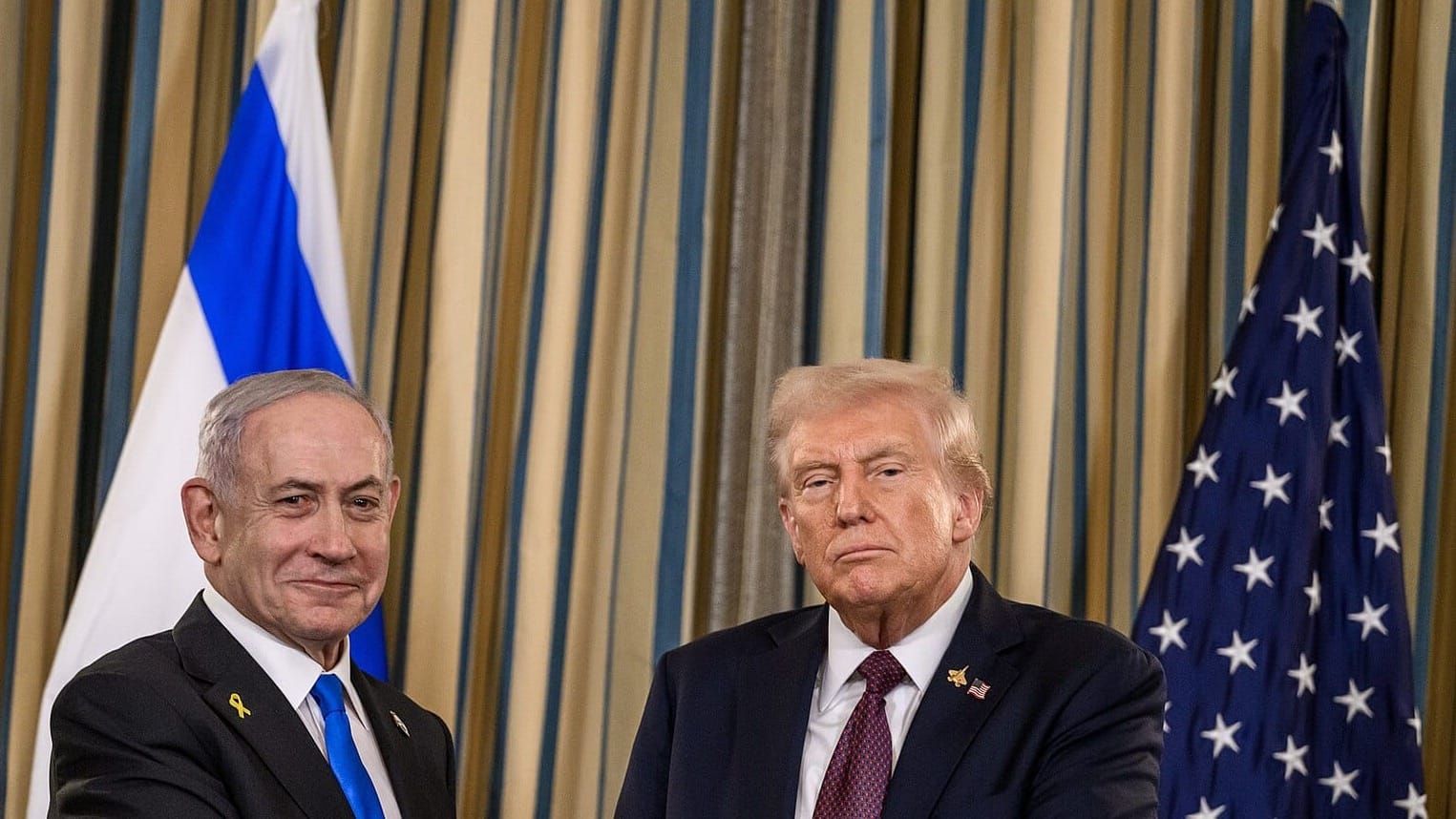
YESTERDAY THE SENATE couldn't reach a 60-vote threshold to advance the annual defense-policy bill, known as the National Defense Authorization Act (NDAA). (The actual funding for the military happens through a separate bill—yes, it's confusing.) That creates breathing space to reconsider—and, potentially, remove—a historic, tectonic shift authorized by the fiscal-2027 NDAA: the merger of the U.S. and Israeli defense-technology enterprises. Doing so will invest the U.S. military in the Israel Defense Forces, which are presently enacting a genocide and a territorial expansion into two of its neighbors, deeper than ever before.
Typically, here's where those who report on what's known as the United States–Israel Defense Technology Cooperation Initiative—Section 219 in the House version, Section 1217 in the Senate one—offer some caveats. The measure stops short of merging the entire U.S. and Israeli defense-industrial bases. But it makes substantial inroads in that direction, by integrating U.S. and Israeli research, development, data sharing and outright production of high-priority defense tech, such as missile defense, counter-drone capabilities, autonomous systems—uhhhhh—"artificial intelligence, directed energy, cyber defense, biotechnology, network integration, and data fusion." So, not, say, big-ticket items like, say, shipbuilding or airframe production—but lots of stuff that will be integrated into those big ticket items. The Navy has for decades wanted directed-energy weapons aboard ship, for instance. Network integration and data fusion impacts a tremendous number of weapons systems, at some point in their production cycles, that the military sets requirements for and then purchases.
The second caveat usually offered here is that the command structures of the U.S. military and the IDF will remain entirely separate. Correct. But that's going to mean less than meets the eye, since the upstream integration of defense research and production will have profound implications for the downstream operations of both militaries, however independent their command structures are.
While co-production agreements exist with other militaries—the Biden-era U.S.-U.K.-Australia pact known as AUKUS, for instance—and indeed already exists with Israel over missile defense systems like Iron Dome, the breadth and especially the structure of this proposed U.S.-Israel integration is, as far as I can tell, unique.
Both the Quincy Institute's Steven Simon and an unbylined analysis by A New Policy, the redoubt of former State Department political-military official Josh Paul, identify and itemize just how deep this integration goes. Israeli defense firms will be eligible for licensing agreements that grant them intellectual-property control over systems made by U.S. weapons manufactures that are their nominal competitors. Its envisioned collaborative-research initiatives and co-production arrangements place Israeli defense firms and universities directly into the supply chains of the U.S. military. A New Policy correctly observes that such a decision will "significantly enhanc[e] Israeli leverage" over U.S. defense decisionmaking. If you watched China blunt Donald Trump's trade war by limiting exports of metals and minerals that the U.S. military relies upon, you have a sense of how this leverage can operate.
But the truly unique transformation accomplished by the NDAA provision occurs through the creation of what it calls an Executive Agent for U.S.-Israel technological integration. Unlike with any other U.S. ally, there will be a new senior official within the Pentagon whose job it is to accelerate, deepen and, if history is any guide, expand collaboration between the two defense establishments. This Executive Agent will be able to overrule existing Pentagon officials and institutions with equity in the military's vast array of research, procurement and production programs.
For instance, a decade ago, the Snowden documents revealed that the NSA considered Israel a premiere counterintelligence threat. Were a research, acquisition or policy arm of the Pentagon to object to a data-sharing proposal/requirement with the Israelis over potential espionage exposure, the Executive Agent will, at a minimum, push back. And they'll be in a commanding position to do so. "They would have precedence authority over nearly the entire DoD bureaucracy on issues relating to US–Israel defense tech cooperation—including the DTSA [Defense Technology Security Administration] and program offices—specifically for the U.S.-Israel relationship," Simon writes.
Calling this position an Executive Agent is typical bureaucratese. The more accurate title is the Pentagon's Israel Commissar. Its entire job, Simon observes, is to "bias internal DoD processes toward U.S.-Israel integration." Again, no other country has any internal Pentagon advocate like this.
I said above that the command independence of the two nations is less than meets the eye. I'm not trying to be dramatic. What I mean is that placing Israel within the U.S. military supply chain accordingly creates an additional U.S. interest in protecting it. Iran has proven that it can strike militarily important targets within Israel. Should this provision pass, those relevant sites—labs, factories, universities—will now look to the U.S. military like areas it needs for its own sake to protect. Add to that the questionable viability of the network of U.S. military installations rimming the Persian Gulf, now that Iran has targeted the U.S.' regional defense footprint in a manner shocking to its hosts. Israel is offering itself as an enticing bivouac, one that Iran will have to expend greater resources, in the form of long-range ballistic missile production as well as the Shahed-136 drone, to attack.
Should the NDAA pass with Section 219/1217 intact, the aircraft-carrier theory of the U.S.-Israel relationship will become more like a supercarrier. And the point of all this is to reduce the exposure of Israel's American patronage to small-d democratic accountability, similar to how AIPAC floods congressional races with money to insulate its beneficiaries from the concerns of their constituents. Israeli Prime Minister Benjamin Netanyahu wants the new arrangement precisely because aid to Israel is increasingly a flashpoint issue in domestic U.S. politics. Embedding Israel within core aspects of the U.S. defense industrial base and Pentagon procurement apparatus will make it vastly more difficult to uproot than any vote to end U.S. materiel or financial assistance.
Even if the provision gets stripped out—outgoing Rep. Thomas Massie (R-Ky.) is vowing to try again—this is still an indefensible $1.5 trillion defense budget. It's a milestone on the road to a world where state functions are hollowed out to preserve the coercive aspects of government power while the citizenry suffers what it must. But with the provision, this year's NDAA represents a historical inflection point for the U.S. imperium, at least the part that it asserts over the Middle East.
ABOUT THAT BIVOUAC. As mentioned in Monday's edition, Iraqi Prime Minister Ali al-Zaidi came to Washington this week to consult with the Trump administration. al-Zaidi said on Tuesday that residual U.S. forces in Iraq will be "out" by September 30. But a Pentagon statement released after al-Zaidi met with Secretary of War Pete Hegseth makes me question that declaration. The relevant paragraphs:
Secretary Hegseth reaffirmed the United States’ intent to fully implement the September 2024 Joint Statement Announcing the Timeline for the End of the Military Mission of the Global Coalition to Defeat ISIS in Iraq, ending the Operation INHERENT RESOLVE mission operating from Iraq by September 30. The United States, Iraq, and Coalition partners have achieved tremendous success in defeating ISIS and now the Iraqi Security Forces, including the Peshmerga and other Iraqi Kurdistan Region security forces, will lead the fight against terrorists in Iraq.
Secretary Hegseth made clear that building a normal U.S.-Iraq bilateral defense relationship requires a secure environment free from terrorist coercion. Following more than 600 attacks on U.S. citizens and facilities in Iraq by Iran-aligned terrorist militias between February and April 2026, the Secretary welcomed the Iraq-led initiative to disarm these malign actors and to assert Iraq’s sovereignty and the supremacy of its democratic leadership over all armed actors.
I could be wrong, as I don't have reporting here to back this up, but that reads to me like Hegseth conditionalizing "a normal U.S.-Iraq bilateral defense relationship" on Iraqi degradation of Iranian-aligned militias over the next two and a half months. The end of Inherent Resolve can be sheep-dipped into a new command structure. If I'm wrong, expect a FOREVER WARS piece on October 1 saying so.
[WHILE WE’RE ON the subject of Hegseth, I just want to note two other stories breaking in the last two days: first, that Hegseth will be ending shaving waivers, an accommodation that affects black servicemembers almost exclusively, and second, that he plans—and I had to check into this twice to make sure it wasn’t a joke—to require testosterone checks and, if “necessary,” top-ups for servicemembers over 30. The vision of an all-white, all-male, high-T military operating in strategic lockstep with a genocidal ally is… an eccentric one.—Sam
Spencer here. To Sam's point I would add only that Hegseth continues blocking promotions for women and nonwhite officers. His latest interference crossed off five crossed off five such Navy admirals from getting their second star. Greg Jaffe at the New York Times reports that the five were among a 22-officer cohort whom the Navy promotions board listed "among the Navy’s highest performers over careers spanning more than 25 years." If military promotion is not available to all its members based on merit, we do not have a military that reflects the society it is tasked to protect and reflect.
Finally, testosterone shots are gender-affirming care.]
SINCE THIS EDITION is already defense-wonky, don't miss Stephen Semler's accounting of the Iran War—$103 billion in just four months, and counting—and his righteous critique of think tanks like the Center for Strategic and International Studies that lowball the costs.
Connor Goldsmith, the telepath behind the Cerebro podcast (and one-half of The Kibitz), makes his comic debut with DID YOU HEAR ABOUT MIMI GREEN?, a fantastic thriller meditating on fame, social media and body horror! You have to read this!
WALLER VS. WILDSTORM, the superhero spy thriller I co-wrote with my friend Evan Narcisse and which the masterful Jesús Merino illustrated, is available for purchase in a hardcover edition! If you don't have single issues of WVW and you want a four-issue set signed by me, they're going fast at Bulletproof Comics! Bulletproof is also selling signed copies of my IRON MAN run with Julius Ohta, so if you want those, buy them from Flatbush's finest! IRON MAN VOL. 1: THE STARK-ROXXON WAR, the first five issues, is now collected in trade paperback! Signed copies of that are at Bulletproof, too! And IRON MAN VOL. 2: THE INSURGENT IRON MAN is available here!
No one is prouder of WVW than her older sibling, REIGN OF TERROR: HOW THE 9/11 ERA DESTABILIZED AMERICA AND PRODUCED TRUMP, which is available now in hardcover, softcover, audiobook and Kindle edition. And on the way is a new addition to the family: THE DISAPPEARED: A FATHER, A SON AND THE WAR ON TERROR.