
Iranian Missile Accuracy's Crucial Chinese Component (Allegedly)
A Chinese alternative to GPS may be crucial to draining the U.S. interceptor magazine. PLUS: FOREVER WARS x The Intercept

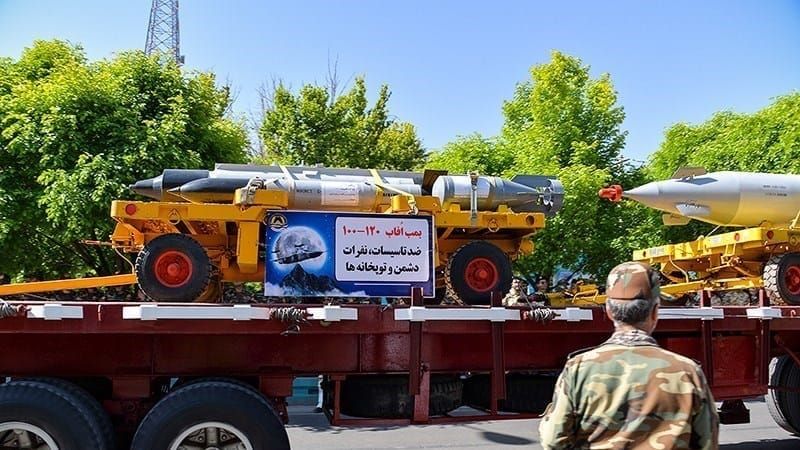
A Chinese alternative to GPS may be crucial to draining the U.S. interceptor magazine. PLUS: FOREVER WARS x The Intercept
Edited by Sam Thielman
THE PENTAGON has released the names of two of the three U.S. servicemembers killed as the result of Iranian drone and missile fire over the weekend at bases used in Iraq and Jordan:
1st Lt. Tyler James Feehan, 25, of Ewa Beach, Hawaii was killed in action on July 18, 2026, and Pvt. Isabella Gonzales, 19, of Carrollton, Texas, was killed in action on July 17, 2026, during an enemy attack on July 17, 2026, at Muwaffaq Salti Air Base, Jordan. The incident is under investigation.
Lt. Feehan and Pvt. Gonzales, along with the still-unidentified third soldier killed at Erbil International Airport on Saturday, bring the casualty total on the U.S. side up to 17. Additionally, U.S. Central Command (CENTCOM) discovered human remains near Muwaffaq Salti, which they're analyzing to see if they match a currently-missing servicemember.
Over the last several days, satellite imagery has appeared to show damage to a Patriot missile battery at Erbil, apparently from an Iranian drone. Similarly, Muwaffaq Salti is supposed to have air defenses—in contrast with the relatively spartan Tower 22 base in Jordan where Iran-aligned Iraqi militias killed three servicemembers in 2024. Back then, the lack of a missile battery at Tower 22 left the base reliant "on electronic warfare systems designed to disable [drones] or disrupt their path to a target," the Washington Post reported at the time.
That's going to be a problem for this renewed U.S./Israeli war on Iran.
Missile defense is hard under any circumstance. (The logic holds for defending against incoming drones as well, although there's a lot of variation in drone airframe and payload that makes these two threats different.) If I send a swarm of missiles at you, and you have a robust missile-defense system that defeats 90 percent of them—either by blowing up my missiles with your interceptors; or by spoofing or jamming their targeting signals to bring them off-target—then I feel good and you feel like you've won a Pyrrhic victory. Depending on how valuable the stuff I hit was or wasn't, I'll feel more or less good, but the successful ten percent of my barrage blew up stuff on your base that will cost you to fix or replace. And that's to set aside any human cost I inflicted. Pentagon planners will celebrate a 90 percent success rate that local commanders looking at smoking craters and dead bodies will not.
The damaged Patriot battery at Erbil represents a return to an Iranian counterforce tactic from the very start of the war. ("Counterforce" is when you target an enemy's weapons systems or hardware—it's a term often used in nuclear strategy to mean blowing up the other side's nuclear-armed missiles, bombers or submarines.) Back then, the Iranians used drones to blow up the radomes at U.S. military bases, the radar domes that guide missile-defense targeting, reducing the accuracy of expensive U.S. interceptors.
But there's a second way to perform missile defense that I mentioned above: spoofing or jamming the signals of the incoming missile and drone. If you're a commander at one of the bases that Iran sends Shahed-136s or Zolfaghar missiles at, you'd rather do it that way. Attacking or tricking the missile's guidance systems via electronic measures "typically costs a fraction of a hard kill"—an expensive interceptor blowing up a cheap missile or drone—"and, depending on the type of weapon heading your way, can often have a higher probability of kill (pKill)," wrote a former Royal Navy air/missile-defense officer, Tom Sharpe, in the Daily Telegraph last week.
Yet the success rates of Iranian missiles and drones, improved from 2025's Twelve Day War, indicates that they have countermeasures to U.S. spoofing and jamming. Longtime FOREVER WARS readers will remember from our March 12 edition that French intelligence indicated the Iranians are using an encrypted Chinese satellite-navigation alternative to U.S.-made GPS, known as BeiDou. Over the last four months, I haven't seen much in the way of hard confirmation of Iranian use of BeiDou, but analysts like Sharpe are taking it for granted. Sharpe explains:
Serious military forces can defeat sat-nav spoofing, however, because they typically have access not only to the standard navigation signals from their chosen satellites but also to encrypted signals broadcast alongside them. If an attacker has been supplied with the current encryption keys for a given sat-nav system, and the defender does not have those keys, the attacker cannot be fooled by spoofing and one of the defender’s best soft-kill methods has been rendered useless.
It appears that this is what has happened: China has given Iran access to encrypted Beidou signals, weakening the soft-kill defences of the US and its allies, reducing their probability of kill (pKill) and driving up the cost of expensive hard-kill interceptors.
You can bet that the NSA is working round the clock to obtain those BeiDou encryption keys. As Sharpe writes, without them, the U.S. is forced into the unforgiving math problem of firing off interceptors that cost a lot more than Shaheds or Zolfaghars to produce, and which in the short term must be pulled into the Middle East from other theaters (East Asia) where the U.S. seeks to deter missile strikes. Commanders do not get those interceptors back. CENTCOM, which has sustained historic damage to its arc of bases spanning the Persian Gulf, has to ration its defenses as it pursues daily attacks on Iranian civilian infrastructure. (The Iranians are doing the same thing, targeting a Kuwaiti desalination plant over the weekend; this war, fitted by both sides to represent a post-Rules Based International Order conflict, is pitiless.) "We do not have enough [base defenses] to safely sustain operations, and I don’t think the White House is aware of that,” a U.S. official told the Washington Post yesterday.
I hesitate to write about BeiDou because it's speculative. I've tried to caveat this piece accordingly. But should hard evidence emerge confirming the Iranian usage of the Chinese sat-nav system, it'll represent one of the most important military capabilities Iran has obtained for a conflict with the United States, one that helps them retain the upper hand in escalation dominance. (See the Friday's edition of Policy Tensor on that subject.) How will the U.S. respond?
LOOKING FOR A PODCAST? You can find me on Friday's episode of The Intercept Briefing, where reporter Jessica Washington kindly had me on to discuss the death of Lindsey Graham, the Iran War, the United States-Israel Defense Technology Cooperation Initiative and other stuff we've been covering recently at FOREVER WARS. Find it wherever you get your podcasts; the link above takes you to the transcript.
THE FBI SENDS ICE an unsurprising signal of total impunity. Much as with the 2002 Justice Department memos pre-immunizing CIA torturers, this represents a green light for this lawless agency to kill more people. We've seen this time and time again during the War on Terror and this is no time to sugarcoat it.
FIVE YEARS LATER. Finally, today this newsletter turns five years old. I can't thank you, our subscribers, enough. I've never held a job for longer than four years. Now Sam and I own something that we built together and that's lasted longer. Better yet, he tells me that our monthly revenue is up 15 percent over last year. This is the only time I've ever been happy over the steady expansion of the forever wars.
But we want to get even bigger. I have some ideas for how we can expand our value to you, although at least one of them involves raising money for a production-value-intensive thing that is still in the wild-ass-idea stage. So here's what I'd ask of you. If you think this newsletter helps you understand the denied world of "national security" better, and can afford a subscription, please buy one. If you can't, please tell a friend to subscribe for free. The more people who subscribe, the larger the pool of people who will eventually convert to a paying subscription.
And there will be more surprises coming that impact our growth—including something I've been working on for a year that I'm hoping to announce next week. For now: thank you for proving the viability of our kind of journalism. I don't take a moment of this for granted.
Connor Goldsmith, the telepath behind the Cerebro podcast (and one-half of The Kibitz), makes his comic debut with DID YOU HEAR ABOUT MIMI GREEN?, a fantastic thriller meditating on fame, social media and body horror! You have to read this!
WALLER VS. WILDSTORM, the superhero spy thriller I co-wrote with my friend Evan Narcisse and which the masterful Jesús Merino illustrated, is available for purchase in a hardcover edition! If you don't have single issues of WVW and you want a four-issue set signed by me, they're going fast at Bulletproof Comics! Bulletproof is also selling signed copies of my IRON MAN run with Julius Ohta, so if you want those, buy them from Flatbush's finest! IRON MAN VOL. 1: THE STARK-ROXXON WAR, the first five issues, is now collected in trade paperback! Signed copies of that are at Bulletproof, too! And IRON MAN VOL. 2: THE INSURGENT IRON MAN is available here!
No one is prouder of WVW than her older sibling, REIGN OF TERROR: HOW THE 9/11 ERA DESTABILIZED AMERICA AND PRODUCED TRUMP, which is available now in hardcover, softcover, audiobook and Kindle edition. And on the way is a new addition to the family: THE DISAPPEARED: A FATHER, A SON AND THE WAR ON TERROR.