
Lindsey Graham Is One Of The Reasons Guantanamo Is Open
The late South Carolina Republican, known for his warmongering, helped preserve an extrajudicial cage that is still swallowing people

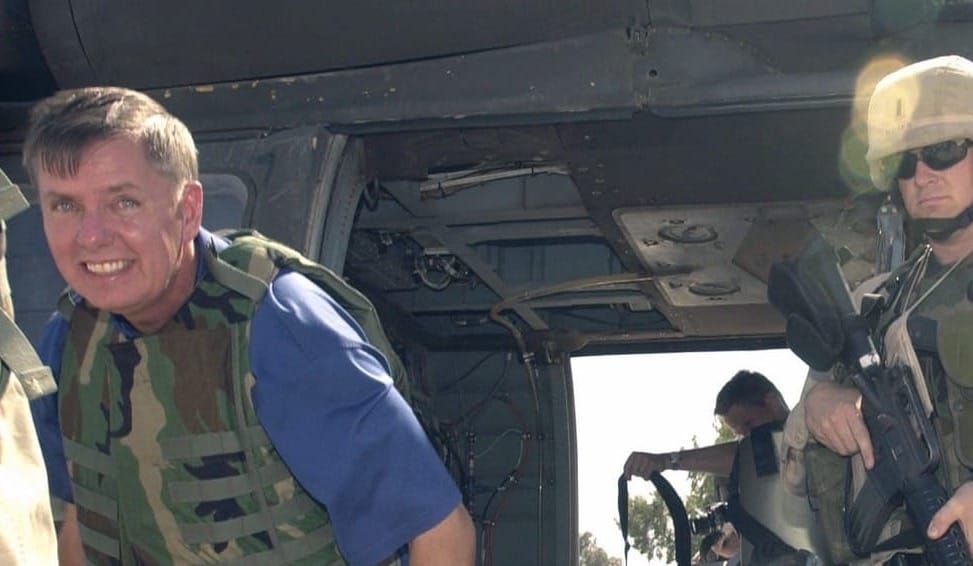
Edited by Sam Thielman
IT'S DARKLY POETIC that Sen. Lindsey Graham (R-SC) left this world the same weekend that the Iran ceasefire collapsed. Graham had wanted this war for a very long time. While it would be nice to think that its rapid emergence as a fiasco would have redounded to Graham's political detriment, absolutely nothing in his political biography as one of Capitol Hill's premiere warmongers suggests that would have happened.
Graham rode for the Iraq War easily as hard—not just the invasion, but the sustained occupation, the surge and against the withdrawal. While Iraq became a liability for some of its champions (John Kerry, Hillary Clinton's 2008 presidential campaign, Republicans trying to hold Congress until 2006), Graham was not among them. He moved oleaginously from advocating one disastrous exercise of military power to the next, an unsubtle, avaricious character out of an unwritten Graham Greene novel.
There's another episode, less familiar in the Lindsey Graham lore than his war advocacy, that sums him up for me. At a pivotal moment early in Barack Obama's presidency, there was a chance to close the detention center at Guantanamo Bay. Graham signed onto it—and went to work chiseling into the national-security bureaucracy everything objectionable about Guantanamo.
Before I go into this history, I want to be really clear that ultimately, blame for keeping Guantanamo open—certainly during the era we're talking about—lies with Obama. Obama was president and commander-in-chief. Graham was not. It so happens that in this episode, Obama comes out looking better than Graham, as low a bar to clear as that is. But anyway.
You can read more about this episode in REIGN OF TERROR, as well as a far superior version detailed in Power Wars by Charlie Savage, the reporter who broke this story. I would prefer to crib from Power Wars for this edition but unfortunately I have long since returned my copy to the library. (Borrow or buy it today. It's a very good and subtle book.)
Obama came into office in 2009 as the beneficiary of a landslide electoral victory that derived substantially from credibly harnessing antiwar anger, even as he caveated his campaign to make it clear there were limits to his critiques of the War on Terror. Included in the antiwar agenda at the time was the closure of Guantanamo Bay. It's easy to forget in retrospect, but at the time, closing Guantanamo was a consensus position. Obama's Republican opponent, John McCain, was for closing Guantanamo. So was George W. Bush, at least nominally, by the end of his presidency. But, as Bush's support for closing the detention center indicated, different people meant different things when using the words "close Guantanamo."
By the spring of 2009, Republican opposition to closing Guantanamo and Democratic timidity in the face of that opposition coalesced into an early wedge issue against Obama on Capitol Hill. Here was a way to portray the then-politically potent Obama as dangerously unconcerned with "national security" without affirmatively opposing the end of the politically toxic Iraq War. (Graham, consistent here at least, had no problem affirmatively opposing withdrawal from Iraq.) Graham didn't join in. Instead, Graham spent the better part of a year working on a plan with White House Chief of Staff Rahm Emanuel to deliver the closure of the detention facility at Guantanamo Bay—but that plan depended on jettisoning the vast majority of what had made Guantanamo objectionable and internationally infamous.
Throughout 2009 and into 2010, Emanuel and Graham worked on something that represented a grand bipartisan bargain on terrorism detentions. First Graham worked with Michigan Democrat Carl Levin to pass into law the Military Commissions Act of 2009, reviving a system for nonjudicial military tribunals that the Supreme Court had struck down in 2006. Obama signed it into law. While Graham and Levin worked on it, granting the accused more procedural rights than in the pre-2006 version, Obama laid the rhetorical groundwork for it in an important speech at the National Archives that May. In that speech, Obama not only defended the concept of military commissions, he embraced indefinite detention. He treated indefinite detention as the "toughest single issue" related to terrorism detentions, meaning it as a regrettable embrace of a wicked problem that he inherited from Bush. (And in the process, Obama soft-pedaled the reason for keeping some Guantanamo detainees as forever-prisoners: they had been tortured so severely as to compromise any hope of a credible trial, even in a military commission.)
What Obama described as an exception, Graham, with Emanuel, sought to make the new status quo. While no one should go easy on Obama for conceding the legitimacy of indefinite detention without trial in any case, he was talking about the disposition of existing cohorts of Guantanamo detainees who had experienced extensive torture. Graham, by contrast, was trying to build a system of indefinite military detention as a solution for future captives, including from the distant battlefields of Iraq and Afghanistan. In exchange, Graham promised to find the Republican votes in the Senate for closing Guantanamo. To Emanuel, it represented an early win for Obama on a campaign promise cherished in particular by the left.
Except now this effort didn't close Guantanamo. It moved Guantanamo. It would take precisely what everyone objected to about Guantanamo and move it onto American soil. Specifically, Illinois, where the Obama administration contemplated the purchase of a decommissioned state prison and its transformation into a wartime-detentions camp. Here would be a place that operated as an institutionalized exception to the U.S. justice system, with global jurisdiction, and applicable in practice only to Muslims. It would be a site not only for military tribunals, but for the forever-prisoners themselves. While Graham's alliance with John McCain extended to McCain's opposition to torture, the institutionalization of indefinite detention incentivizes torture. It would have funneled people into an unreviewable system in which they can be treated as their captors please.
(Graham's vote for McCain's important 2005 Detainee Treatment Act, a contemporaneous Washington Post account reminded me, linked "legislation written by Sen. Lindsey O. Graham (R-S.C.) [that] would deny detainees broad access to federal courts.")
Obama ultimately rejected Graham and Emanuel's grand bargain. Whatever his extensive compromises on Guantanamo, he couldn't countenance creating what amounted to a massive constitutional carveout in perpetuity. Graham, according to Savage, never got a straight rejection from the White House to the plan. It withered instead from inattention. The senator took it as a slight.
That was Lindsey Graham. Graham sought the unconscionable, exploited fear to promote it, and was a sufficiently savvy politician to portray it as a reasonable compromise—even as a way for liberals like Obama to get a win during the brief and forgotten period before it was politically safe to oppose Obama. Once the grand bargain vanished into the ether, so did any chance of the Republican cover that the cautious Obama believed he needed to close Guantanamo, meaningfully or otherwise.
And so Guantanamo remains open, increasingly as a site for ever more War-on-Terror-like detention of migrants. Perhaps the revitalized Migrant Operations Center at Guantanamo can be named after Lindsey Graham. He surely would have preferred a park or a traffic circle in Baghdad or Teheran to be named after him, but that won't ever happen. A cage is a more fitting monument.
ONE FUNNY LINDSEY GRAHAM story. I feel like I can't honestly publish this piece without it. Graham reached the Senate in 2002, the same year I made it to Washington DC. That fall, at an Interpol show at the 9:30 Club, I was talking with a Salon reporter who shall remain nameless about his time covering the 2000 presidential election. The guy told me that at one McCain campaign stop that Graham was at, he went up to then-Congressman Graham and asked him, "Is it true that you said George W. was so dumb he probably couldn't spell cat if you spotted him the C and the A?" Graham allegedly replied, "I didn't say probably." Graham was a terrible human being but such people can often be legitimately funny.
NOT EVEN A WEEK after ICE killed Lorenzo Salgado Araujo in Houston, Maine's attorney general said on Monday that it has slain again, this time a 26-year old man from Colombia, in a shooting in the town of Biddeford. As of this writing the man's name is not yet public. But he is believed to be the 11th such person killed by ICE—outside ICE's detention centers, that is—during the second Trump administration. That would make him the 63rd person killed by ICE either on the streets or inside ICE's cages since Trump's return to the White House.
WITH THE IRAN WAR now resumed—or at least with the diplomatic process thrown into uncertainty by continued attacks, and with Iran declaring the Strait of Hormuz closed—the new Iraqi prime minister, Ali al-Zaidi, arrived in Washington on Monday for consultations with the Trump administration. al-Jazeera reports that al-Zaidi, per his spokesman, seeks to move U.S.-Iraq relations "from a framework of crisis management to a strategic economic partnership." That likely means attempting an alternate overland route for Iraqi oil exports. And wouldn't you know it, just last week (the week of the NATO summit in Ankara) Turkey and Iraq agreed to re-up an agreement that keeps the Kirkuk-Ceyhan oil pipeline operational.
al-Zaidi will meet with Secretary of War Pete Hegseth at the Pentagon on Tuesday, where I'd expect the future of U.S. basing rights and the presence of Iranian militias in Zaidi's country to be up for discussion.
Connor Goldsmith, the telepath behind the Cerebro podcast (and one-half of The Kibitz), makes his comic debut with DID YOU HEAR ABOUT MIMI GREEN?, a fantastic thriller meditating on fame, social media and body horror! You have to read this!
WALLER VS. WILDSTORM, the superhero spy thriller I co-wrote with my friend Evan Narcisse and which the masterful Jesús Merino illustrated, is available for purchase in a hardcover edition! If you don't have single issues of WVW and you want a four-issue set signed by me, they're going fast at Bulletproof Comics! Bulletproof is also selling signed copies of my IRON MAN run with Julius Ohta, so if you want those, buy them from Flatbush's finest! IRON MAN VOL. 1: THE STARK-ROXXON WAR, the first five issues, is now collected in trade paperback! Signed copies of that are at Bulletproof, too! And IRON MAN VOL. 2: THE INSURGENT IRON MAN is available here!
No one is prouder of WVW than her older sibling, REIGN OF TERROR: HOW THE 9/11 ERA DESTABILIZED AMERICA AND PRODUCED TRUMP, which is available now in hardcover, softcover, audiobook and Kindle edition. And on the way is a new addition to the family: THE DISAPPEARED: A FATHER, A SON AND THE WAR ON TERROR.