Moazzam Begg Watches Gitmo Repeat Itself With ICE
His organization, CAGE, will release a report next week on the War on Terror's legacy for immigration suppression

His organization, CAGE, will release a report next week on the War on Terror's legacy for immigration suppression
Edited by Sam Thielman
IN DECEMBER, at the dawn of its assault on Minnesota, ICE detained an auto mechanic named Adam Abdullah. Abdullah was living in the United States legally. It didn't matter to ICE. After months of right-wing demonization of Somali migrants like him as a criminal class—which lay atop 25 years of the War on Terror's Islamophobia; which lay atop 400 years of American racism—the law was less important than making Minnesota white again.
ICE bounced Abdullah through the archipelago of its detention centers for the next nine months. Kentucky. Louisiana. Florida. Then, in August, his captors informed Abdullah that he would be deported to Somalia. But first, his flight would make a refueling stop.
Abdullah emerged into the baking heat of southeastern Cuba. His indefinite-but-allegedly-temporary new home was Camp Six at Guantanamo Bay. He remained there until his deportation last month.
Here there's a temptation to write something like Guantanamo was built for terrorists, and Abdullah had a couple unpaid parking tickets. But that would distort what Guantanamo really is. Guantanamo is not a place for dangerous men, though the handful that genuinely were dangerous—more on that in my book THE DISAPPEARED, coming in March 2027—won't ever be given a trial at this point. It's a place where the United States caged and abused people captured in Afghanistan after putting the word out that it would pay for captives, and then from elsewhere. In other words, Guantanamo was a site where the War on Terror incepted itself into reality, at the cost of the lives and freedom of men—and indeed boys—ground in the gears of its machinery.
And so it is those men who see the continuities between what ICE is now and what the War on Terror has been with greater clarity than the rest of us.
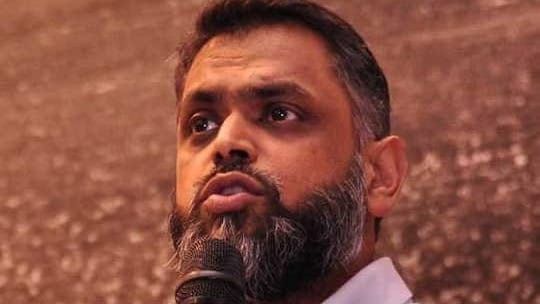
Abdullah's Guantanamo detention is "disappointing but not surprising," says Moazzam Begg. Begg, a British citizen, was kidnapped at gunpoint out of his Islamabad apartment at the dawn of the War on Terror and trafficked to Kandahar Air Field, Bagram Air Field and Guantanamo Bay. The U.S. caged him at Guantanamo until January 2005, when it released him without charge. Begg's memoir, Enemy Combatant, is a seminal text of the War on Terror.
"Before we were sent there as prisoners of the War on Terror and as enemy combatants, [Guantanamo Bay] was of course used for Haitian refugees. It was a place, by necessity, [that] was chosen because, ironically, the American government argued in our case that the rule of law doesn't apply," Begg tells FOREVER WARS. "We as individuals were not subject to laws, but if an iguana, say, is damaged, then a person might face a fine because of the Endangered Species Act." (That's true, by the way. I saw with my own eyes the signage on Guantanamo access roads warning personnel on base that they faced hefty penalties for running over one the base's many iguanas.)
Begg is now a senior director for CAGE, a civil-rights organization in the UK that confronts counterterrorism targeted at the Muslim community. CAGE gave FOREVER WARS an early look at its forthcoming report, "The Forever War on Terror." Scheduled for release next week—so look for it on CAGE's website—"The Forever War on Terror" traces the direct line between what the U.S. began doing to Muslims after 9/11 and what it does to a broader category of migrants—actual migrants and presumed migrants, which is to say nonwhite people—today.
The War on Terror has always operated within a nativist framework, however obscured by credulous depictions of it as a necessary, even valiant enterprise. The CAGE report tracks its development within that framework: "As well as a site of torture, Guantanamo was the site of ideological production, advancing an understanding of racialized peoples as threats who ought to be subject to law enforcement abuse and detention" is one of the report's many insights.
"If you're black, brown, Asian, African, then you're likely to get put in these kinds of places," Begg says. "So someone like Abdullah being sent from the United States by ICE to Guantanamo is precisely the thing that President Trump had said in his first [campaign for the presidency], that he was going to load Guantanamo up with [more] people. Now I think he's following up on his promise."
A version of that promise was the subtext of much of the War on Terror. The CAGE report traces that subtext skillfully. The ICE prisons, and the rendition flights that fly from them to prisons in partnered countries, are "one node in a carceral network that abuses Palestinian political prisoners in Israel, tortured Muslims in CIA black sites around the world, and continues to illegally hold men with no charges in Guantanamo, all based on the rhetoric of terrorism and national security."
Recognizing the continuity at work here "allows us to draw lessons that go beyond simple longing to return to a pristine liberal status quo," it continues. Such lessons involve questioning the logic of "national security" that prioritizes state interests at the direct expense of the people these states claim to protect. "The key lesson is not to reinforce the rhetoric and logic of national security, acting as if there is some true definition of 'Good Muslim' or the 'Good Immigrant' that we just need to reach to avoid the abuses of the security state," the report contends. "Rather, we must work with an understanding that the very foundation of these terms is racialized and politicized." (The language may change by publication.)
Begg, of course, experienced it with horrifying directness. He observes that Guantanamo's lawlessness never applied to any American—and, indeed, prompted several who served there to resign in disgust. (Not the current secretary of defense, though.) When the Iraq and Afghanistan wars ended, Begg expected that "surely [Guantanamo] would wind down." Instead, the opposite has happened. Since Trump's second term began, he has caged 850 migrants at Guantanamo. That is more than were ever held at the wartime prison that opened in 2002.
"It's a city. It's not a small little town, a small little naval base," Begg observes. I can confirm his observation; with the caveat that the same applies to many if not most U.S. military bases I've been on. "It's something to make money out of, and get money into. Millions if not billions have been spent already on this project."
One of the contributions of the report is its recognition that the surge in ICE kidnappings isn't only targeted at immigrants generically. It's particularly targeted at noncitizens who speak out for Palestine, like Leqaa Kordia, Salah Sarsour and Mahmoud Khalil. Begg notes that one of the remaining captives at Guantanamo, who has never and probably will never be charged with any offense, is the Palestinian known as Abu Zubaydah. (Much more on him, and the role Palestine played in his trajectory, will appear in THE DISAPPEARED as well.) "You can't overstate how Palestine has connected everything: all of the abuses, the torture, the murder," he says.
In Begg's United Kingdom, the crackdown on advocacy for Palestine after October 7 has been as draconian as the American version. Britons from all walks of life have been arrested on terrorism charges for simple advocacy of the banned group Palestine Action. (Including the frontman for Massive Attack, one of the greatest bands in UK history.) Begg points out that the absurdity of arresting people holding I Support Palestine Action placards as terrorists exposes the selective repression at the heart of the War on Terror.
"Because of the support for Palestine activism, thousands upon thousands of people have been arrested in this country. Pensioners. White people. Former advisers to the government. Former soldiers. Doctors. Medics. Priests. Priestesses. They've all been non-Muslims, and all been arrested for terrorism," Begg tells me. "The largest number of terrorism arrests in this country in its history haven't been for Irish republican terrorism or Islamic terrorism. They've been for Palestine activism, for people holding placards saying I Support Palestine Action, I Oppose Genocide…. The word 'terrorism' now means nothing. It never did—Nelson Mandela was the world's most celebrated man and was a convicted terrorist, and we now have convicted terrorists because they held up a placard saying they oppose genocide."
One of those arrested for holding a placard, last year, was Begg himself, outside Parliament. I said I imagined that the experience must have recalled for him his ordeal in the cages of the War on Terror. He swiftly corrected me.
"When I was arrested, detained, after a CIA agent stormed into my house and put a gun to my head, dragged me off to a secret location where I was interrogated by Pakistanis and the CIA, it was very, very different," Begg explains. "Literally I was arrested on the street alongside hundreds and hundreds of other people. The majority were not Muslims. The majority were ordinary English people, who had no connection to politicization. Most as I said were medics and students and pensioners. So I didn't feel that way, I just felt this was nonsensical, because I had eight police officers come, handcuff me, take me into a police vehicle, take me around the corner and put me in a line where there's hundreds of other people waiting to give their personal details and be given bail. One of the bail conditions was that you don't return to any Palestine Action demonstration.
"And I literally went back to the same place where I was and carried on," Begg concludes. "That's the thing that we've seen that hasn't happened before: a mass movement against anti-terror legislation in Britain, which didn't happen after the wars in Iraq and Afghanistan."
Don't let anyone convince you that the abolition of the War on Terror is unrealistic.
SPEAKING OF PALESTINE, Verso has just published the first ever English translation of Palestinian Resistance Literature Under Occupation, 1948-1968, a seminal work of literary and political criticism by the eminent writer, journalist and freedom fighter Ghassan Kanafani. Having read his classic Men In The Sun shortly after Israel began its genocide, I devoured this short but powerful volume over the weekend. (Israel assassinated Kanafani in 1972 with a car bomb that, as the Columbia University historian Rashid Khalidi notes in his introduction, also murdered Kanafani's 17-year old niece.) Kanafani exposed me to poets, writers and playwrights I had never heard of before, as well as a breathtaking Mahmoud Darwish poem, "Mawwal." He also introduced me to the state of Israel's deliberate, malign neglect of Palestinian education within its 1948-67 boundaries, complete with purged Palestinian teachers.
Such ordeals were central to the one-man, two-act play House of Madness by Tawfiq Fayyad, in which a character who had lost his job as a teacher addresses an audience that was assured to primarily contain Jewish settlers. I'll let you benefit from reading Kanafani's volume and Fayyad's libretto yourself, but here's just a bit of it, at a moment when the text instructs the actor to examine the audience:
(angrily) What! There is no law anymore in this world!? (astonished) Utter cheek! I cannot imagine! How can a person allow himself to enter some house other than his and without the owner's permission?! (angrily) Even the zoo… even cemeteries have certain visiting hours! Indeed, cemeteries have gates that enclose the dead!! I don't understand how you enter my house as if entering some bar… or public toilet!? (weakly) Do I owe you anything? (angrily) No… I will not allow you to sneak into my house, my private life! This is mine… mine alone… (furiously) Why are you looking at me in this way? You'll call me mad… Ha!! Isn't it my right to rebel for my freedom? But you'll claim that I'm violating your freedom! To hell with you and your freedom, a freedom you build on the ruins of the freedom of others… the ruins of my freedom… my ruins!!
Ellipses are in the original, as notes for the performance.
MATT BORS is back like he never left—with a new series of Toxic Avenger! This time, the goated political cartoonist turned comics writer pairs with the excellent artist Felipe Sobriero for Toxic Avenger vs. Noxious Offender, whose first issue drops October 7—but because of the dysfunctional way the comics market operates, you should right now let the friendly staff of your local comics shop know that you want it!
Connor Goldsmith, the telepath behind the Cerebro podcast (and one-half of The Kibitz), makes his comic debut with DID YOU HEAR ABOUT MIMI GREEN?, a fantastic thriller meditating on fame, social media and body horror! You have to read this!
WALLER VS. WILDSTORM, the superhero spy thriller I co-wrote with my friend Evan Narcisse and which the masterful Jesús Merino illustrated, is available for purchase in a hardcover edition! If you don't have single issues of WVW and you want a four-issue set signed by me, they're going fast at Bulletproof Comics! Bulletproof is also selling signed copies of my IRON MAN run with Julius Ohta, so if you want those, buy them from Flatbush's finest! IRON MAN VOL. 1: THE STARK-ROXXON WAR, the first five issues, is now collected in trade paperback! Signed copies of that are at Bulletproof, too! And IRON MAN VOL. 2: THE INSURGENT IRON MAN is available here!
No one is prouder of WVW than her older sibling, REIGN OF TERROR: HOW THE 9/11 ERA DESTABILIZED AMERICA AND PRODUCED TRUMP, which is available now in hardcover, softcover, audiobook and Kindle edition. And on the way is a new addition to the family: THE DISAPPEARED: A FATHER, A SON AND THE WAR ON TERROR.