Fanute The Houthi Coup
One decade. Three adversaries. Total domination. It's time to respect Ansar Allah

One decade. Three adversaries. Total domination. It's time to respect Ansar Allah
Edited by Sam Thielman
LAST YEAR, I wrote for Zeteo that the Houthis won their Biden-ordered confrontation with the U.S. Navy (sorry, a "multinational naval coalition") once the Trump administration reached for a deal. The Navy waged its most sustained naval campaign since World War II—that's according to then-Fifth Fleet commander Adm. Brad Cooper, whose defeat did not impede his ascension atop U.S. Central Command. Not even that could compel Ansar Allah (the organization shorthanded as "the Houthis") to cease their attacks on Red Sea shipping. Ansar Allah attacked Red Sea shipping to impose costs on Israel, and its foreign patrons, to compel it to end its genocide of the Palestinians in Gaza. Rather than do that, the U.S. bombed Ansar Allah. And lost.
I got pushback on that piece. There's always, in the United States, ways to explain why an adversary success/an American loss doesn't count. The end of the U.S. mission in the Red Sea came, generally speaking, without any acknowledgement that the Houthis notched a victory, as opposed to the Americans pulling up stakes. Yet the reality remains that the Houthis imposed their political will on Red Sea shipping, rather than the Americans imposing their will on the Houthis and returning Red Sea shipping lanes to the status quo ante from October 7, 2023. That is what it is to win wars, rather than simply to wage them. My hot take is that the part of American military culture that overstates tactical success and underrates strategic success, so persistent over so many decades and so many wars, originates with the former Confederacy's need to believe its own myth of martial valor. [There’s a lot of culpability to go around on that one but Hudson Strode’s perfidious biography of Jefferson Davis, which Shelby Foote loved, is probably guiltier than most.—Sam.]
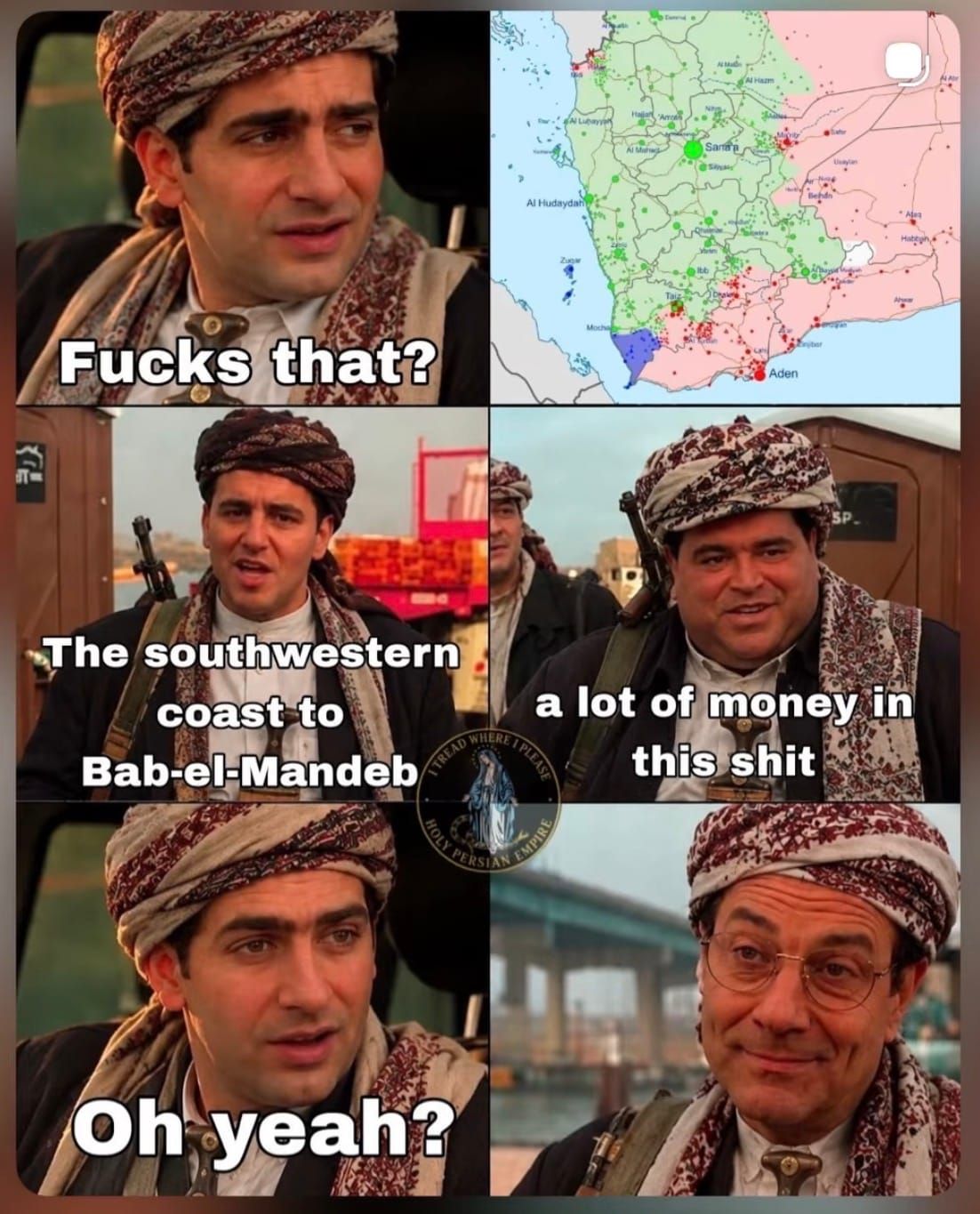
Last week Ansar Allah shocked the world. With their decade-long war against the Saudis back on, they intensified their Red Sea blockade on Saudi oil exports by barrelling down the western coast of Yemen, taking it all from Riyadh-backed forces theoretically belonging to the long-ousted pre-Houthi "government" of Yemen in exile. (That government, formally known as the Presidential Leadership Council, is so enfeebled that it constantly refers to itself as the Internationally Recognized Government, or IRG. Never a good sign!) First they seized the crucial port city of Mokha–yes, like the coffee—whose defenders fled. Adding to the embarrassment for the IRG, Mokha had been held by the nephew of U.S.-backed longtime strongman Ali Abdullah Saleh, whom the Arab Spring dispatched. Ansar Allah won a military victory with enormous symbolic power. Read Iona Craig's dispatch for Drop Site, as she knows Yemen extremely well. She called Ansar Allah's southwestern push "the most significant shift in territorial control in five years of the country’s long-running civil war."
Then, on Friday, in a stunning move, Ansar Allah conducted an amphibious assault and took an island in the mouth of the Bab el-Mandeb.
Amphibious assault—coming onto land from the sea as an invading force—is the most perilous maneuver in warfare. You're barrelling into the mouth of an entrenched defense that will surely hold the high ground and fire upon you as you seek to come ashore, while your ability to fend off an attack through air power or naval artillery as your forces hit the beach is minimal. Amphibious assault is an established core competency of the U.S. Marine Corps. For extremely understandable reasons, they desire to do it as little as humanly possible.
I have yet to see a proper account of how assault unfolded and what, if any, resistance Ansar Allah overcame. Even if the island were undefended, putting fighters on speedboats to take an island in the middle of a commercially pivotal waterway is audacious to the point of legend. Ansar Allah has drones, but no known aviation assets otherwise to defend their assault. There will be movies made about this some day. Just not in English.
Now Ansar Allah holds the Bab el-Mandeb for real. That puts the Iran coalition in control of two of the world's most important waterways.
In addition to losing export access through Bab el-Mandeb and the Strait of Hormuz, the Saudis had to shut down the east-west oil pipeline, owing to an attack said to originate from Iraq. That shutdown takes up to 7 million barrels per day of oil offline. Remember my piece looking at the geography of Mideast conflict to come, the one that envisions routing oil to the Eastern Mediterranean? Events are coalescing in its predictive direction.
And in another historic move, one that tears up the premise of the U.S.-Saudi alliance, Crown Prince Mohammed bin Salman asked Trump for assistance and Trump said no.
Now, the U.S. is already deeply complicit in the long Saudi war against the people of Yemen. I would never argue that the U.S. ought to return to it because MBS needs to be saved from the consequences of his own actions. Instead I mean to observe that the deal between Riyadh and Washington since 1945 has been that the U.S. military safeguards the Saudi state in exchange for cheap and abundant oil priced in dollars. Already the Iranian counterstrategy in this war has been to expose the hollowness of the U.S. security umbrella over the Middle East. Trump has demonstrated American unreliability under fire far more vividly than any military withdrawal from Iraq or Afghanistan. (Then Pakistan and Turkey refused to let the Mecca Pact bail MBS out! Ansar Allah is pulling card after card!)
Remember how the Axis of Resistance was supposed to have been weak? Barely two years after the Israeli sabotage of the Hezbollah pagers, the Iranian coalition has in its hands a substantial amount of global energy exports. And a whole lot of the credit needs to go to the very poorly understood commanders of Ansar Allah.
I AM NOT saying that as a man who smugly thinks he understands them. I'm saying that as someone who wants to understand Ansar Allah and finds English-language insight wanting. Too often "the Houthis" appear in U.S. media as angry, gun-waving fanatics, usually just before journalists identify them as being under the Iranian sway. But every halfway-informed portrayal of Ansar Allah instead situates them as substantially independent of Tehran. As I briefly wrote in my Zeteo piece, there is a longstanding debate within U.S. defense circles about how much of the Ansar Allah missile arsenal is domestically produced and how much is Iranian-supplied. Usually that debate is held in the context of presenting Iran as a regional threat. But it has the effect of suggesting Ansar Allah is fundamentally weak, in need of sponsorship and, in the final analysis, an afterthought to the greater issue of Iran.
That just cannot be true. Since the late-2014 Ansar Allah coup that ousted the U.S. and Saudi-backed government, Ansar Allah has held Sana'a, the port of Hodeidah and much of Yemen's northwestern territory, mostly under conditions of a pitiless siege. For practically every day of its hold on power it has fought more powerful and technologically advanced adversaries, and won. Ansar Allah has defeated forces backed by the Emiratis known as the Southern Transitional Council, as well as the Saudi-backed fighters; endured airstrikes by the Saudis; and absorbed naval artillery and airstrikes from the United States. It has done so while scaling up its military capabilities. And it picks its engagements impressively, with a fingertip-feel for moving its opponents into no-win situations. Trump, for instance, reached a ceasefire with the Houthis after their resilience following his escalation left him with the unpalatable option of sending forces ashore into Yemen.
These guys, in other words, show every sign of having farsighted generals. People worth studying. (People worth, at a minimum, knowing by name!)
But that's not how the U.S. military rolls when it comes to its adversaries, despite priding itself on being a learning organization. If you read this 2013 WIRED piece of mine, you'll see that the Army never bothered to study what the Iraq War looked like from the perspective of the insurgency, even though there were lots of opportunities to see the war through Iraqi eyes. I remember once talking to a since-passed friend about his experiences fighting the Taliban on multiple tours in Afghanistan's east. His assessment: mediocre riflemen, expert mortarmen. He was an enlisted man, and as is often the case, his focus was correct while the Army's was blinkered. It didn't understand the Afghanistan war that its enemies waged. It barely understood the war it waged, and that's being generous.
Now I know what some will say. We didn't REALLY fight Ansar Allah in 2024-5. They never went up against the Army or the Marines. OK, and? That just meant Ansar Allah successfully leveraged Washington's unwillingness to deploy ground forces when it encountered the U.S. in the Red Sea. I call that good generalship. War isn't a matter of reading off capabilities from a fucking Magic The Gathering card to decide the outcome of a battle. Ansar Allah has now triumphed over three different adversaries, adversaries who cumulatively devastated Yemen, and it is in a stronger position than ever. You can coulda-woulda-shoulda this all you want and it won't change that.
Somewhere in a leadership position in Ansar Allah is the Yemeni equivalent of Võ Nguyên Giáp, the master strategist who commanded the North Vietnamese forces. (And whom the U.S. didn't respect until long after withdrawing from Vietnam.) I would like to know what this Yemeni general's name is. If he's really more like multiple people in a military council, I'd like to learn all their names and what their deals are. He has/they have a lot of insight into how war is fought in the Middle East against impossibly technologically superior forces. And I think we can see more clearly than ever what ignoring that insight has yielded.
I AM NOT the one to adjudicate whether last week's vocalized fears of uncontrollable AI are yet another grift from an endeavor captained by the least trustworthy people on earth or speak instead to a rational wariness over irresponsible engineering. (I will defer to Lina Khan on what regulators can do in response right this very moment, not that they will.) But when Trump rejects a development pause on the grounds of primacy—that is, to prevent a Chinese AI advantage—you can see clearly the wages of putting this technology in the service of Great Power Competition. The Manhattan Project metaphor, so necessary for inflating the AI bubble, so necessary in particular for subsidizing it and perhaps tomorrow bailing out its companies, is now at odds with the industry that promoted it. There is no excuse, having lived through the original Cold War, for not seeing how that would develop. Presenting AI as the fulcrum between sustaining American primacy or ceding primacy to China—already a misunderstanding of Chinese grand strategy, but put that aside—will always incentivize development over every other concern. That is how you get buffoons like Ted Cruz saying insane things like he'd prefer the AI that kills him to be American rather than Chinese. He could end up getting his way!
I HAVE DONE an insane number of 9/11-related interviews, podcasts and public speaking over the past week-plus. (And the 9/11 anniversary season, for me, isn't even finished.) The next edition of this newsletter is going to be a roundup of them, since I made a number of points that ended up not quite getting fleshed out in last week's marathon editions. Since I've got a deadline for another outlet approaching and we're in the thick of High Holidays, that's all I'm going to have time to produce for FOREVER WARS this week.
But before we leave, I need to remind everyone: pre-order NO ONE ESCAPES THE DIALECTIC, and do so this week, because Final Order Cutoff—the last date by which you are guaranteed to get the book when it releases to your local comic shop in November—is Monday, September 21! I need this book to be a hit! I promise you you're going to like it – it's got political violence, internecine conflict within the security agencies and a surprising amount of basketball sicko shit. Find your local comic shop today and tell them you want NO ONE ESCAPES THE DIALECTIC! I'm doing more and more interviews about the comic, too, so I'll keep promoting them here.
MATT BORS is back like he never left—with a new series of Toxic Avenger! This time, the goated political cartoonist turned comics writer pairs with the excellent artist Felipe Sobriero for Toxic Avenger vs. Noxious Offender, whose first issue drops October 7—but because of the dysfunctional way the comics market operates, you should right now let the friendly staff of your local comics shop know that you want it!
Connor Goldsmith, the telepath behind the Cerebro podcast (and one-half of The Kibitz), makes his comic debut with DID YOU HEAR ABOUT MIMI GREEN?, a fantastic thriller meditating on fame, social media and body horror! You have to read this!
WALLER VS. WILDSTORM, the superhero spy thriller I co-wrote with my friend Evan Narcisse and which the masterful Jesús Merino illustrated, is available for purchase in a hardcover edition! If you don't have single issues of WVW and you want a four-issue set signed by me, they're going fast at Bulletproof Comics! Bulletproof is also selling signed copies of my IRON MAN run with Julius Ohta, so if you want those, buy them from Flatbush's finest! IRON MAN VOL. 1: THE STARK-ROXXON WAR, the first five issues, is now collected in trade paperback! Signed copies of that are at Bulletproof, too! And IRON MAN VOL. 2: THE INSURGENT IRON MAN is available here!
No one is prouder of WVW than her older sibling, REIGN OF TERROR: HOW THE 9/11 ERA DESTABILIZED AMERICA AND PRODUCED TRUMP, which is available now in hardcover, softcover, audiobook and Kindle edition. And on the way is a new addition to the family: THE DISAPPEARED: A FATHER, A SON AND THE WAR ON TERROR.