
Big STELLAR WIND Energy
With the mass-surveillance authorities of Section 702 on the verge of expiration, the chairman of the Senate intelligence committee has some suggestions for post-expiration continuity

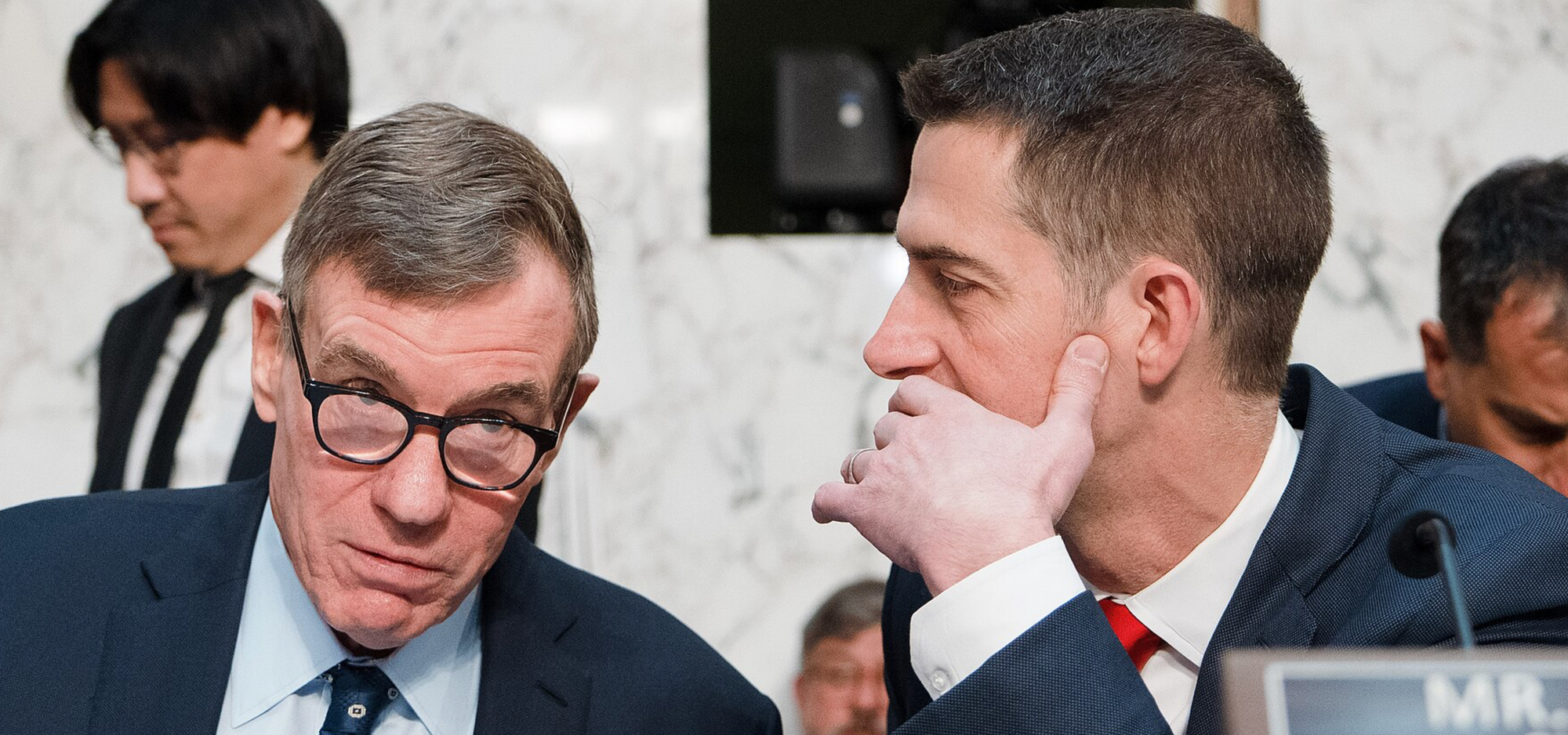
With the mass-surveillance authorities of Section 702 on the verge of expiration, the chairman of the Senate intelligence committee has some suggestions for post-expiration continuity
Edited by Sam Thielman
IT MIGHT actually happen. It might actually happen at midnight tonight.
Of course I mean the expiration of the Foreign Intelligence Surveillance Act (FISA)'s infamous Section 702, the seminal post-9/11 bulk-surveillance authority permitting the NSA to collect data from Americans' international communications, which the FBI and other agencies can then warrantlessly search. Unless a legislative deus ex machina happens before the end of the day, it's gone. I've been waiting for this for a very long time. How long? I met my wife while reporting on the congressional machinations of the interim bill that set the stage for Section 702. That was in 2007.
Anyway, there may yet be a legislative deus ex machina. Security-State-aligned Democrats—Connecticut's Jim Himes on the House intelligence committee, Virginia's Mark Warner on the Senate intelligence committee—wouldn't vote to re-authorize Section 702 until President Trump pulled his nomination of an unqualified crony experienced in political retribution, Bill Pulte, to replace Tulsi Gabbard as director of national intelligence. On Thursday afternoon, Trump caved and nominated Jay Clayton, the U.S. attorney for the Southern District of New York.
There seems not to be time to save the reauthorization of 702. The House recessed after narrowly rejecting a measure to extend the surveillance authority, 198-218, and won't be back until June 23. That should make it a wrap—although given the way 702 works, surveillance approved by a joint attorney general-director of national intelligence certification will continue until the certification's expiration in March 2027.
If I'm writing overly cautiously, it's because I've seen predictions of killing 702 come up empty in the past. All I'm saying is that post-Pulte, there will be more Democratic votes for saving 702 than there were yesterday.
But an unresolved question is whether the Security State and its allies would actually accept the loss of what the intelligence agencies consistently describe as one of their most important authorities. Last week, the chairman of the Senate intelligence committee, Sen. Tom Cotton (R-Ark.), provided the latest reason to suggest they won't. And if they don’t, so much for the ability of what passes in this country for the democratic process to contain the prerogatives of the Security State.
ON JUNE 5, a week before expiration, Cotton and Sen. Chuck Grassley (R-Iowa), the chairman of the judiciary committee, wrote to Secretary of State Marco Rubio (Cotton's predecessor as intel committee chair) to warn of "a potential significant gap in foreign-intelligence collection." Cotton and Grassley urged Rubio to convene a meeting of senior officials to prepare contingencies. They suggested that the administration "determine alternative lawful and constitutional intelligence-collection methods by which the United States could continue collecting intelligence on these individuals, and… if necessary, draft a new Executive Order to remedy the gap left by the lapse of FISA Title VII [i.e., Sec. 702] in a lawful and constitutional manner."
Jake Laperruque of the Center on Democracy and Technology thinks that trying to reconstitute the lapsed Section 702 powers through an executive order will fail. The service providers whose compliance with (secret) surveillance-court orders yields the surveillance harvest of Section 702 won't comply with an executive order, Laperruque recently contended:
Coercing providers to assist with warrantless surveillance through executive order would be unconstitutional — a clear violation of separation of powers and overreach into a sphere Congress has established limits for — especially if such an effort were made after Congress rejected legislation requiring such assistance. The notion that such compelled production could be forced via an executive order was decisively rejected in the early years of the war on terror (including by legal authorities within the executive branch itself), and that conclusion has remained the clear legal consensus ever since.
However. My eye twitches when I read Cotton and Grassley urging the administration to "determine alternative lawful and constitutional intelligence-collection methods" to continue 702 surveillance. That sounds a lot like shoehorning 702 surveillance into some existing surveillance law and having the lawyers produce some retcon about how that was what Congress always intended. And that could succeed—because it happened 22 years ago.
In 2004, there was an internal Bush administration showdown over the continuation of a secret, never-congressionally-authorized constellation of bulk surveillance activities begun a month after 9/11 by Lt. Gen. Michael Hayden, director of the National Security Agency. The activities were known by the codename STELLAR WIND. This is a well-known story, but if you want a recap, this 2021 report Laperruque wrote has you covered.
To forestall a cascade of public resignations over the top-secret STELLAR WIND program, the administration agreed to stop some of it—or so it appeared. As I was able to report in 2013 thanks to Edward Snowden's surveillance disclosures, the Justice Department and NSA "immediately began efforts to recreate this authority," according to an NSA history contained in the Snowden trove. The bulk international internet metadata collection continued two months later under an order from the chief judge of the secret Foreign Intelligence Surveillance Court (FISC), which, according to the NSA history, "essentially gave NSA the same authority to collect bulk internet metadata that it had." A few years later, following unauthorized public disclosure of aspects of STELLAR WIND, that order was codified by Congress into Section 702.
Another part of STELLAR WIND, one that collected domestic phone-call data in bulk, got folded into the PATRIOT Act, under PATRIOT's controversial and since-expired Section 215. As egregious as Section 215 was, no one who voted for it in 2001 voted to authorize the warrantless NSA acquisition of a massive number of Americans' phone records. When we at The Guardian revealed what was really going on with the PATRIOT Act—something Sen. Ron Wyden (D-Ore.), a longtime intelligence committee member, was only able to warn about obliquely, since the program was classified—it became the only part of STELLAR WIND that Congress, in 2015, affirmatively voted to kill. But immediately, that prompted fears, as I reported at the time, that the NSA, FBI and Justice Department would once again creatively lawyer away Congress' clear no until it sounded more like yes. Sure enough, that surveillance activity only ended after the regime Congress created for it post-2015 led to massive over-collection.
Cotton and Grassley's letter is a blueprint for the NSA, the FBI and the CIA (which, along with the bureau, warrantlessly searches through the 702 databases) to repeat this undemocratic, freedom-killing history. When they sign off by telling Rubio that "our two committees remain ready to assist you and your staff with these actions," it suggests that they have legislative vehicles or language in mind to launder 702 surveillance. Remember that the Trump administration has over these past two years declared more and more domestic dissent—particularly for Palestine, against ICE and against capitalism—to be terrorism. "A hunt for foreign connections to domestic left wing groups will unlock a whole lot of surveillance authorities, especially Section 702 of the Foreign Intelligence Surveillance Act, and they don't have to be plausible connections," this newsletter noted last month.
I want to say one final thing. The intelligence agencies break surveillance law constantly.
They have a consistent, 18-year track record of violating Section 702, so consistent that "violating" is the wrong, and we ought not to consider over-collection under 702 not an abuse but rather the authorization working as intended. Judges on the FISC just as consistently complain that the NSA misleads them about how the 702 surveillance actually works, since all the agency needs to provide judges is a technical description of how the collection operations fit within the porous guidelines of the authorization. (Their complaints, however, are hollow, since these judges rarely if ever withhold their orders.) We only know about these judicial objections long after the fact, since the FISC is a secret court, whose opinions emerge late, if at all. Remember that Wyden in the spring warned that there's a still-secret FISC opinion detailing "serious violations of Americans’ constitutional rights and how the Trump administration has used Section 702." He's also revealed that there's another secret internal re-interpretation of Section 702, one that lawyers away the meager limitations set by the statute into something Congress did not vote for. Apparently even the permissive language of Section 702 is too restrictive.
And ever since 2024, under rules set under not Trump but President Biden, the intelligence agencies have been permitted to purchase highly revealing digital data on Americans from data brokers, something with (at the least) the potential to once again evade FISA's requirement that it be the "exclusive means" to conduct foreign-directed surveillance on U.S. persons or within the United States. The guidelines set under former Director of National Intelligence Avril Haines call such end-runs "flexibility to experiment." They're "experimenting" with your freedom from government intrusion into your behavior, your associations, and your speech. In March, FBI Director Kash Patel explicitly told Congress that the bureau purchases location data on Americans that would otherwise require a judicial warrant to obtain.
All this has been so obscured and so normalized as to no longer register as what it is: institutional lawlessness from U.S. intelligence, not only tolerated but encouraged by members of Congress. Ever since Congress in 2008 retroactively blessed STELLAR WIND by creating Section 702, we have been told by advocates of bulk surveillance that if the duly elected representatives of the people (no matter how many of them represent their donors rather than their voters, let alone their constituents) object to mass surveillance, they can simply let 702 expire. Cotton and Grassley are showing the cynicism of that assurance. There is no democratic culture within the Security State, with the exception of the military culture of abiding by civilian control, and we are (at the very least) on the precipice of artificial-intelligence-enabled surveillance. Letting 702 survive after expiration will be the latest milestone on a road to ruin, a journey where the American people do not control their surveillance apparatus—an apparatus used, with increasing frequency, against them.
MUCH IS HAPPENING with Iran, but we're not going to touch on it here. I've got a Zeteo column in the works on an aspect of it, and the column is slated to run over the weekend. Paid subscribers to FOREVER WARS will, of course, get it in their inboxes the next day. Don't miss out!
Buy my friend Laura Hudson's comic book Exploit!
Connor Goldsmith, the telepath behind the Cerebro podcast (and one-half of The Kibitz), makes his comic debut with DID YOU HEAR ABOUT MIMI GREEN?, a fantastic thriller meditating on fame, social media and body horror! You have to read this!
Buy my friend Colin Asher's book The Midnight Special! I recently finished reading this in galleys, and you're just not ready. No spoilers, but it ends with an incandescent chapter about Afeni and Tupac Shakur.
WALLER VS. WILDSTORM, the superhero spy thriller I co-wrote with my friend Evan Narcisse and which the masterful Jesús Merino illustrated, is available for purchase in a hardcover edition! If you don't have single issues of WVW and you want a four-issue set signed by me, they're going fast at Bulletproof Comics! Bulletproof is also selling signed copies of my IRON MAN run with Julius Ohta, so if you want those, buy them from Flatbush's finest! IRON MAN VOL. 1: THE STARK-ROXXON WAR, the first five issues, is now collected in trade paperback! Signed copies of that are at Bulletproof, too! And IRON MAN VOL. 2: THE INSURGENT IRON MAN is available here!
No one is prouder of WVW than her older sibling, REIGN OF TERROR: HOW THE 9/11 ERA DESTABILIZED AMERICA AND PRODUCED TRUMP, which is available now in hardcover, softcover, audiobook and Kindle edition. And on the way is a new addition to the family: THE DISAPPEARED: A FATHER, A SON AND THE WAR ON TERROR.