
Ron Wyden Only Talks Like This When The Spies Do Something *Real* Bad
No, I don't know what they did. But I have a lot of experience with the senator

Edited by Sam Thielman
ALMOST FIFTEEN YEARS AGO, Sen. Ron Wyden (D-Ore.) granted me an interview in his Senate office, with the understanding that he was going to say nearly nothing.
Wyden is a longstanding member of the Senate intelligence committee. He takes seriously its responsibilities to stop the intelligence agencies from using their operational secrecy to break the law, violate peoples' privacy – or worse – and enmesh the country in dangerous misadventures both foreign and domestic. Sometimes he has allies on the committee. Often he's alone, since the resting state of the committee is to facilitate the intelligence agencies' prerogatives. Remember that oversight has two different and diametrically opposed meanings. I wrote a whole scene in WALLER VS. WILDSTORM #4 about this. I based a character on Wyden.
Interviewing Wyden is a maddening mixture of candor and obstinacy. He has a security clearance to lawfully access classified information. The reporter interviewing him does not. He wants to tell you what he found, but that would break the law and get him, at a minimum, thrown off the committee. You as the reporter are trying to absorb what little Wyden is telling you. You are primarily attentive to the vastness of what he leaves unsaid. You try to improvise clever ways to ask, and reask, questions that might clarify what he means, and/or yield leads for other ways to investigate it. Usually Wyden says he can't answer those, either.
You leave the interview wondering what it is you have that can convince an editor to run a story you can't describe beyond Senator Says Something Bad Is Going On. Editors love that.
When I went to Wyden's office in 2011, the Senate had just reauthorized expiring sections of the PATRIOT Act. Wyden had been on the Senate floor warning, vaguely, that doing so was a grave mistake. What did he mean? He didn't tell me. He told me something else.
In secret, the intelligence agencies were re-interpreting the PATRIOT Act in a manner significantly divorced from the text. "We're getting to a gap between what the public thinks the law says and what the American government secretly thinks the law says," Wyden said. What did that mean? He couldn't say.
Wyden's formulation was a way to keep attention on a legal interpretation, not the classified activity that the legal interpretation was facilitating. The interpretation might be held just as secret, but the idea that Congress had passed a law that the intelligence agencies were using in a manner divergent from its language was something both disturbing and legal to reveal, even if it was unsatisfying. A person might not know what Wyden is talking about, but could grasp that the government reinterpreting the law in secret takes a sledgehammer to democracy and the rule of law before it even gets around to doing the worrisome, secret thing that's going on.
And Wyden was worried about the PATRIOT Act—which for a decade had unleashed surveillance powers so massive as to rebalance the citizen's relationship between liberty and "security." Wyden's implication was that the intelligence agencies were going beyond even the flimsy restraints on surveillance that PATRIOT established or retained.
And it was clear from context that what worried Wyden was the just-reauthorized Section 215, which permitted federal law enforcement to get customer records from businesses with neither notification nor a judge's order. I asked Wyden about that. "It is fair to say that the business-records provision is a part of the Patriot Act that I am extremely interested in reforming," was his answer. We went with a story headlined There's A Secret PATRIOT Act, Senator Says. I did my best.
It would take Edward Snowden, two years later, to reveal what Wyden was talking about. The "gap" Wyden mentioned was a bit of lawyering the NSA and the Justice Department performed to shoehorn the NSA's secret collection of all Americans' phone records—begun after 9/11 by the NSA in blatant violation of existing surveillance law and, more fundamentally, the Constitution's First, Fourth and Fifth Amendments—into an act of Congress. I was lucky enough to be on that story for The Guardian. Finally I understood an interview I had done years before.
I say all that to say this: The vaguer Ron Wyden is, the worse things are. And yesterday, Wyden released maybe the vaguest warning I've ever seen him release.
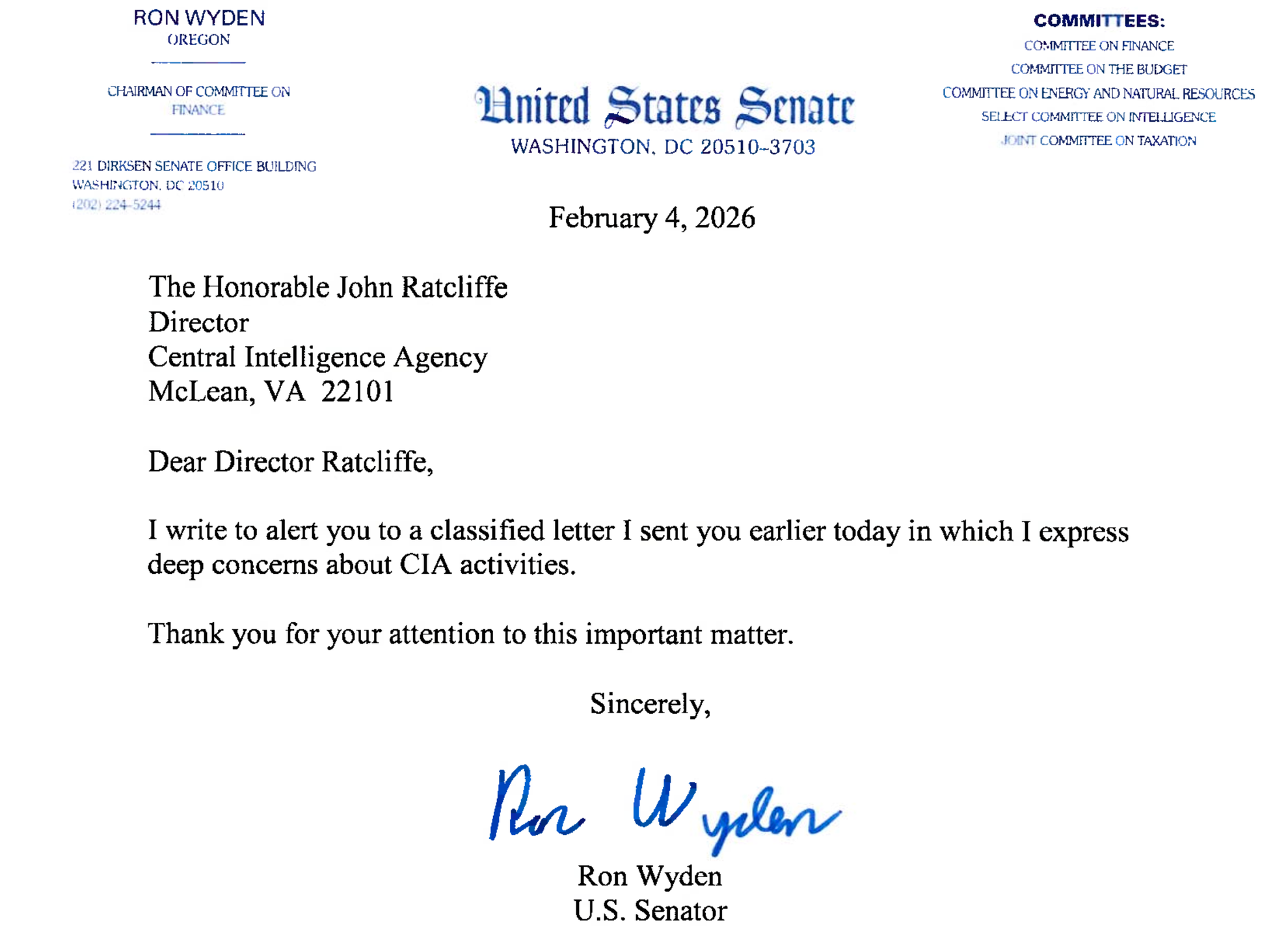
It's a short letter. It's a letter about a letter. Specifically, it's a letter to CIA Director John Ratcliffe to alert Ratcliffe to a classified letter Wyden also sent. Now, that's not quite right. It's not really a letter to Ratcliffe. It's a public record that can be released to you, via reporters like me, noting that Wyden sent a classified letter to the CIA director about the "deep concerns [he has] about CIA activities."
That is (a) exceptionally vague and (b) concerns CIA activities, plural.
I will spare us all a lot of speculation and say I spent as much time as I could devote yesterday to figuring out what Wyden is talking about, and I have bupkis. There is no shortage of "CIA activities"—plural—to which this could apply. But it feels irresponsible for me to suggest them, since anything I list here could carry the inescapable implication that it might be what prompted Wyden's "deep concerns," and I do not know what actually prompted them. Isn't it fun to be an intelligence reporter?
A year after our PATRIOT Act interview, Wyden wrote another letter, to Director of National Intelligence Jim Clapper, that acknowledged an NSA surveillance activity under Section 702 had on at least one occasion violated the Constitution. A year after that, Wyden famously asked Clapper in a hearing if the NSA was collecting data from millions of Americans, prompting Clapper to lie in public. It would take Snowden to expose what Wyden meant. We still don't know what Wyden and committee colleague Martin Heinrich meant in 2022 when they announced in the broadest of outlines that the CIA has for years been collecting Americans' data—it's unclear what—in bulk.
To be 1000 percent clear: I do not know there to be any relationship between that 2022 warning and yesterday's correspondence between Wyden and Ratcliffe. I am haunted by the ghosts of editors' notes past—the ones that invariably asked me such questions ahead of suggesting we cut the context paragraphs I write, since they might suggest a direct connection to a reader that we can't establish. I don't know what Wyden meant! I tried! Figuring this stuff out often takes years. And, again, he's talking about activities, plural.
All I can tell you is that Wyden's record of warning that there is deep and constitutionally-serious dirt being done by the intelligence agencies in secret is unblemished. Never once in the many years I have been reporting on Wyden have I ever encountered a warning of his to be hyperbolic, let alone baseless. Wyden is the only senator on the intelligence committee I have consistently found trustworthy and appropriately focused, even when I disagree with him. Whatever he means here may not be known for years. But I have never known Wyden to point to smoke that doesn't emerge from a five-alarm fire.
JEFFREY EPSTEIN AND Mohammed bin Salman? Jeffrey Epstein and Mohammed bin Salman.
WHAT JEFF BEZOS HAS DONE to the Washington Post is disgraceful, and has to be seen within the long and ignoble tradition of oligarchs shaping reality to their liking through their purchase of media companies. Social media companies scale better than traditional media companies, but the task is the same, as seen with Elon Musk's purchase of X and the Ellisons' acquisitions of TikTok, CBS News, Paramount and everything else they have. I have 25 years of professional criticisms of the Washington Post, but never once did I think the country's civic foundations would be stronger if the paper was decimated. Firing a reporter who is risking her life for you in a war zone is so risible that I better not finish this sentence.
We don't need to pre-obituary the Post, and everyone knows its Watergate glory days. But for me, its glory days were 2013 and 2014. That was when I spent months pouring through the Snowden files for The Guardian, racing against Bart Gellman's team at the Post that was trying to beat us—and unfortunately sometimes did—as much as we were trying to beat them. The public has a richer understanding of the realities of post-9/11 surveillance because of our competition. The only time I ever wrote for the Post myself was in 2024, when I reviewed Steve Coll's latest book about the Iraq war. The section I wrote it for was a casualty of Bezos this week. Democracy dies in capitalism.
[Bezos and his flunkies closed the entire books section and fired every single arts writer yesterday. Spencer’s was one of many, many good pieces that section published. The way the current generation of media barons have treated arts coverage over the last two decades is maybe the single clearest demonstration of their seething contempt for the public, their utter hatred of the very idea that people who aren’t morally insane money vampires might be allowed to enjoy something in the time they ought to spend working.—Sam]
I'LL BE ON AN UPCOMING EPISODE of The Intercept Briefing podcast talking about the War on Terror, the rise of ICE and Minnesota. It could be out as soon as Friday, though I have no control over that. Either way, add that podcast to your feed, since I'll be spending the rest of my week working on an upcoming freelance piece and revisions to my forthcoming book THE TORTURE AND DELIVERANCE OF MAJID KHAN. As soon as we have a preorder link for that book, prepare for a barrage of newsletters to get you to buy it. It's the best thing I've ever done in journalism, and, well.
WALLER VS. WILDSTORM, the superhero spy thriller I co-wrote with my friend Evan Narcisse and which the masterful Jesús Merino illustrated, is available for purchase in a hardcover edition! If you don't have single issues of WVW and you want a four-issue set signed by me, they're going fast at Bulletproof Comics! Bulletproof is also selling signed copies of my IRON MAN run with Julius Ohta, so if you want those, buy them from Flatbush's finest! IRON MAN VOL. 1: THE STARK-ROXXON WAR, the first five issues, is now collected in trade paperback! Signed copies of that are at Bulletproof, too! And IRON MAN VOL. 2: THE INSURGENT IRON MAN is available here!
No one is prouder of WVW than her older sibling, REIGN OF TERROR: HOW THE 9/11 ERA DESTABILIZED AMERICA AND PRODUCED TRUMP, which is available now in hardcover, softcover, audiobook and Kindle edition. And on the way is a new addition to the family: THE TORTURE AND DELIVERANCE OF MAJID KHAN.