
Confronting The Belfast Pogroms
Guest writer Sarah Kay reports on the community resistance to the anti-immigrant assaults in her beloved city—a solidarity overlooked by the media
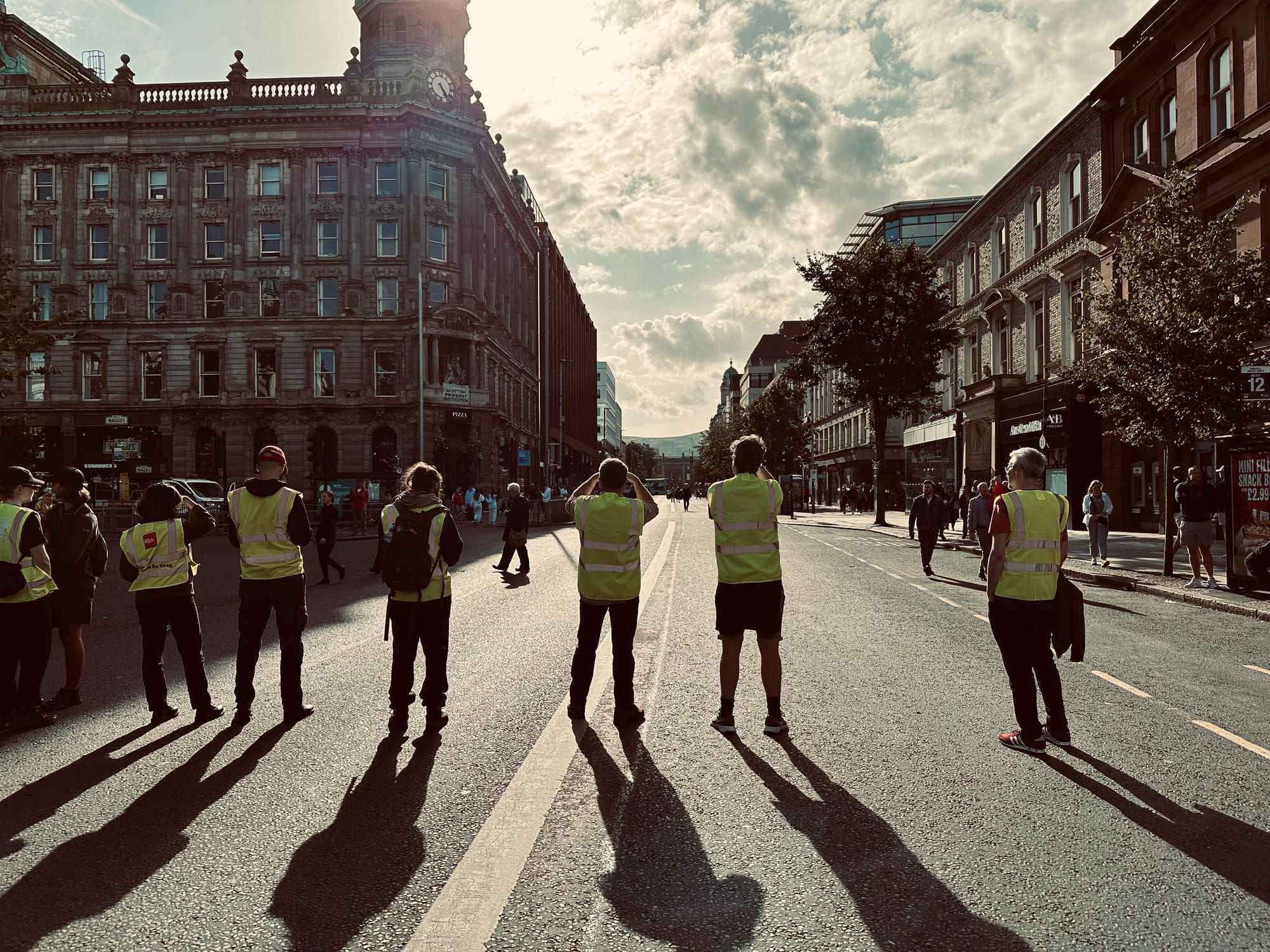
Edited by Sam Thielman with photos by the author
My friend Sarah Kay is a human rights lawyer who has taught me much in the way of connections between counterterrorism campaigns throughout history. She’s also a daughter of Belfast, where she lives today. When the anti-immigrant pogroms began, I thought there would be no better local voice to provide an on-the-ground perspective. I hope you’ll pay her heed.—Spencer
ON JUNE 9, an attempted beheading in Kinnaird Street in North Belfast was interrupted by passers-by. Random Belfastians wrestled 30-year-old Hadi Alodid, the attacker, away from his victim, 44-year-old Stephen Ogilvie. Ogilvie was rushed to hospital in critical condition from stab wounds to the neck and head. Someone filmed the attack and circulated it on social media, where it spread like wildfire. The police disclosed both Alodid’s name and his immigration status: He is a refugee from Sudan, granted the right to residence in Belfast.
Beginning the next day, riots organized by racist “Active Clubs” using Facebook and X, and supported by Northern Ireland’s loyalist paramilitary groups ignited all over the city. Mobs targeted any person of colour, any Muslim or supposed Muslim person or family. They spray-painted “fuck Islam” on the shutters of closed shops. In 2026, the organisation PPR, in coordination with the women’s refugee group Anaka, relocated 200 families. Matthew O’Toole, the Leader of the Opposition (equivalent to the Minority Leader in the U.S. House or Senate), disclosed in a tearful video he relocated 12 families from his constituency. CATU, the tenant’s union, did the same. Socialist republican groups issued statements that they would fight the rioters back. 20,000 people showed up on the last days of the riots to say no.
Belfast is two cities. One is a place with a thriving punk scene, part of its active, bustling, bubbling, hyperpolitical (and chronically underfunded) arts sector. It holds a Culture Night, celebrates diversity with Belfast Mela, mixes joy with union politics during Feile, and opens the doors to its museums and galleries during Late Night Art the first Thursday of each month. Each June, C. S. Lewis Square is filled with concerts, drag queen storytimes, open mic comedy and walking tours. Our student movement has championed some of the North of Ireland’s biggest recent advances in human rights.
We fight against paramilitaries, though we have neither the armoury nor the training to do so.
The other Northern Ireland is the most dangerous place in Europe to be a woman. It often makes headlines for the pain we have never stopped inflicting on each other. This violence is aided and abetted by chronic institutional dysfunction, especially the collusion of our police force, and vigilantism by active loyalist paramilitaries—the same paramilitaries the 1998 Good Friday Agreement, our peace treaty, supposedly forced us to disarm and disband. Colonialism has never left. It is tangible; you can breathe its air, you can see its destruction, you can hear it speak over ordinary people simply seeking to live a life free from violence. I am a Belfast child: I have never known that freedom.
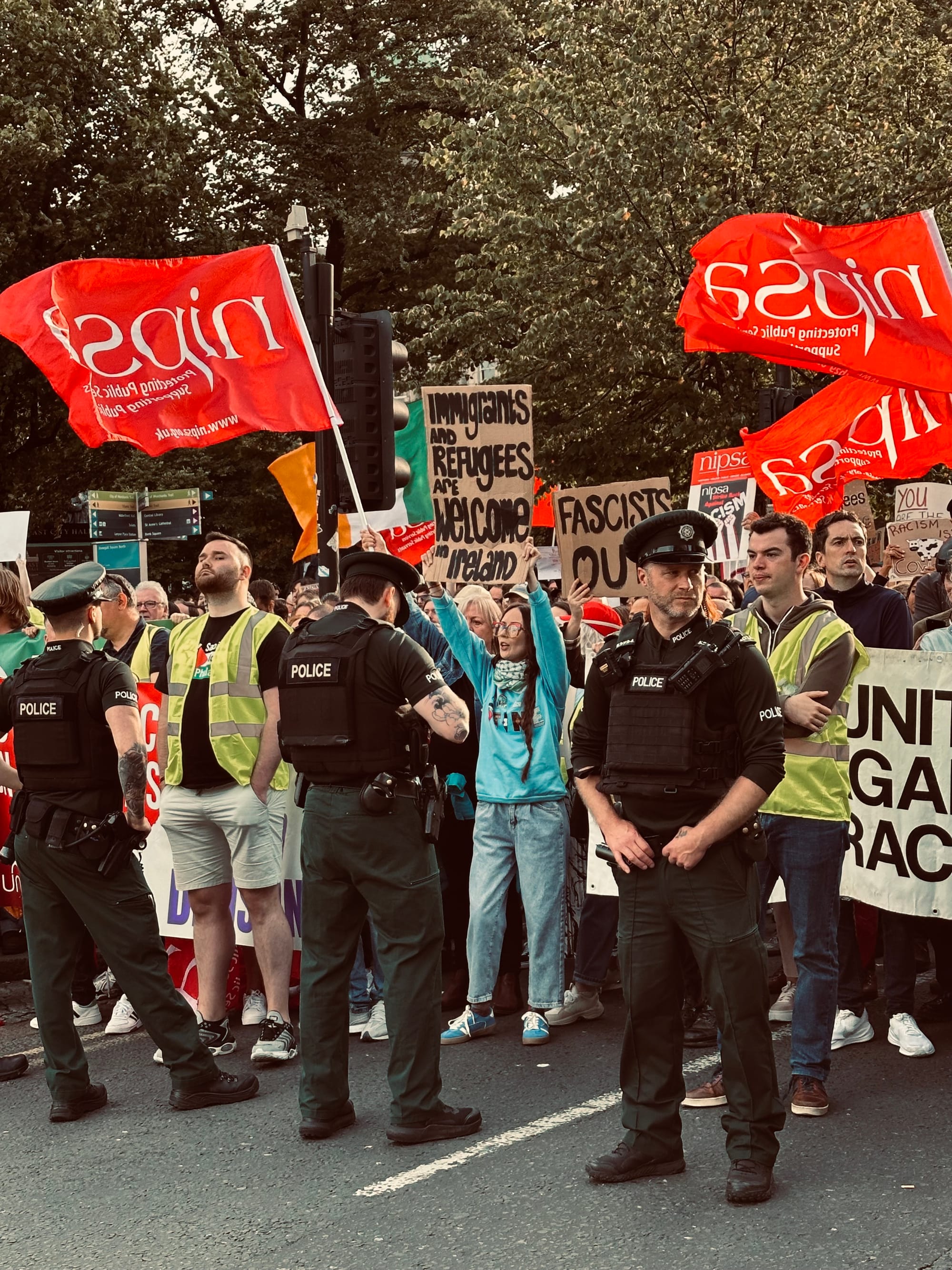
In 1969, Irish Catholics living on Bombay Street were burned out of their homes. In 1997, Emer Nic Gabhann recalls friends being burnt out of their home in the largely loyalist town of Carrickfergus, in response to the negotiations over what would become the Good Friday Agreement. In 2001, Irish Catholic children attending the Holy Cross school in North Belfast were barred by British loyalist crowds on their way to school. As they were escorted away, crowds pointed and screamed “Scum! Scum! Scum!” at the children.
Recent years have seen old forms of violence directed at new people. In 2024, rioters and press blamed a more recent round of violence on a knife attack in Southport, a town north of Liverpool. Disinformation spread, notably fake statistics exaggerating the frequency of violent crime by nonwhite people. Protesters held up signs deploring “demographic replacement,” though a recent census shows that the population of Northern Ireland is 96.6% white.
For weeks, people outraged by these displays, including me, coordinated on Signal group chats. We patrolled the streets around the Belfast Islamic Centre hoping to be a deterrent. We relocated hundreds of displaced families with little resources. We provided hot food, carpooled children to school, pulled every string we could—with social workers, with the Housing Executive, and even with the Home Office. We had no one to rely on.
During those 2024 attacks, we watched as rioters—most of them bused in from Dublin and ferried in from England—ravaged the south of the city, burning Middle Eastern supermarkets on Botanic Avenue and hunting down ethnic minorities in the Holylands. The next day, locals cleaned up the broken glass, boarded up the windows, and removed the racist graffiti. After four days, racists staged an anti-immigration protest and a large counter-protest marched them out. It didn’t feel like a choice.
Last year, similar riots followed the attempted rape and sexual assault of a young girl in Ballymena and the arrest of two young boys of Roma origin. (The charges were later dropped due to lack of evidence.) Racists saw an opportunity and rioted for two weeks, burning homes and businesses. A local elected official, pregnant at the time, rushed into a house on fire to search for survivors. Inside, she rescued a woman eight months pregnant herself, whom she found huddled and terrified in the attic with her toddler. Leaked internal emails show that the Police Service of Northern Ireland (PSNI) had issued instructions to officers during the violence that they should not intervene unless there was a threat to life. People fleeing flames were rushed to a nearby leisure centre where they had to sleep on mats. Rioters came to set it on fire, too.
I will defend my city with my last breath, though I am exhausted by the chronic resurgence of violence. I feel defeated by media coverage only interested in us when we burn effigies down, or when kids throw rocks at armoured police cars, conjuring images of “the Troubles” that the BBC covers and consumes with vile voyeurism. This time, the enemy has been redefined. It is no longer Irish Catholics, but people of colour from all walks of life. Egged on by Elon Musk posting incitement to hate from atop his trillion dollar fortune and supported by white supremacists sleeping soundly in their London beds, we fight against paramilitaries, though we have neither the armoury nor the training to do so. We have no choice. We are all the city has. Our government, Stormont—a literal white house on a literal hill—just issues empty proclamations that “this is not who we are”, that we “can do better”, and then rehashes the racists’ “legitimate concerns” about immigration. Nobody believes Stormont has suddenly begun to care about their constituents—as if we weren’t the poorest region in the UK, as if a quarter of our children weren’t living under the threshold of poverty, as if 50,000 families were not waiting for housing! Stormont, and the Department of Justice in particular, may deplore the pogroms, but it certainly doesn’t know the Belfast that confronted them.
We are a mosaic of colourful, loud, consistent, committed residents. Our “no” will always burn brighter than incendiary weapons. Our collective strength has always been underestimated. We don’t make headlines, because kindness as a political opinion does not make for a sexy evening news report. We will always be who we are.
Living under paramilitary boots we are told don’t exist, grassroots organisations continue to fearlessly speak truth to power. They opened their homes and spare rooms to displaced families, not because they were asked to do so, but because it was the right thing to do. They leave their phone numbers under the doors of marginalised people’s homes to let them know to call if they feel unsafe. They wash away racist graffiti in their neighbourhoods. They take casseroles to soup kitchens to ensure fewer of the displaced go hungry. They put their bodies and their lives on the line by standing in front of homes that would otherwise be burnt. They are Belfast. They are the best of us. Not politicians, not racist influencers: those who do the work, unnamed, unfunded, yet relentless in their pursuit of justice.
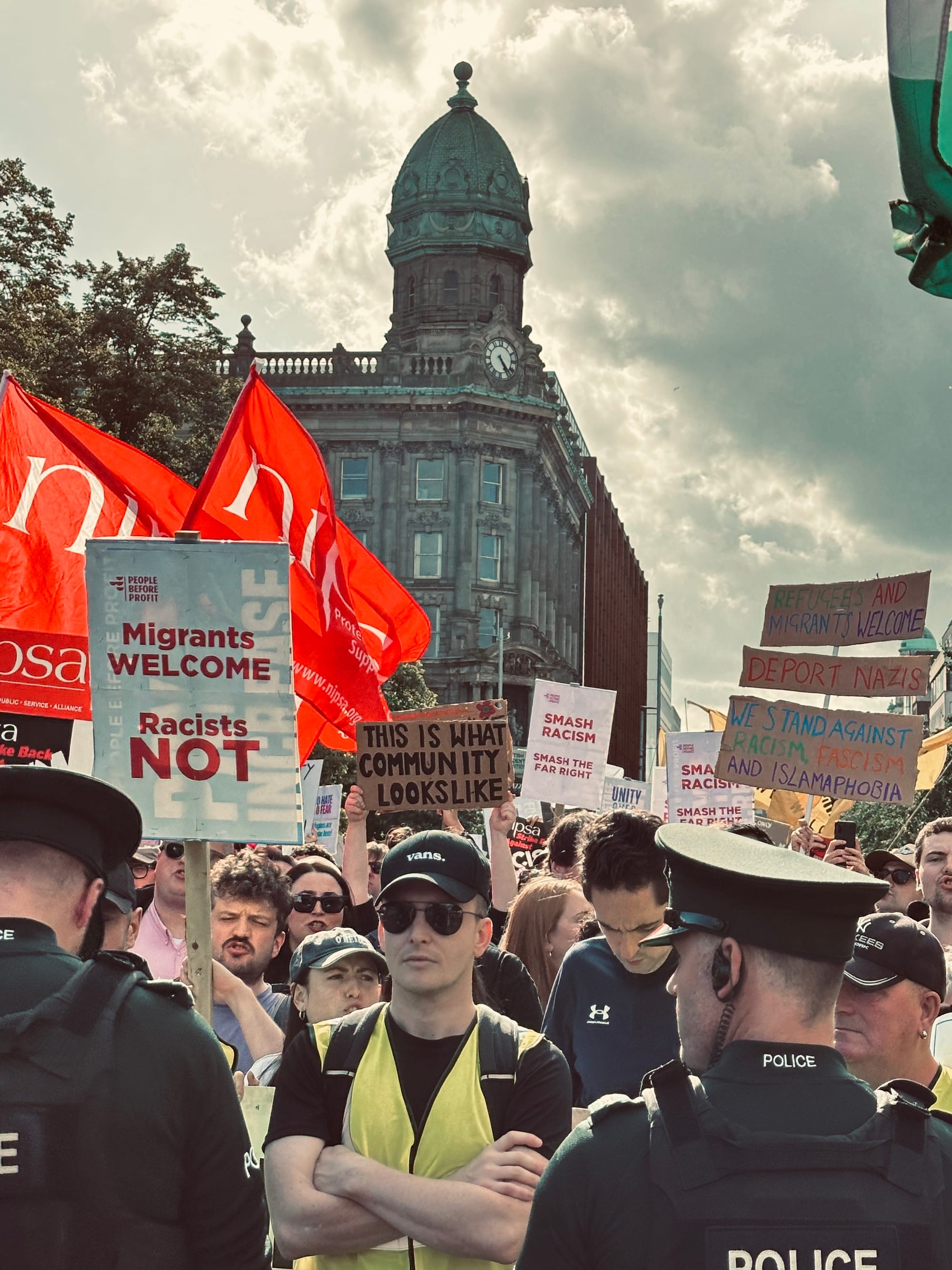
The motto of the city of Belfast is “pro tanto quid retribuamus”, which translates to “what shall we give in return for so much?” I see that selfless offering every day. I see it every damn day. I hope I will see it until I die, and perhaps even after. Belfast is not “resilient”, a favorite buzzword of diplomats parachuting into our city every few years to congratulate themselves on a nonexistent peace. There never was peace, and we will never know peace for as long as paramilitaries exploit women, exploit children, finance themselves through drug trade, exploiting our severe mental health crisis stemming from hundreds of thousands of lives hiding from bombs. Our message is as follows: we don’t need their peace. We will make our own. That is what we are giving in return.
Buy my friend Laura Hudson's comic book Exploit!
Connor Goldsmith, the telepath behind the Cerebro podcast (and one-half of The Kibitz), makes his comic debut with DID YOU HEAR ABOUT MIMI GREEN?, a fantastic thriller meditating on fame, social media and body horror! You have to read this!
Buy my friend Colin Asher's book The Midnight Special! I recently finished reading this in galleys, and you're just not ready. No spoilers, but it ends with an incandescent chapter about Afeni and Tupac Shakur.
WALLER VS. WILDSTORM, the superhero spy thriller I co-wrote with my friend Evan Narcisse and which the masterful Jesús Merino illustrated, is available for purchase in a hardcover edition! If you don't have single issues of WVW and you want a four-issue set signed by me, they're going fast at Bulletproof Comics! Bulletproof is also selling signed copies of my IRON MAN run with Julius Ohta, so if you want those, buy them from Flatbush's finest! IRON MAN VOL. 1: THE STARK-ROXXON WAR, the first five issues, is now collected in trade paperback! Signed copies of that are at Bulletproof, too! And IRON MAN VOL. 2: THE INSURGENT IRON MAN is available here!
No one is prouder of WVW than her older sibling, REIGN OF TERROR: HOW THE 9/11 ERA DESTABILIZED AMERICA AND PRODUCED TRUMP, which is available now in hardcover, softcover, audiobook and Kindle edition. And on the way is a new addition to the family: THE DISAPPEARED: A FATHER, A SON AND THE WAR ON TERROR.