
The First Truly Free Planet: A Q&A
FREE PLANET writer Aubrey Sitterson talks to FOREVER WARS about what comes after the revolution–allegorically speaking

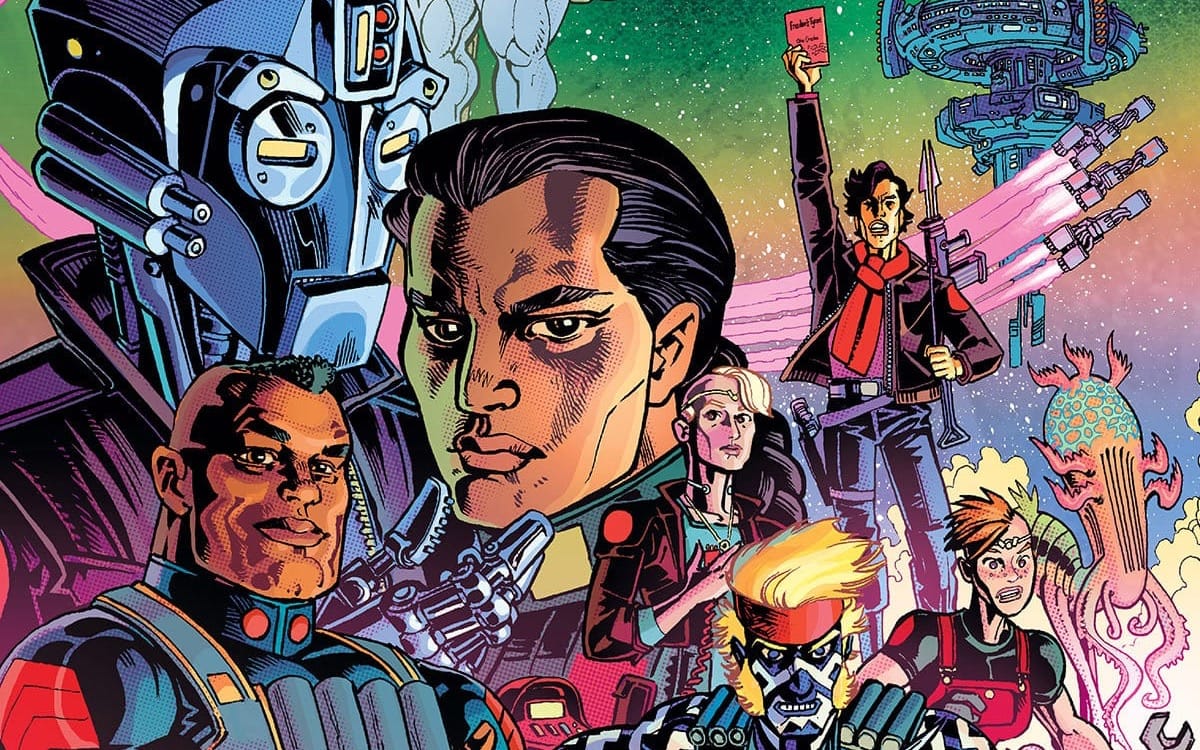
FREE PLANET writer Aubrey Sitterson talks to FOREVER WARS about what comes after the revolution–allegorically speaking
Edited by Sam Thielman
REGULAR READERS of this journalism-focused newsletter know that I don't often push my taste in comic books here. (Promoting my own comics work is another matter entirely.) When I do, it's because a story is both exquisite and relevant to the subjects of FOREVER WARS, like LAZARUS. And that describes FREE PLANET by Aubrey Sitterson and Jed Dougherty, published by Image Comics. It was one of my favorite pieces of new fiction in 2025.
FREE PLANET follows a political-security alliance, the Freedom Guard, in the wake of a successful war of liberation. The far-off planet Lutheria has thrown off the yoke of the Interplanetary Development Alliance (IDA)—for now. Lutheria is rich in a crucial fuel resource called orchaleum that IDA won't simply abandon. Crucial for the success of the revolution was the unity of the fractious elements of Lutherian society and their off-world and robotic allies. Can the Freedom Guard, whose membership reflect those fractures, keep what the people of Lutheria have won?
After each issue, readers get briefed by the historian Dr. Aldous Foyroushi. Dr. Foyroushi is a device of Sitterson's to fill in the gaps of how Lutheria, a planet populated by humans ages after the Terran Dispersion, came to be. A typical backmatter-page lecture from the doctor reads: "The romantic and prevailing view is that humanity is destined to wander, that something deep within us urges us forward into the unknown. But this is an overly charitable estimation of one of humanity's most defining traits, for at the core of human expansion lies not a passion for exploration but, rather, a desire for luxury, leisure, and the wealth that makes both possible." We love to see historical materialism thrive in the vastness of space.
Foyroushi’s lectures speak to a central triumph of FREE PLANET. The worldbuilding that Sitterson and Dougherty have done in a few short issues—the seventh came out this month—is off the charts. (Literally. There are several charts in this comic.) Social codes from different Lutherian ways of life are painstakingly rendered and distinguish factions from one another. Through the fascinating nun-like characters of the orthodox Hora and the reformist Fweha, varieties of Lutherian religious experience are on display—traditions that both justify and subvert the economic extraction at the core of the intergalactic emergency—and the variety helps illustrate the thousand schools of thought that contend in FREE PLANET. And that's leaving aside the hostile rival to IDA, the Orouran Empire, which seems religiously motivated, or at least religiously justified.
Underpinning the ideological debates are sharp differences in understandings of freedom and how to secure it. One of the Freedom Guard, Jackson Crater, is not unreasonably considered a terrorist by his comrades-in-arms; others might consider him a labor militant, as his movement was the Zetas to a fictional-space-union's Gulf Cartel—that fuel the plot engines.
Layered atop it all is a compelling design sensibility, one that owes a lot to 80s wrestling, winks at 90s "extreme" comics art and is distinct on its own. Dougherty's pages do things that can only be done with comics art. Several times in each issue the "screen" will expand across two pages, with component storytelling panels layered within. It's arresting, deeply intentional and provides FREE PLANET a dynamic pacing reminiscent of Howard Chaykin or Darwyn Cooke. Any comics reader knows that's high praise.
FREE PLANET just released its first collected edition. It'll make a great holiday present for the sci-fi fan in your life. And you should also go to your local comics store and ask the helpful staff to order and reserve each new issue for you. Doing that is the surest route to keeping FREE PLANET a going concern. This being Image Comics, Sitterson and Dougherty own their creation, but they also have to DIY it. If you subscribe to FOREVER WARS, FREE PLANET is for you. You'll want it to keep going until Sitterson and Dougherty finish the story they've set out to tell.
For further insight into the revolutionary moment in Lutheria, the First Completely Free Planet, I called up Aubrey Sitterson. Our lightly-edited Q&A follows below. As you read it, just imagine the two of us are laughing after every third sentence or so, since that was how our interview played out, but I don't want to keep typing "[laughs]" constantly.
Once you check out our interview, I hope you'll buy the FREE PLANET collection and subscribe to the monthly comic at a comic store. And also buy a subscription to FOREVER WARS, the only newsletter that's giving you reporting on the Somalia bombardment, insight into the pedigree of Florida torture methods and recommendations of great new comics.
Spencer Ackerman: So before I ask you to talk about how you came up with FREE PLANET, I need to know: What kind of history sicko are you?
Aubrey Sitterson: Oh, dude, so, honestly, a relatively new one. During the pandemic, I really wanted to start reading more nonfiction work. I realized that I, like a lot of other folks, like a lot of other creatives, especially in comics, were pulling primarily from other fiction work, and it was making my work repetitive and trite and familiar. I wanted to do something more complex and richer, and I also wanted to just improve my reading habits. So at the very start of the pandemic, I reached out to a buddy of mine, his name is Daniel, and he's a librarian in Birmingham, Alabama. I said, brother, I need some nonfiction books. I don't even care what they're about, just interesting ones, just good ones, ones that you've enjoyed, that you think I might enjoy.
He recommended two books to me. One of them was a book about how France became a country. Like the conception of France and where that came from. And I don't remember what it was called, but it was great. And then the other one that he recommended to me was The Storm Before The Storm by your buddy Mike Duncan. I devoured it, I adored it, and I fell down the rabbit hole. It became kind of an obsession during the pandemic, just getting the biggest doorstop tomes I could about mostly 20th century revolutions and civil wars. That was the bulk of it. But you know, my history sicko-tude has been very much something I've developed just in service of FREE PLANET. I didn't start out that way.
Wow. So what are the historical and cultural inspirations and influences that you're drawing from to craft both the story of FREE PLANET and the really impressive world building that has gone into it?
Thanks, man.
You know, the starting place for it—though it absolutely became something else—was 'space G.I. Joe defending Venezuela on another planet,' right? That really was the original concept for it.
And also, I'm a big Aldous Huxley fan. I love Brave New World and stuff, of course, but I love his kind of British society novels. Point Counter Point is the best one. They do this awesome thing where it's this massive cast, and each one of them has this really well defined worldview, and they bicker. They just bicker with each other all the time about everything, and just these big, huge soliloquies and monologues and, you know, back and forth.
And I wanted to do that about something that was deeply interesting to me, as a way to kind of touch on all these big issues around freedom. I didn't want to do something that was a direct metaphor. I didn't want to do agitprop. I've done that kind of political work before. I want to do something that dug in deeper. And it required research.
I read about Venezuela. It was a little bit tougher, reading about Venezuela because a lot of the most useful stuff was in Spanish, which wasn't helpful to me, only speaking English. So I'll tell you the historical event that was most influential on kind of building up this world and thinking about these characters and this kind of post revolutionary landscape was the Spanish Civil War. All these different people who were on the same side about needing something new, right, and needing to create a new world, but completely at odds about what that world was going to look like. I read a really, really great book by Hugh Thomas, The Spanish Civil War. And I love that, and I loved his Cuba one. That was really, really important, too—and I'm just listing my bibliography now, but so was CLR James' The Black Jacobins.
Yeah, you can really see the inheritance of Haiti and Haitian history on FREE PLANET, particularly in the relationship Lutheria has with this predatory economic powerhouse, IDA, that refuses to accept the revolution's victory.
And it's the same with Cuba, right? The same with Venezuela. Like, this is a pattern that repeats itself. And, you know, by kicking it forward, millions and millions of years into humanity's future, we can kind of mix things up and divorce ourselves from preconceived notions about who these characters are and what their struggles are about, and who's the good guy. And it's been really gratifying for me. That approach has paid off in that—you know, I'm talking to you for your blog, so people can probably kind of take a guess at where I stand politically, but I've had a lot, more than I would have expected, a lot of right-wing folks, a lot of libertarian folks really latching on to this thing. Because, and this was my hope, this was my theory, you know, what do we all want? What is the American founding mythology based upon? What do we all agree on? It's that we want to be free. We want freedom. Everybody wants freedom. But what the hell does that mean? And FREE PLANET is my inroad to just yammering about that every month for 20 pages.
So Vera, Jackson Crater' lover, lost an eye in a black site. Is that an Abu Zubaydah reference?
Not specifically, not specifically, but–
Okay, never mind! On to the next question…
Yeah, no. I mean, I'm looking at all this stuff, and it's been an effort to try and take what I know to be true– and this is the fun thing about working with speculative fiction, as I know that you're aware from your fiction writing– that even if you're not going to do direct one-to-one comparisons, you're still obligated to draft off of what people know about and understand about the world. So in a contemporary context, if we start talking about, you know, paramilitary subcontractors and black sites, that automatically dredges up in people opinions about stuff which is going to help color their view of what comes afterwards. So that's been part of the task with doing FREE PLANET for sure.
So what's the origin story for FREE PLANET? How did you decide, you know, at this point in your life to just go for it, and basically doing it yourself through Image Comics.
I've been in comics my entire adult life. I started as an editor at Marvel when I was an editorial assistant, technically when I was still in college. So I've been at this for a minute, and I've done a lot of work, and it's work that I'm proud of. It's almost entirely creator owned stuff, right? Because I don't like anybody telling me what to do. But you know, I realized that I wasn't doing the work that I enjoyed. Like I was doing work that I thought was well executed and really fun for me to do, but it wasn't the kind of complex, challenging work that I actually enjoy reading, right? And so I started thinking, you know, a lot of contemporary comics is built around approximating a television or film experience like that's how these books are written, is how they're paced. When I worked at Marvel, they sent me to Robert McKee story seminars. But it's a different medium, right?
So I was looking another direction, because I like TV and film, but I was more of a novel kid growing up. I really wanted to create something that had novelistic depth, which I think is exceedingly rare in comics. Howard Chaykin's work, stuff like that, has what I consider to be the essential components of a novelistic work, of actual literature, which is ambiguity and complexity and leaving the reader enough room to come to their own conclusions. Right? It's not a polemic. It's not about making a specific point. It's more about digging into a broader, more foundational issue, and then letting the readers explore it, right? And I wanted to do something like that. FREE PLANET, the idea that I couldn't get out of my head, seemed to lend itself to this kind of approach, because of that Huxley connection I was talking about earlier.
So what's the political spectrum represented on the Freedom Guard? What perspectives do they embrace? What do they shun?
That's a good question. So I worked really hard. For a lot of them, I started with like, kind of real-world analogues, but then I worked really hard to try and muddy the waters enough that it was difficult for people to pick it up and be like, Ah, this is the Marxist-Leninist-Maoist character or whatever, right?
The world of Lutheria, like the government that they're trying to build, what they're aspiring to is ancom, right? It's libertarian communism. And to my sense, like, that's the idea of, oh, it's truly free. It's truly free. It's a completely free planet. What does that mean?
It's economic freedom. It is personal liberty, freedom. You can do whatever you want, as long as—what, right? And that's the tough part that they need to figure out. And so broadly speaking, it is an anti-corporate stance, right? Everybody shares that because of the corporate-dominated oligarchy that they've fought a war against and broke away from. And beyond that, there isn't really much similarity, right? There are die-hard, kind of what we would kind of classify as conservative military elements, but they're still deeply committed to the dream of this new freedom. And there are also multiple religious actors who have views of freedom that are informed by their varying religious dogma. And then there are people whose motives are maybe a little bit less altruistic, right, who are more focused on themselves and what this new world can do for them. And this too, was informed by all this reading, right, looking around at the Russian Revolution—dude, have you read Trotsky's History of the Russian Revolution?
No, I never actually have. I know I need to. I've read excerpts where he's settling scores.
He's just the cattiest bitch on the face of the planet. It's so good. It's wonderful. But you know, so much of that book is about all the people who are on the same side. It was infighting, right? It's infighting and jockeying for position and trying to figure out the way to move forward achieving your goals, but without alienating everyone else around you. It's a tough question to answer because I did work really hard to not, you know, you know, tie them to specific contemporary political ideologies.
So what's your relationship with religion? Because Fweha and Hora are two of my favorite characters. What powers your presentation of their theological disputes?
Well, I grew up in the church. I grew up—I tell people Southern Methodist, because we were Methodist, but, you know, there's this perception of Methodists as being one of the more progressive denominations. Not where I was growing up. It was like, James Dobson, Focus on the Family, evangelical fundamentalist right-wing Christianity. And I adored it. I was all in, man, I went to Sunday school every week, up to when I was 16 or something. We've gone Wednesday nights. A lot of times I loved and admired and respected and took advice and solace from my pastor. Religion was deeply, deeply important to me.
And when you get raised in a religion, any religion, I don't think that stuff washes off really easily. I'm not a religious person now, but I'd be lying if I didn't think, if I said I didn't think about it constantly, you know, and it's a there's a little bit of score settling there for me, in that, I think that a lot of the contemporary progressive or liberal or leftist or however you want to define it, that crowd and that audience often disregards the importance of the religious experience to everyday people.
Absolutely. This is a foundational mistake I think the left in the West makes.
Well, I mean, I think it's a mistake for two really key and distinct reasons, right? One is, whether you like it or not, this is a part of people's lives. It has been an important part of humanity for as long as humanity has been a thing, right? Our brains create it, right? Like, it's just one of those odd things. But then the other and maybe the more pertinent or more important reason is, if you look at the role that, really, you know, certainly, certainly, religion has played a conservative role, and, you know, supported, you know, in any revolution you can think, you can find religious people on the conservative side of things, but you can also find the opposite. You know, even in the contemporary environment, right anytime there's a big protest, you always see the nuns, you always see the pastors. You always hear about these churches or other religious groups that interpret their dogma in a way that is aligned with this struggle.
And I'll tell you to add on to this. You know, I feel pretty similarly about the depiction of the military in FREE PLANET, right? The left thumbs its nose and looks down upon veterans and military personnel and just the concept of a military generally, which, again, is just wildly ahistorical. For all of the people clamoring for big change and revolution and this, that and the other, how is that going to be safeguarded? Right? Like, how does any of that happen without military involvement and buy-in? And the truth of matter is, you know this as well as I do, it doesn't. It just can't. So that was a really important thing for me, too. Both, you know, religion and the military are generally in the contemporary context, coded as, you know, arch-conservative, right-wing institutions. But it doesn't have to be that way.
I think it also speaks to a certain cultural alienation, but we don't have to get into all that.
We'll save cultural alienation for the next interview.
Makes sense. So, this is a nutrient-dense comic, and it's one that demands a reader engage with its ideas on a deeper level than most. Did you, or do you, ever feel pressure to kind of dumb FREE PLANET down?
I have felt pressure from peers and colleagues. Like, when I was putting this thing together, I would show this to folks, and they would say, oh, how are people gonna get through the first page of this thing? Look at all these text boxes. I showed it to Howard Chaykin, the legendary cartoonist, who is a dear friend of mine. I showed it to him, and he said, "You know, I love this. There's zero market for this. You have no audience. You're making this for an audience that does not exist." He was adamant about it.
So I've got pushback from peers and colleagues that they think it's just too much, and there's not really anybody willing to engage with it. Certainly there are readers who it's not for, right? Because it is so wildly different from the de rigueur approach to comics right now, and comics are informed by shonen manga, you know, they're breezy. They're informed by television, like teleplays and, you know, like scripts and things so that it's very dialogue-based, this rat-a-tat-tat dialog. Even the way that people write panels, right?
Like, something you'll see all the time in comics is like, Oh, well, here's a page zooming in on something. And I guess that can be used effectively for pacing purposes, but what a huge waste of space, right? It's a technique that works great in film and television, but in comics, anything you depict is space. It's not time, it's space. There's a hard ceiling on how much space you have at any point in the comic. And, you know, FREE PLANET is not that. FREE PLANET is a different thing, and that's by design. It's intentional. And again, it's, it comes from me wanting to make the type of comic that I want to read, right? I've had enough of comics that I flipped through quickly and then don't think about ever again. I've had enough of just grinding narrative and nothing more I wanted to make. Did you read those Dinotopia books when you were a kid?
No, I didn't.
They're cool. They're kids books, but they're like, big, huge, widescreen, hardcore, you flip them open, it's just a ton of stuff. It's diagrams, it's maps, it's journal entries, it's all of these things thrown onto the page. And that, to me, is comics. I think a lot of conceptions of what comics are are really just more akin to storyboards, right? That is really limiting. That's certainly a way you can do comics, right? Just show every moment of a scene and then the attendant dialogue in each panel. You can certainly do that, and a ton of people do it to way more success than I've ever had, certainly.
But to me, it's insufficient. It's not enough. It's not using the medium to its full capabilities. Because comics isn't just putting words and pictures on the page together. Comics is the interplay of these things through design, through proximity, through where they're placed on the page. And once you realize that, once you broaden that perception of what comics is, you have this outrageous amount of freedom, such that you can just drop in a psalm from one of these religions, right? And then reading that psalm next to whatever I, The Creator have chosen to place it next to hopefully conjures up in readers connections that wouldn't have been there otherwise.
There's some great form-and-content unity in FREE PLANET with the way that clearly, this is you and Jed unrestrained. And it also leads to my next question, which is that the layouts of the pages feel like they're making an argument about how comic books can be constructed uniquely from any other medium. How do you and Jed approach page composition, and how do you make it serve the story?
Great question. So Jed's my favorite guy to work with. We've worked together a number of times. Actually met him through the aforementioned Howard Chaykin. He used to be one of Howard's assistants. I think that you can see that in Jed's approach and how, in exactly what you're talking about here, how he tackles the page with FREE PLANET.
I'm writing it completely differently than I've done books in the past, including books with Jed, in that I have an added step. I think most people, myself included, I would, you know, I would outline things, like scene by scene, and then maybe do page breakdowns, and then I would get into the script. I would send it off to Jed, and maybe, if I was struggling with something, I would do a little drawing just to make sure it worked, or, you know, to help wrap my brain around it. But that was all of the actual thinking about the page that I really did right, beyond just making sure that, you know, and this is, this is how people generally write comics, because it's fast, it's fast and it's efficient, and it makes for a script that can be sent off to anybody, and then they do it. There's an average of four and a half panels a page. There's a splash page. Every once in a while you have a cliffhanger at the bottom of your right-handed pages. There's all these algorithmic ways to just make sure that you make a functioning comic book script.
And I didn't want to do that anymore. When you do that, you're not writing a comic. You're not writing a visual, you're not creating an art object, right? You're not writing towards the page. What you're doing instead is you're writing a narrative. You're writing a narrative, and then you're just trying to hammer it into the shape of a comic. And I think you leave a lot of opportunities and tools on the table in doing that.
And so for me, the two revolutionary things for me in my work process on FREE PLANET, one we already touched on, which was research. And then two is thumbnails. I do thumbnails prior to scripting, and that's crucial, and it's crucial that I do them prior to scripting. I have an idea of what's going to be in the issue, generally speaking, what's going to take place and what we need to cover on each page. But then before I start thinking about clever dialogue, or, you know, pacing and close-ups and stuff like that, what I think about is the most visually impressive and expressive and dense and effective way to communicate this idea visually. And rarely, rarely, rarely, is it ever a grid, right? I try and challenge myself when I'm working on this thing. I'm working on thumbnails for issue 13 right now. And it's every single page, every single page turn, so I really try and think about spreads, because when a reader turns the page, they're confronted with both pages, not just one.
And I always start from: What's the visual touchstone here? What is the big attraction? What is the thing that's going to make people stop in their tracks and study this thing for a while? And sometimes it's charts and graphs, sometimes it's infographics or maps, or maybe just a massive close up of a character rattling off some kind of soliloquy at you. It needs to be something that arrests the reader and forces them to stop and break them out of this habit of just reading, bouncing their eyes, bouncing from word balloon to word balloon, to get through these things as quickly as possible.
So I do thumbnails. I do not send them to Jed because Jed doesn't need them. He's better than me at this shit. But it's still an essential part of my process, because it ensures that I'm thinking about the comic not as a story that has to squeeze into 20 pages, but as 20 individual visual experiences that I need to write in such a way that Jed can show up and impress.
So does that mean that when you're writing the script to give to Jed and you don't share the thumbnail, is your goal to just communicate, through text, what the prime visual element on the page is? Or do you just sort of write it and trust him to figure that out?
More the former, right? If there's graphs and charts, which there are sometimes, I'll do ugly versions of those and include them. My scripts have appendices, and I'll include the charts and graphs in those. But, yeah, no, if it's a big, complex layout, I will say, you know, there's a big dance scene in the center, and then there's, like, big full-body shots of these two characters flanking it.
But I'm not sending through the thumbnails because I want Jed to be empowered, to come up with something better, which he almost always does. Sometimes in my newsletter I'll show process stuff, like from my thumbnails all the way through to the finished project. I love looking at that stuff because it's proof of concept for this approach, right? The types of things that Jed is doing on the page he wouldn't have room for if I was just writing five-panel pages and sending them over to him, because there would just be too many requirements in terms of matching what the script needed. But by baking into it, first and foremost, how is this page going to look and how is this thing going to be arranged, and what is the goal of this specific page, By starting from a place like that, it allows Jed the flexibility and the freedom to do these really exciting things.
Last question. What's on the FREE PLANET soundtrack?
Oh, man, great question. International Noise Conspiracy.
Oh sure, yes.
Look, we're a bit of a certain age.
Certainly a very, very short-lived era of hardcore.
Perhaps, yeah, man, International Noise Conspiracy, for sure. Atari Teenage Riot. I feel like Rage Against The Machine is like an obvious one, but it needs to be included. Coheed & Cambria for, you know, this big space opera, epic-type vibes and story. I listen to a lot of Krautrock, so I really like Can. Probably my favorite. But Cluster is probably more appropriate for FREE PLANET. MC5, too.
I love that. To anyone reading this, I just want to say that FREE PLANET is a comic book that rewards both close reading and rereading. You'll get lost in this. And Aubrey, thank you so much for talking to me.
Brother, thank you. This has been a hoot.
THEY CALL IT THE 'DOG CRATE.' Jose Pagliery, a talented reporter and an old Daily Beast colleague of mine, found two Alligator Alcatraz survivors who described seeing people put into the "confinement box" that we reported on earlier this month. One of them referred to it as the "Dog Crate" and said it operated in lieu of a "Hole" (i.e., solitary confinement):
"It was like a dog crate,” said Rogelio Enrique Bolufé Izquierdo, a Cuban migrant currently jailed in New Mexico pending his deportation. “It was maybe two meters tall, like a little box. A little larger than a coffin."
And that meant hours trapped in a pen under the scorching South Florida summer sun in the heart of the intensely humid Big Cypress National Preserve. Bolufé remembers dreading most the thought of being trapped inside and barely being able to move while the swamp’s massive gallinipper mosquitoes attacked.
"The mosquitoes were huge. And if someone tells you they’ll put you in the cage, you immediately get scared," he said.
I CAN'T SAY IT ANY BETTER than Daniel Larison:
Imposing a blockade on another country is an act of war. The U.S. has already been waging a pitiless economic war on Venezuela for years, but a physical blockade to shut down its oil exports is a major escalation. If enforced, it would inflict additional harm on the people of Venezuela, who have borne the brunt of broad sanctions since the first time Trump pursued regime change in their country. This is the cruel and destructive policy that Maria Corina Machado, the Venezuelan opposition leader, has been cheering on.
The recent seizure of one oil tanker and the threat to seize more are more proof that economic sanctions pave the way for aggression and military intervention. Sanctions are not an alternative to intervention. They are usually the prelude to attack.
No war against Venezuela. No support for any politician who acquiesces to one.
THE WORLD'S SHITTIEST NEWSPAPER, the New York Post, owned by media oligarch Rupert Murdoch, tries to scandalize Ramzi Kassem, who has been one of the most crucial civil-liberties lawyers in the country throughout the War on Terror. Kassem's legal clinic at the City University of New York brought a lawsuit that reined in the NYPD's post-9/11 initiative of operating a secret police aimed at Muslim communities. Presently he represents Mahmoud Khalil and Leqaa Kordia, targeted by ICE for speaking out on behalf of Palestine.
If the British incels in the Post newsroom understood the first thing about freedom, they would be celebrating Kassem. But since he's a Muslim, the concept doesn't compute for them. Their smear attempt centers around Kassem representing "al-Qaeda terrorist" Ahmed al-Darbi, then a Guantanamo detainee. What you won't learn from their reporting is that Kassem negotiated a guilty plea for Darbi via a cooperation agreement to provide information on Abdul Rahim al-Nashiri for Nashiri's military commission. Any halfway rigorous, let alone honest, journalist or editor would have included that context. Couldn't be Isabel Vincent or Craig McCarthy.
Actual New Yorkers, whose freedom Kassem has safeguarded, see through this bullshit. The Post was once a great paper. I still read its sports coverage. New Yorkers should own this local institution. By the reasoning of many a nativist Post's editorial, such ownership would be the only way the paper would reflect the culture of New York.
FINALLY, WBEZ IN CHICAGO profiles "the Liberace of the Border Patrol," in the memorable words of a former agent, Greg Bovino of Customs and Border Protection, the man who terrorized Chicago this year. During Operation Midway Blitz, Bovino, who brazenly lied about being attacked so he could violate a court order restricting CBP's use of force, preened in fascist-chic trench coats that could have been out of a Hugo Boss collection. "As a Border Patrol boss, Bovino has repeatedly cited the threat of undocumented immigrants who’ve killed U.S. citizens while driving drunk," WBEZ reminds us, before reporting that Bovino's own father killed a U.S. citizen, 26-year old Janie Mae Mitchell, while driving drunk.
WALLER VS. WILDSTORM, the superhero spy thriller I co-wrote with my friend Evan Narcisse and which the masterful Jesús Merino illustrated, is available for purchase in a hardcover edition! If you don't have single issues of WVW and you want a four-issue set signed by me, they're going fast at Bulletproof Comics! Bulletproof is also selling signed copies of my IRON MAN run with Julius Ohta, so if you want those, buy them from Flatbush's finest! IRON MAN VOL. 1: THE STARK-ROXXON WAR, the first five issues, is now collected in trade paperback! Signed copies of that are at Bulletproof, too! And please pre-order IRON MAN VOL. 2: THE INSURGENT IRON MAN is available here!
No one is prouder of WVW than her older sibling, REIGN OF TERROR: HOW THE 9/11 ERA DESTABILIZED AMERICA AND PRODUCED TRUMP, which is available now in hardcover, softcover, audiobook and Kindle edition. And on the way is a new addition to the family: THE TORTURE AND DELIVERANCE OF MAJID KHAN.