
Matt Duss: End The Iran War, End The Blockade, Stop The Israel Merger
The foreign-policy adviser to Bernie Sanders and Alexandria Ocasio-Cortez tells Dems not to fear voting down the National Defense Authorization Act

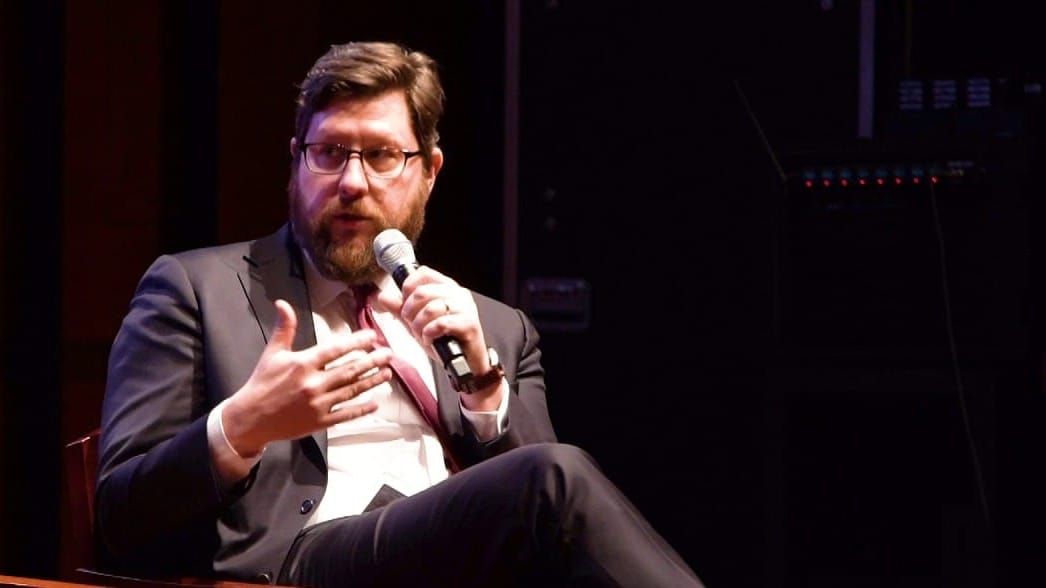
Edited by Sam Thielman
TO EXPLAIN WHAT'S developing in left-wing foreign-policy circles with access to the current and incoming round of Democratic congresspeople, there are few better people positioned than Matt Duss.
Duss has spent his two-decade career in Washington researching, writing and networking to push the Democratic Party in a left- and working-class-focused direction on foreign affairs—an arena where the party elite strongly pushes back. That led him to become Sen. Bernie Sanders' foreign policy adviser, a perch that gave him a crucial role in passing a ban on U.S. assistance to the merciless war in Yemen, a bipartisan rejection of brutality that Donald Trump vetoed in his first term. These days, Duss is executive vice president of the Center for International Policy and a foreign-policy adviser to Rep. Alexandria Ocasio-Cortez.
But I primarily know Matt as my friend of twenty years. I met him back during the struggle to end the Iraq War. At the Foundation for Middle East Peace and elsewhere, Matt was an advocate for justice and freedom for Palestine long before that was anything resembling a safe position in Washington. He's principled, decent and committed. Seeing his rise has been one of the more hopeful signs that the socialist reawakening in this country will have the internationalist component it needs.
Last week, Matt was up in New York for the book launch of a new foreign-policy anthology he edited, A World for All. He had just published an article in Foreign Affairs arguing that both the outgoing and incoming Congresses, fresh off the gigantic Democratic victory the week earlier, should take the Iran War out of Trump's hands before he re-escalates it. We had lunch and talked about the immediate-term foreign-policy priorities for the new Congress, and beyond. It was a more professional version of our typical bullshitting, and there was much less discussion of his beloved Dinosaur Jr. An edited version of our conversation is below.
Before we get there, we had this conversation hours before the horrific building collapse in Flatbush. If you missed Saturday's edition and you're looking to help the long process of resettling our now-homeless neighbors, see this for information on how.
SPENCER ACKERMAN: So, going to your Foreign Affairs piece, you were arguing that among the things this incoming Democratic Congress needs to do, and rapidly, is force an end to the Iran War.
MATT DUSS: Yeah.
SA: Trump is framing the blockade as an alternative to the Iran War. So does forcing an end to the war also mean forcing an end to the blockade?
MD: A blockade is an act of war, so no money whatsoever for anything having to do with the Iran war. That includes the blockade, yes.
SA: Appreciate that clarification. One thing that I was kind of surprised wasn't in your piece was zeroing out aid to Israel. Is that something you think the Democratic Congress will be prepared to do early on? How do you build consensus for that; and if not now, when?
MD: Yeah. It's a fair point. I wanted to keep the target list relatively small, what's most urgent for Congress to do right now. But obviously, ending aid to Israel, and frankly, ending arms sales to Israel in light of its current policies, I think is really important. On the aid question, I don't want to call the argument over, but in some ways, on the Democratic side, when you've got Rahm Emanuel supporting that position, as the rightmost pole in the Democratic Party debate–
SA: I'm suspicious of that, though.
MD: I'm suspicious of it, too. And let's also acknowledge, when Donald Trump says 'we'll end aid,' as I've said elsewhere and others have noted, they're trying to kind of repackage aid as quote-unquote "joint research projects" in the current NDAA [National Defense Authorization Act; the bill that approves the stuff for the Pentagon that a separate bill funds] under Section 219. There was a great letter [last week] from, I think it was 12 senators, urging the stripping out of that section, which is again, something Congress should absolutely do when it comes up in this lame duck.
SA: Where do you see internal obstacles to the Democrats ending the Iran war, zeroing out funding for Israel in the lame-duck congressional session before the newly elected Congress is sworn in; and then if they can't get it done in the lame duck, for the next Congress?
MD: Yeah. Well, in the lame duck , it'll be the fear of being blamed for a government shutdown, right? And that's not an unreasonable fear. But again, as I wrote in my piece, if there was ever a time to threaten to shut down the government, a reckless, illegal, globally destructive war that the American voters have just decisively rejected is it. So I think they should be willing to threaten that. And I think what they should offer, and I expect that they will, is a CR [Continuing Resolution] with language in it that specifically prohibits any funding used for the Iran war. And dare the Republicans to vote against that.
SA: Do you see a path to stripping out Section 219 from the NDAA, or should it just be that the NDAA is done, and the Democrats basically kill the thing and force the administration to go back and start again?
MD: Yeah. I think if it's not stripped out, this is a disastrous measure. Democrats should hold the line.
SA: Are there countervailing pressures that you see, people on the Democratic side, AIPAC politicians and so on, lining up to stop this?
MD: Of course. I mean, AIPAC still remains. Even if they have become publicly toxic, they still are privately listened to. Any organization that's able to direct that amount of money is going to get some ears on Capitol Hill. And you also have members, including some Democrats, who are just more ideologically hawkish, and they see real value in joint projects between the U.S. and Israeli military, even if they recognize that Israel is becoming more problematic in American politics.
Because generally, they share the belief that Israel's continuing role in the region should be as the hegemon, and Israel plays a major role in the projection of U.S. power in the region. Now, obviously, I disagree with that a lot. Progressives and I think a majority of Democrats disagree with that. But you do have people in positions of leadership like [Rep. Hakeem] Jeffries, like [Sen. Chuck] Schumer, probably Chris Coons, who's the incoming chairman of the Senate Foreign Relations Committee, who are supportive of that. So, I'll be watching Coons on this.
SA: When we speak about those countervailing forces, after the election, how do you see the order of battle in terms of the forces aligned against progressive and socialist foreign policy? Are they regrouping? Do you see them as ultimately showing a glass jaw? Something in the middle?
MD: I think what we've seen a lot unfortunately is, and I don't know that this will be the first thing, but we've seen a lot, we saw this obviously, Ilhan Omar is an example of this, of using accusations of antisemitism to split Democrats and to kind of keep progressives on their back foot.
SA: Rashida Tlaib…
MD: Rashida Tlaib as well. I mean, the fact that the only member of Congress to be censured for comments in the wake of October 7th was the one Palestinian, that's disgusting, just on its face. That is absolutely disgusting.
SA: And, I want to add, so is the attempted denaturalization and deportation of Ilhan Omar.
MD: Absolutely. Absolutely. So listen, we saw some of the worst anti-Muslim bigotry and Islamophobia directed at Abdul El-Sayed in Michigan. And again, I'm someone who's researched Islamophobia for almost 20 years. This was horrible shit. It's just like the grossest and dumbest, like creeping Sharia, taqiyya [the accusation that Muslims are religiously sanctioned to lie to nonbelievers], all the usual stuff that I had hoped at one point would be fading out, but it's just come roaring back.
SA: That said, it just got defeated.
MD: It got defeated. That's absolutely right. I think that's really important to note. But we also saw attempts to use antisemitism accusations against him. And obviously don't downplay the unfortunately growing prevalence of antisemitism. But clearly it was being used in an instrumental way against Abdul El-Sayed. We've seen it used in the same way against some of the other members who I just mentioned, and against the broader kind of progressive foreign policy coalition. Unfortunately, I think we're going to see that. I think it's going to have much less truck than it's had in the past. But I think it's really on Democrats, particularly progressive Democrats, not to fall for it.
SA: Do you see this as being an area, meaning ending support, ending military largesse to Israel, and stopping the merger of the defense-technological bases, where progressive and anti-Zionist Democrats could have active partnerships on the Republican side as well?
MD: I think so. Yeah. I mean, that's one of the more interesting developments I think in the foreign policy left-right, transpartisan coalition. Sometimes a rough coalition, but at least a shared interest in doing much less stupid stuff around the world. Critics from the establishment will call this isolationism, but that's a bunch of nonsense. I think the real question is, does it move beyond the fringes into the real mainstream?
And the key question here is, where does Donald Trump land on this? Because he still has enormous control over the caucus. I think the question you asked is a good one, but I think it's part of a bigger question of, okay, at what point do we start to see Republicans in the House and Senate start to show any real independence from Trump in any real numbers? And a normal president would enter his lame duck period a little bit chastened, but this is not a normal president, and he will not be a normal ex-president.
I mean, I think this is someone who will still probably retain the ability to do real damage to members of Congress-–
SA: That's true.
MD: –even after he leaves office. As long as he's got his phone, and he's able to put out social posts condemning Congressman or Congresswoman So-and-So, he's going to remain a force. That power could ebb, but that's why I'm saying I'm not making a prediction.
SA: To return to the defense question. Inevitably, now in this changed landscape, we're going into presidential primary season. Even assuming a progressive Democrat can win in 2028, which I think is possible, Democratic presidents, and even Democratic socialist mayors of New York City, run away from confronting hard power. They run away from imposing socialist solutions and socialist personnel or progressive personnel onto the institutions of the security state.
MD: Yeah.
SA: Do you see any appetite starting to change on that? And are there people that we should know who are coming up from the left in this world who would be ready to become, say, Undersecretary of Defense for Policy or take up acquisition roles, consider policies like defense conversion and things like that, that can actually deal with what it will mean to get out of the hegemony business?
MD: There are definitely people I could name. I don't know if I want to get people in trouble. But I would look at some of the names in the book I just edited. [A World For All: New Visions of U.S. Foreign Policy] Some folks who–
SA: But when they come onto Capitol Hill, very often, it's been CNAS and CAP or some of the less directly partisan think tanks like CSIS that advise electeds to move in the foreign-policy establishment's direction. And then they become an anchor for the status quo when it's time to staff a Democratic administration.
MD: Yeah. Can't deny that. Even though the progressive foreign policy bench is growing dramatically, there are a very small number of people who can sit in those bigger jobs. But what's key here is to have a president who has run and won on a real commitment to change that paradigm—to change the mindset, to go back to that comment from Obama back in the 2008 campaign.
People in Washington like to say that personnel is policy. Sometimes that's true, sometimes it's not. It does matter, but it matters sometimes not as much as people want to believe. But it really does matter for, obviously, the president and a dozen people around him or her, and finding those people. And not just the cabinet secretaries, but top advisors who understand how the bureaucracy works and can make sure that the president's will and the president's decisions are executed properly.
So, there's no version of this, even the best version of this, the best outcome in 2028. A progressive president who has committed to doing everything, I guess that, as you know, as someone who's reported on this very well and deeply for a long time, yeah, the institutional imperatives of these places and the cultures are very hard to shift. They are built for primacy. They are built for a very specific purpose. But even to start the job of transforming them begins on the campaign trail and coming in with the mandate to do it.
SA: And do you feel confident that there will be at least one candidate—who, perhaps, at times you may have advised—who will be ready to make that critique and perhaps even eager to make it and win on it?
MD: I'm hopeful that we'll have at least a few.
SA: So, what's the state of the bench of both left-wing Democratic foreign policy-focused legislators and the apparatus around them, who might be empowered in the next Congress, either politically or institutionally? And as someone who has been on the side of the left in these factional debates, what advice would you offer them so they can not just hit the ground running but avoid negative and even corrupting influences?
MD: Yeah. Well, I would say, you've got a number of great leaders in the House. Joaquin Castro is a standout. His team is great. I can run down a list of some others. Obviously Ilhan, Mark Pocan, [Jim] McGovern in Massachusetts. They all got really capable teams who have been at this for a while. They know how the process works. That's an initial challenge for anyone who's just going to the Hill for the first time: to understand the rules of these institutions, which can seem pretty bizarre, and still do to me, even after having spent six years up there.
The advice I might give, first of all, and I give this to every staffer, is make sure that you are not getting out in front of your boss. That's the main rule. Staffers who try to freelance do not last. People do not listen to them. They are very ineffective if and when it becomes clear that they're not speaking on behalf of the member they work for. But having a bunch of this new class coming in in January, including a lot of great folks from here in New York, is going to continue to move the needle.
The teams of the members who I just mentioned will be there to help mentor, train, assist a bunch of new staffers, even folks who've never been on the Hill before. And I hope and expect that these new members will be bringing in folks from their districts who have the– they obviously need some folks who have the experience. But part of the project here needs to be, and has been, as you said, building out that bench.
I'M ENDING THIS HERE because the rest of our conversation involved me ranting in a way that didn't really contain a question for Matt to answer. But the rant concerned something I want to observe: It has perhaps never been easier to tie the advance of oligarchy to both the economic precarity we feel to the imperial wars that we pursue.
The Iran War made more Americans bear direct economic pain for a foreign-policy fiasco than in most people's living memories, and all without so much as an effort to manufacture consent for it. But so do data centers—construction of which, Naomi Klein reports, the lame-duck Congress is moving fast this week to shove down the throats of the masses of people who reject them.
These air, noise, and light-polluting monstrosities poison your community. They import an existing workforce. They arrive with no community input. They lie to you about their impact on you and your children's health. They threaten to render your job or maybe your entire livelihood obsolete. They drain community resources like water, while they advance a surveillance state that commodifies your data, so your food prices go up depending on their AI's assessment of how much to squeeze out of your wallet; all while three-letter agencies that rely on AI capture and deport your neighbors. The same data centers power wars and mass atrocities that incinerate schoolchildren. The harms, hazards and risks of the data centers are socialized, while whatever benefits they produce are privatized—into the hands of, first, a new class of data-center landlords that are going to be the car-dealership reactionary middlemen of the 21st century; and then upward, into the hands of something like a dozen billionaires.
These are not different problems. Domestic and international, it's one problem with different aspects. And it's past time to address the problem as such.
HARRY DAVIES AND YUVAL ABRAHAM provide yet another example of what I'm talking about. "The files suggest the ties between AWS [Amazon Web Services] and the Israeli military deepened during a period in which Israel has been accused of committing grave crimes in Gaza, including genocide…" Amazon has to be considered a witting participant in the genocide and tried as such.
SECRETARY OF STATE-PLUS Marco Rubio gave a speech arguing for unbridled and eternal American Exceptionalism over anything resembling international law: "The ultimate question of our time is whether Americans have a moral right to exist as a distinct nation and a distinct people, and thus to demand a government that defends and pursues our interests above all else." Like all primacists, Rubio collapses the difference between being a "distinct" country and being an exceptionalist country. He does so to argue against having the same laws and standards that the United States demands for foreign nations apply to itself. Rubio just can't handle that: it's always hegemony or collapse, in primacist paranoia, and never the recognition that usually throughout history it's the prerogatives of hegemony that lead to collapse. Then Rubio dresses up the choice between equality and exceptionalism in bog-standard racist language about "open[ing] our borders" and permitting these imagined feral newcomers "remak[ing] our society in their image."
Rubio rejects "subordinat[ing] the national will to the menial consensus of the world." That sure would hit harder had the exceptionalists not provoked a war with Iran and lost, but that's Rubio's problem to ignore. That said, put this Rubio quote in my veins: "Even as we defeated the institution of Soviet communism, we did not triumph over the spirit of Marx. That spirit of Marx, it lives." That's destined to be a back-cover quote for NO ONE ESCAPES THE DIALECTIC.
Perhaps most psychotically, and credit to Daniel Larison for picking this up, Rubio approvingly quoted Pompey Magnus' fateful line during Sulla's civil war: "Stop quoting laws to men with swords." The transcript records laughter and then Rubio saying it's "not politically correct." The reason why Pompey's line echoes through history is because it heralded the eventual murder of the Roman Republic—which would ironically but poetically be Pompey's end as well.
THIS WEEK WE'LL LEARN the winners of the 2026 National Book Awards. Before we do, read this interview with the finalists – particularly Colin Asher, author of The Midnight Special: The Secret Prison History of American Music, my brother for more than 30 years and counting. Stick around for what he says about Hillbilly Elegy.
MATT BORS is back like he never left—with a new series of Toxic Avenger! This time, the goated political cartoonist turned comics writer pairs with the excellent artist Felipe Sobriero for Toxic Avenger vs. Noxious Offender, whose first issue drops October 7—but because of the dysfunctional way the comics market operates, you should right now let the friendly staff of your local comics shop know that you want it!
WALLER VS. WILDSTORM, the superhero spy thriller I co-wrote with my friend Evan Narcisse and which the masterful Jesús Merino illustrated, is available for purchase in a hardcover edition! If you don't have single issues of WVW and you want a four-issue set signed by me, they're going fast at Bulletproof Comics! Bulletproof is also selling signed copies of my IRON MAN run with Julius Ohta, so if you want those, buy them from Flatbush's finest! IRON MAN VOL. 1: THE STARK-ROXXON WAR, the first five issues, is now collected in trade paperback! Signed copies of that are at Bulletproof, too! And IRON MAN VOL. 2: THE INSURGENT IRON MAN is available here!
No one is prouder of WVW than her older sibling, REIGN OF TERROR: HOW THE 9/11 ERA DESTABILIZED AMERICA AND PRODUCED TRUMP, which is available now in hardcover, softcover, audiobook and Kindle edition. And on the way is a new addition to the family: THE DISAPPEARED: A FATHER, A SON AND THE WAR ON TERROR.