
ICE Tried To Turn This Minneapolis Teacher Into An Informant
Brandon Siguenza was detained for doing legal-observer work. ICE's real interest was in generating snitches. PLUS: Mojtaba Khamanei isn't surrendering

Brandon Siguenza was detained for doing legal-observer work. ICE's real interest was in generating snitches. PLUS: Mojtaba Khamanei isn't surrendering
Edited by Sam Thielman
RECENTLY, I had occasion to speak with a teacher from Minneapolis named Brandon Siguenza whom ICE took into custody in January. What he experienced there was very familiar from the War on Terror.
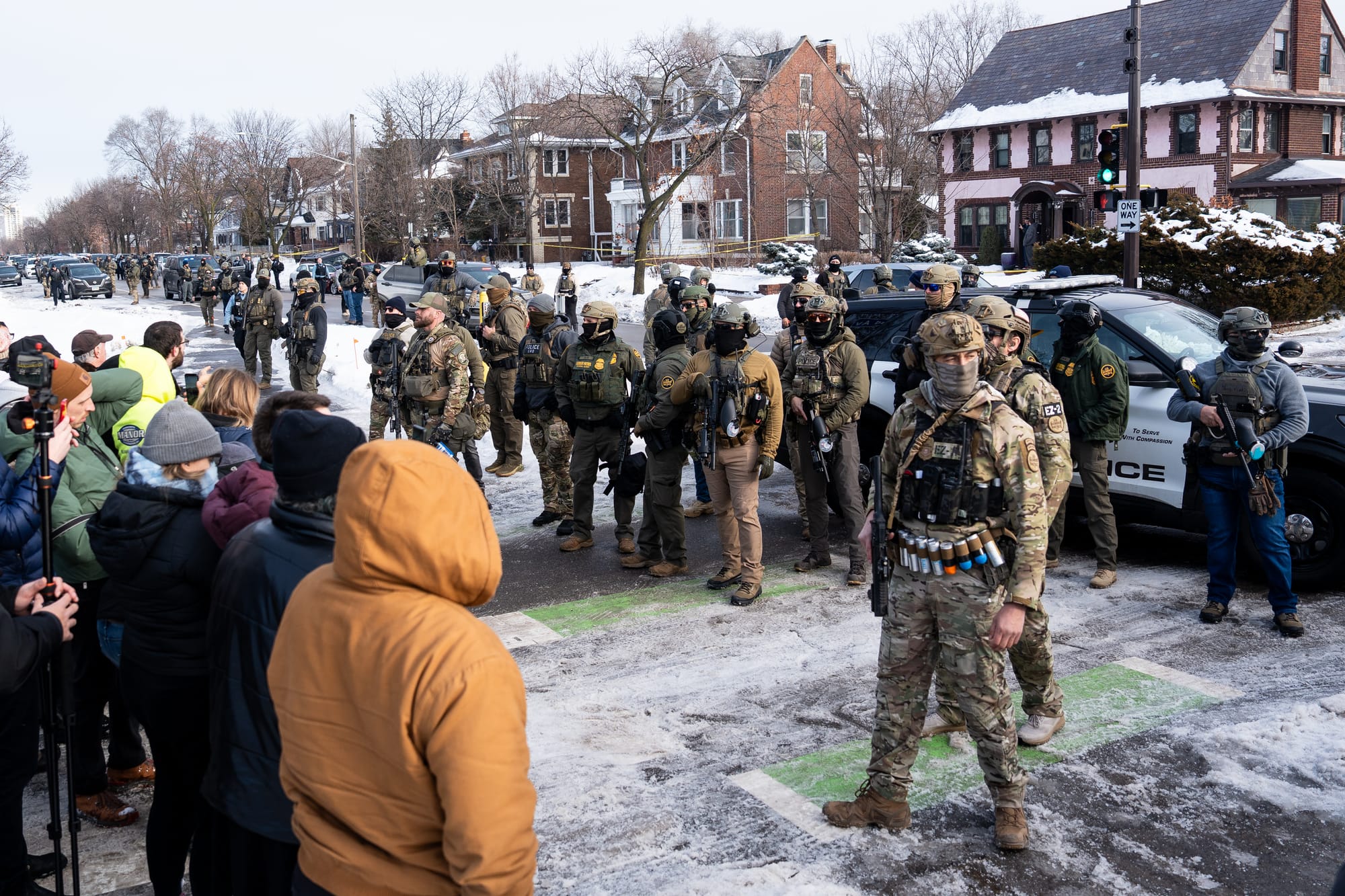
On Jan. 11, during the height of the ICE/CBP occupation of Minnesota known as Operation Metro Surge, Siguenza and a friend were in his friend’s car, doing legal observer work behind an ICE vehicle. It didn't take very long before ICE stopped them, grabbed them, and took them to the Whipple Federal Building, an ICE staging facility on the decommissioned military base at Fort Snelling. There's video of their encounter. Siguenza wrote about it for the Star-Tribune, where he included a picture of an agent pepper spraying the intake vent of his friend's car. That diabolical maneuver has ensured his friend, two months later, still breathes it in when she drives.
Siguenza spent about eight hours in ICE custody before they released him without charge. During those eight hours, however, ICE interrogated him three times. They wanted information—information on "illegals" in his neighborhood; and also on the protesters who challenged ICE when ICE came for their neighbors.
Siguenza told me that his ICE questioners seemed to believe there was a command structure in place. They wanted to flip him to get to his imaginary bosses. They seemed not to understand that their actions had provoked a whole lot of regular people into spontaneous resistance. ("Anarchism with Minnesota characteristics" in my phrase; "Neighborism" in Adam Serwer's better one.)
This was a story I've heard many times before, but never in such a context.
Usually, U.S. military interrogators have that perspective, mirror-imaging a command structure onto frightened people captured overseas. And usually it was the FBI, on the domestic front, who attempted to coerce people in custody—often people they themselves entrapped—into becoming informants. Now, on the streets of Minneapolis and surely beyond, it's ICE—looking not for alleged threats to national security, but for people in this country without proper documentation (a civil and not criminal misdemeanor, remember) and for protesters. I know I say this a lot, but these are the wages of normalization.
Siguenza is my favorite kind of hero: an everyday person who sees goons with badges menacing his community and doesn't take it lying down. He spoke to FOREVER WARS yesterday. A lightly edited transcript follows.
Spencer Ackerman: Brandon, what happened after ICE took you into Whipple?
Brandon Siguenza: I was taken out of an unmarked SUV and brought into an unheated garage, where the first thing I noticed was a lot of brown people in handcuffs, in a line, lined up. I was taken to a temporary table with a paper placard that read obstruction, and that's the first time I realized why they were taking me. I came to understand that I was being charged with obstruction, although I was never ultimately charged with a crime.
How long did you sit there before someone came to question you? And did you expect anyone to question you?
I've never been arrested before. I wasn't really sure what was going to happen. They took my passport and they put it in a mesh bag and had me sign a paper that listed my possessions. After being processed—after about, I would say, 20 to 30 minutes at the facility—I was brought into a small room for my first of three interrogations.
What happened in that first interrogation?
A special agent showed me a badge. That was the first time I'd seen a badge or any or anyone identified themselves by name or what organization they're from.
They identified themselves as an ICE special agent?
He identified himself as an agent with the Department of Homeland Security Investigations, HSI.
HSI. So what did this person say to you?
He frisked me again, because the first people that processed me had done it incorrectly and left stuff in my pockets. And I let him know that I had gloves on because it was really cold in that room, and I asked to put them on. And he said, "Oh, that was supposed to be taken from you, so I have to refrisk you. Please put your hands up against the wall." After that, he showed me his badge, told me his name, and he seemed to be training the other agent that was with him. I say this because he was like, showing her around, showing her how to unlock doors, explaining to her, for example, "here's where we write their names down. Use this marker to write their name on this whiteboard. Here's where we keep the USCs," which means US citizens. And the interrogation was very short. He reviewed my Miranda rights. He asked me if I wanted to speak with them about what happened. I declined. He allowed me to call my wife. My friend Patty, who was detained with me, was never given a chance to make a phone call.
How long did that interrogation last?
Maybe five minutes.
Did you expect that would be the end of anyone from ICE attempting to interrogate you?
I mean, I declined to answer their questions, and I figured—I'm not a legal expert, I've never been arrested before—so I figured, well, it's probably best to have a lawyer present if I'm going to answer any of their questions. So I declined [to answer], and over the phone, my wife told me that a lawyer was on their way to see me. So yeah, at that point, I figured, "Okay, done here. I guess I'll just wait until they let me out." I had a pretty strong feeling that I did nothing wrong, and I had a pretty strong feeling that they did not have a strong case against me.
So were you surprised when another interrogator showed up? And how long did it take before that happened?
After I was brought to a cell that was specifically designated for U.S. citizens in the Whipple federal building.
Was this a single occupancy cell, or were you in a bullpen with other people?
This was a single occupancy, as far as I can tell. It was a 10-by-10 foot room, and I believe it's intended only for one person, although I passed other cells of the same size that were packed with upwards of 15 people, whom I presume are non-citizens.
Did they keep you in that room for an extended period of time before an interrogator showed up? Or did it happen relatively quickly?
About an hour, if I could guess. I didn't have a clock or anything with me. I spent that time banging out a window and begging people to let me go to the bathroom.
So they didn't let you use the bathroom?
[Agents] told me things like, "Oh, I don't have a key to the cell," or, "Oh, I'll go get someone." But short answer, yes, they declined to let me go to the bathroom. Eventually an interrogator came. I guess he had a vested interest in, I guess, accommodating me, because he found someone with the right key, and I was able to go to the bathroom. He was from out of town. He had a Californian accent. He introduced himself as being from HSI as well. And he kept insisting that he was not ICE. I remember because he said it like three or four times: "I'm not ICE, by the way. I'm just interested in knowing what your motivations are."
That's interesting, because HSI is ICE. He said he wants to know what your motivations were?
Yeah, he said he asked Patty and I separately, he was curious what our motivations were. I wasn't interested in answering his questions, but I could hear through the wall my friend Patty, who was detained alongside me and housed in a cell next to me. I could hear her starting to answer his questions, and he asked things like, "Do you know of anyone that would want to set up a bomb? Do you know anyone who would want to snipe an ICE agent?" So when he says motivations, I suppose he means he's interested in if we want to commit violence, or know if anyone wants to commit violence. Patty and I are both non-violent people. I am a vegan special-education teacher. I don't know anyone who knows how to make a bomb, and I found his questions ridiculous.
Did he attempt further questioning of you, or only Patty?
He asked me the one time. I declined, and he and he left it there.
So was that the end of your interrogations, or did another one happen?
I was detained for over eight hours. After about six hours, some three men came to the cell and they invited my cellmate to a room for questioning.
So by this point they had brought someone else into your cell as well?
Yes, at this point, there were two men in the cell, me and this other guy. They asked if he could answer some questions for them. I can only speak for myself, but out of boredom, I think, he said yeah. I mean, we're just in there for hours with nothing to do. Okay? Very little to eat, very little stimulation. So, I mean, it's something to do. So he agreed. And then they came back and asked if I could answer some questions for them. I was curious what they would ask me. So I said, "Yes, I'll meet with you." They took me into another cell, three men. They also said that they were from the Department of Homeland Security Investigations. They said they're not ICE, they insisted they weren't ICE.
The one who seemed like he was in charge, he sat next to me. The other two kind of sat around me in a circle. The gentleman was like, "Yeah, it looks like you're in some trouble here. Like, man, it really seems like you're in a tough spot." And I said yeah, because at this point, not only am I in custody, but I expected to be charged with a crime.
At this point, I'd spoken with a lawyer, luckily, and the lawyer said to me that usually when they detain citizens at the Whipple federal building, since Metro Surge began, they usually let them out after three or four hours. And I had been here in this room for, I think, six hours at this point.
So when he says, you're in a spot now, is he making an offer to you, or is he pressing you more coercively to cooperate?
It seemed like he was offering me things. He was vaguely saying things like, "Really, I can help you out. I can do things for you." And he was very vague on that point. And so I pressed him. I asked him to state it in clearer terms. I said, you know, I'm really tired, I'm hungry, try explaining that again. I'm not really sure I understood. And he would say another vague thing, like, "yeah, maybe we can help you with some stuff." And eventually, I was like, "I don't know what you're talking about. Can you tell me exactly what it is that you're offering me?" And it was at that point he said, "Well, if you have family that's out of the country, and they need help getting into the country, maybe we can get them the right documents."
Wow.
My dad is a citizen, a naturalized citizen, born in Mexico and moved to the United States. My last name is Siguenza. It's a Hispanic last name, but I don't have family trying to get into the country. I told him that. I said that's interesting what you're offering me, but I'm not really interested in that. And he said, "We can offer you all kinds of things, like maybe money." And that was shocking to hear.
And so he was offering me these things, and then he wasn't really clear on what he wanted. So again, I had to ask several times for him to clarify. And eventually he told me. He said, "You know, we just want to keep everyone safe." And everyone in the room nodded, including me. I said, Yeah, that sounds great. "We just want to keep people safe. We want to make sure no one gets hurt at these protests. So if you could, you know, give me the names of protest organizers, maybe I can help you out."
I remember that phrasing because I found it so odd. He said the names of protest organizers. In my head, I'm thinking like, you know, like marches or demonstrations or political actions. I mean, they're organized by organizations, nonprofits that you can Google. You can find out who the organizers are pretty easily. But upon reflection, it seems to me like he was curious who had sent me. And I was doing legal observation as a volunteer. No one asked me to do it. No one told me to go to this intersection on this day. But I don't think that made any sense to him. I don't think he could reckon with someone doing what I did without external motivation.
Like a command structure?
I can only speculate, but that, to me, seemed to be the gist of what he's asking. Who is your boss, right? What are the names of these organizers that are telling you to do this? But the only thing I heard him say was "the names of protest organizers" and that didn't make a lot of sense to me. I told him as much. I'm like, "I'm not really sure what you mean, not really sure what you're asking for." And again, he said this thing about, "if you know anyone that wants to set off bombs…"
In trying to explain, I guess, to enlighten him, I just tried to say, "Sir, I was just trying to protect my neighbors." And at that point he said, "Oh, your neighbors. Where are they from?"
So literally, we're in a scene where he, as a person with a badge in a custodial situation, is asking you to inform on your neighbors?
Yes. He asked me what country my neighbors were from, and he had previously offered to give me money.
That sounds like secret police type shit.
He asked if I knew anyone who was in the country without permission as well.
So he wants to know about the structure of protest organizing; and he wants to know who you know that's a quote-unquote 'illegal'?
Exactly.
And he's offered you money and assistance with your legal circumstance?
He vaguely hinted at the legal circumstance, and he explicitly told me he could help me get family members that are outside of the country into the country.
And what did you tell him?
It was shocking. And you know, I've been sitting in a yellow room for six hours at this point. I was hungry, I was tired. Obviously, cooperating had no appeal to me, but I believe I said something along the lines of, like, "Sir, it's very interesting what you're saying, but I don't think I can help you at this time."
Did he leave it at that?
He said, "All right, that's that. No problem. You know, I'm just at my hotel room. I'm bored, you know, just watching TV. So if you want to give me a call, you can." He gave me a little piece of paper with his phone number on it. I left it in the cell. Because I got back into my cell, I sat down, and I was, like, so repulsed and disgusted by the experience I just had that the paper, to me, just had this, like, dark, heavy energy to it. I couldn't bear taking it with me. I wish I did, but I left it along with a paper cup I ripped up into tiny little pieces so that they could clean it up.
How long after that did you get out of Whipple?
About two hours after that.
And what did they tell you? They just told you you were free to go?
I heard some people outside the cell. I heard a special agent say, yeah, the white one. The door opened, the special agent said my name. The two other men in the cell were Hispanic men like me, but I was the most white-passing of the three, so I figured she meant me. She brought me to an elevator. I tried asking like, "Can I call someone?" I didn't have a phone because it was knocked out of my hand. She told me there was no phone for me to use.
I begged [another agent] essentially, "Sir, please, my wife doesn't know where I am, doesn't know I'm getting out." It was dark outside. He eventually gave me his government cell phone and let me call my wife. They told me to go out. They instructed me on where to walk out of the building. They took my ankle shackles off for the first time in eight hours. They told me to walk into this protest area that was a permanent fixture outside of Whipple. It still is.
I did as they instructed. About five minutes later, I heard a bullhorn, some ICE agent yelling, "Stay out of the street. Stay out of the street. This is your final warning." I looked down at the ground, I saw that I was standing on the sidewalk, as instructed. I even moved a little bit away, because they sound intense. And then the next moment, I heard bangs and explosions, and I was struck with a projectile.
They let you out into a confrontation with protesters and put you between them?
Yeah, they just let me out. They instructed me to go there. That was the way I was supposed to go.
And you got struck with a projectile. Where did it hit you?
Hit me on the thigh. Did not leave a mark. Patty got hit in the ankle with a different projectile, and that left a mark. And then tear gas was deployed like feet from me. It was a very chaotic, scary scene. People were screaming and crying. There's a woman hyperventilating that I just came across, and I sat with her, and I breathed with her, and I said, I'm going to find you an inhaler, because she was having an asthma attack. So I found a medic and got her an inhaler. And then she said, "Wait, are you the guy from the red car?" She had seen a video of my detainment. And that's when I was like, "Oh, shit, I'll have to explain this at work."
Well, last question for you, Brandon, and thank you very much. Did ICE try and contact you afterwards at all, or was that the end of your encounter with them?
That was the last time I had heard from ICE or any federal agent.
AS I WAS FINISHING up this transcript, Mojtaba Khamanei made his first statement as supreme leader of Iran. It was anything but the "unconditional surrender" that Donald Trump has demanded.
He made sure everyone understood that the U.S. had killed his father and six other members of his family. Frankly, Mojtaba's rise to power is like Act One of a Steven Segal movie. "We need to be patient and we need to believe in the promises of God almighty. We will never retreat. We will avenge the blood of our martyrs."
Anyone in the Gulf looking for a signal that the Iranians will cease attacking them surely came away dismayed. Sounding very different from President Masoud Pezeshkian's assurances over the weekend, Mojtaba declared: "We will destroy [the enemy's] facilities. That will bring the compensation that we need. We have good relations with 15 neighboring countries... But the enemy has certain military bases in some of these countries and have used them to attack us... My advice is to stop these bases from operating."
Earlier, IRGC-linked media warned that the tech and AI companies supporting the U.S-Israel war on Iran will continue to have their infrastructure in the Gulf targeted. They mean Google, Microsoft, Palantir, IBM, Nvidia, and Oracle.
The younger Khamenei also addressed a dog that has yet to bark. "[T]he resistance in Yemen"—Ansar Allah, AKA the Houthis—is "ready" to join the fight, he said. The Houthis literally beat now-CENTCOM chief Adm. Brad Cooper before. What will Cooper do—what will Trump do—if the Iranian coalition closes both the Strait of Hormuz and the Bab al-Mandeb, blocking the entrance to the Red Sea?
SPEAKING OF, Iran's closure of the Strait of Hormuz is about as obvious a response as can be predicted from an Iranian government fighting for its survival. Yet from all available evidence, the Trump administration was unprepared. Days ago, Trump mused about the Navy escorting oil and other cargo ships traversing the strait, though he's stopped talk of that over the past 24 hours or so. The Iranians would love for him to try it, entranced by visions of a $2.7 billion Burke-class destroyer burning, listing and sinking. The Houthis were able to beat a Navy task force in the Red Sea—one, again, commanded by the same guy running the war right now!—so running this strategy back against a far-stronger adversary on his home court will be, well, a choice.
By now you've seen that the International Energy Agency has authorized the release of 400 million barrels of reserve oil to meet energy needs and reassure markets. That's more than at any time since the 1973 oil shock. The economic implications of Trump's aggression are staggering, global and deep. Iraqi oil production is down 70 percent.
The Treasury Department has gone ahead with another mitigation factor. The closure of the Strait of Hormuz doesn't have to be a military measure (beyond a threat/declaration). It can happen through insurance companies deciding they don't want to be liable for a blown-up cargo ship and telling the shipping companies that their liability is their own. So a relatively new and obscure Treasury agency, the U.S. International Development Finance Corporation, announced that it will provide up to $20 billion of your money to re-insure losses "on a rolling basis."
Encouraging continued commercial crossing of the Strait by propping up insurers is a psychotic improvisation, one that can easily get people killed—which will in turn alarm the markets that the measure seeks to reassure. But when the Corporation says it has "identified best-in-class, preferred American insurance partners," it sure makes sense as a wealth transfer.
I DON'T KNOW who needs to hear this, but the FBI is beyond ludicrous for concocting a scenario where Iran launches Shahed-136 attacks against California. Iran has no way of staging such an attack. I don't feel like putting effort into refuting this. It's just fucking stupid. They think you're fucking stupid. [Speaking of fucking stupidity at the FBI, in a move sure to protect Americans from drone strikes, podcast host—I’m sorry; bureau director – Kash Patel announced yesterday that his agents will train with UFC fighters. No news on Savannah Guthrie’s mom, who has been missing since January, in case you were wondering.—Sam]
GREG PAK, a friend and comrade of mine, is a fantastic writer. I won't go through his whole resume, but if you saw Thor: Ragnarok, a great deal of that movie comes from Greg's excellent "Planet Hulk" saga. Now, Alberta, Canada has included Greg's Firefly comic-book adaptations on a list of books they are banning from school libraries. This absurd act of censorship is predicated on protecting children from sexually explicit imagery. There is none in Greg's Firefly books. Greg has some guesses as to why they banned his comics, but ultimately "censorship is for weak losers and bigots," as he writes.
Buy my friend Colin Asher's book The Midnight Special! I recently finished reading this in galleys, and you're just not ready. No spoilers, but it ends with an incandescent chapter about Afeni and Tupac Shakur.
Buy my friend Laura Hudson's comic book Exploit!
WALLER VS. WILDSTORM, the superhero spy thriller I co-wrote with my friend Evan Narcisse and which the masterful Jesús Merino illustrated, is available for purchase in a hardcover edition! If you don't have single issues of WVW and you want a four-issue set signed by me, they're going fast at Bulletproof Comics! Bulletproof is also selling signed copies of my IRON MAN run with Julius Ohta, so if you want those, buy them from Flatbush's finest! IRON MAN VOL. 1: THE STARK-ROXXON WAR, the first five issues, is now collected in trade paperback! Signed copies of that are at Bulletproof, too! And IRON MAN VOL. 2: THE INSURGENT IRON MAN is available here!
No one is prouder of WVW than her older sibling, REIGN OF TERROR: HOW THE 9/11 ERA DESTABILIZED AMERICA AND PRODUCED TRUMP, which is available now in hardcover, softcover, audiobook and Kindle edition. And on the way is a new addition to the family: THE TORTURE AND DELIVERANCE OF MAJID KHAN.