'Repeat Offenders': Chris Condon on His Iraq War Comic Book
'Repeat Offenders': Chris Condon on His Iraq War Comic Book

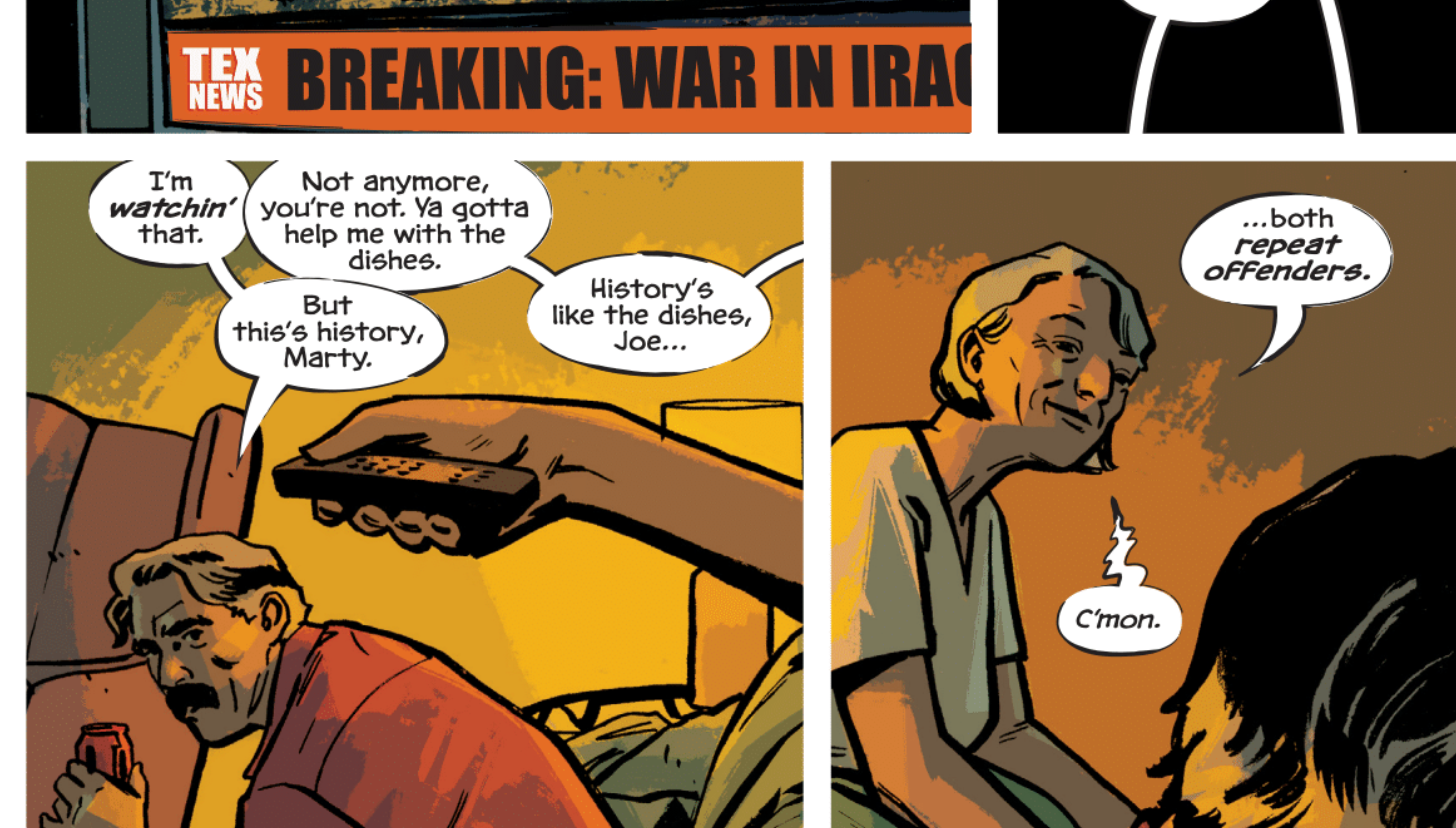
'That Texas Blood', one of the best crime comics running, sets its next story during the Iraq invasion 23 years ago. It's just in time for the Iran War
Edited by Sam Thielman
CHRIS CONDON has broken through in recent years as one of the most promising writers in contemporary comics. While superhero fans got Condon's work on Green Arrow for DC and the smash hit Ultimate Wolverine for Marvel, enthusiasts of crime, noir and Southern Gothic fiction found something special in That Texas Blood, his series with artist Jacob Phillips. The fictional Ambrose County of That Texas Blood is beset by generational traumas, ranging from the intimate to the occult. We see them play out over various eras in the life and career of Ambrose's sheriff, Joe Bob Coates. If you're into Cormac McCarthy, you'll like it, but Condon and Phillips aren't doing McCarthy pastiche. They're doing something uniquely them.
Condon and Phillips—who also work together on the similarly great detective serial The Peril of The Brutal Dark for DC/Vertigo—will bring That Texas Blood back for its fourth arc in June. Their new story, "Hell Comes To Allison Ranch," uses the Iraq War as both a backdrop and a mirror. That's rare these days: I tend to find that the Iraq War has been memory-holed, despite the urgent relevance of its legacy. Condon and Phillips are making an inspired choice by invoking the war, and not only because of the Texas of it all. I got an early look at their first issue, #21, titled "Shock and Awe." Set days before the invasion launches in 2003, it lives up to its promise. This is a book about a heist. I'm sure it's going to go according to plan.
I had the pleasure of having dinner with Chris a few years ago, shortly before my run on Iron Man and his runs on Ultimate Wolverine and Green Arrow were announced. I like to flatter myself that what I did with Iron Man was on a similar wavelength to his Green Arrow. Once I heard that That Texas Blood would take on the Iraq War, I had to ask Chris about it—and, particularly, about "Hell Comes To Allison Ranch" reaching readers right as the U.S. launches yet another disgraceful military aggression in the Middle East. A lightly edited transcript of our conversation follows.
Since this edition doesn't exactly report on current events, we'll be putting up a paywall during the Q&A. Make sure to subscribe to FOREVER WARS so you don't miss any of Chris Condon's insight on That Texas Blood—to say nothing of our regularly-scheduled journalism. Right after that, contact your local comics shop by May 11 and ask the staff to reserve you a copy of That Texas Blood #21.
SPENCER ACKERMAN: Chris Condon, thanks for doing this interview. I really love That Texas Blood, and I think this is the best issue that you and Jacob Phillips have produced. Congratulations on that. This is an Iraq War story, and from the start, on the threshold of the invasion, we see our protagonist, Sheriff Joe Bob, talk repeatedly about "witnessing history." He's experiencing the Iraq invasion as a media event in 2003, watching the news as so many did. I wanted to know why you chose that perspective for Joe Bob to start your story.
CHRIS CONDON: Well, first of all, thank you very much for having me, and thank you for the kind words on the book. This has been a story that I've been wanting to tell for a while. Jake and I knew that we were going to be telling this story. We had just been waiting and waiting and waiting to find the right time to do it, and right when we decided to do that, America decided to launch a war with Iran. So it's very weird timing.
I grew up in the 90s. I was 10 years old when 9/11 happened. When 9/11 happened, it was sort of [encountered] through the media that I ingested. I'm born and raised in New Jersey. New York is not very far. But you know, when we were told at school what had happened, they told us that the World Trade Center had been hit by airplanes. Nobody knew what the World Trade Center was. I was 10 years old. We knew it as the Twin Towers. I had no idea what happened. I got home and I experienced it through the television, where we got no other television channels other than, other than Channel Two, the CBS [affiliate in the tri-state area]. That was the only channel that we got. So all I had for months, until we went up in the attic and moved the antenna to point at the Empire State Building, all that we had was CBS News coverage of 9/11. So I was just inundated as a child—no cartoons, no Cartoon Network—I had only the [non-cable] channels, two through 13. And so that was kind of my life for, you know, however many months that was. And then same thing with the war in Iraq.
I remember very specifically witnessing it on television, like so many other people. I mean, obviously there were real people involved in this. But the way that I ingested it, the way that I viewed it, was through the television set. That viewing, you know, almost as a voyeur, was how I wanted to bring us into this story. Obviously there's a lot that is analogous to the Iraq War, and that's on purpose. But yeah, I wanted to bring people into this world through the television set, through media, because that was how I learned it, and how I lived through it.
Joe Bob is typically our font of empathy in the world of Ambrose County in That Texas Blood. I was curious about what's going through his head as he sees the Iraq War unfold and talks about the opportunity to watch history. While that was, I think, the tenor of a fair amount of the news coverage at the time, it is something of a bloodless way to describe what's about to happen. And I want to ask you about that choice.
Sure, yeah. I mean, so he says he's a spectator. He's a spectator watching the war, you know, arrive in Iraq. Then he's all of a sudden thrust into a war at home, which I think is something that America is—I'm trying to think of a way to describe this. [Laughs] But the reason that I wanted Joe to be a spectator here and be watching the war in Iraq begin was because I wanted to have that perspective of, yeah, he is watching this thing, and then he is just sort of thrust into it. And this is largely about a heist that goes wrong. But it's also, in a lot of ways, a war book. And I wanted to have that juxtaposition, because I do think it is important to kind of see what most Americans, [were] watching, and watching from a certain perspective. I mean, up until that point, they were watching U.N. white SUVs driving around in Iraq, looking for WMDs. Everybody was just watching it from, from afar. I was, what, 10, 11, 12 years old when this was happening. I had a certain view of what the government was, a certain amount of trust. Even though I was nine when it happened, I remember Gore-Lieberman. We were a Gore-Lieberman house,. So I remember being a Gore-Lieberman house, and we didn't want Bush, but Bush was the president, and you just supported America, and that was kind of the perspective. And then, obviously, as media developed, as the internet developed, you started learning things, seeing things, things that you might not otherwise see. I mean, this happened with Vietnam, too. But, yeah, [with] the Iraq War, quickly it became apparent that it wasn't a just war, and it was started on false pretenses, straight up lies.
It's a good thing that never happened again.
Exactly. That's what's so weird about writing the book now, because I was planning this for so long, and now it's happening again. And I'm like, Oh, my God, this is prescient again, and I really wish that wasn't the case. I wish that people learned their lessons well. But yeah, that's, that's the world that we live in, doomed to repeat ourselves. But yeah, from my perspective, it was just, you know, it was important to kind of have that juxtaposition, until he was thrown into his own war. Also started on lies and misinformation, but on a much smaller scale.
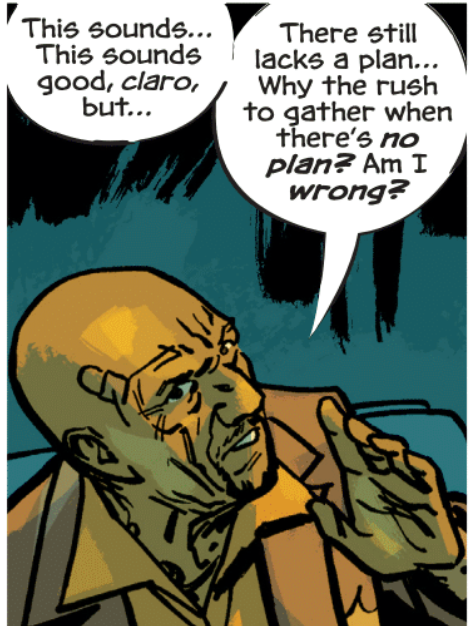
You do a simply fantastic job of putting both the themes of the war and the feeling of dread from the time onto the panel, in really elegant and subtle ways. There's a character we meet, I believe for the first time, named Sally, who has a wonderful panel of dialogue that rings especially loudly when it comes to the state of the Iraq war on the cusp of the invasion. He says, "There still lacks a plan. Why the rush to gather when there's no plan?" What went into writing him?
It's people who do a certain job, right? They're expected to do their job. That's being a soldier. You're supposed to go and you're supposed to fight wars, but what if there is no plan? What are you fighting for? I think that's always the question. I'm working on a book right now at Marvel with Captain America. That's literally the opening of the book. It's him asking, because that was, that was the question in World War Two, right? That it was part of the propaganda. Why We Fight.
Frank Capra, yeah.
They're trying to drum up nationalism, you know, let's support our troops. Let's support America. But the bigger question is, why do we fight? And if this is a person's job, they're supposed to be good at their job, and they can, they can do their job, sure. We're seeing that in Iran right now, where there's airstrikes, and maybe it's going well according to what they're supposed to be doing, but they're not going well in terms of a larger war. They're not really impacting anything. So what are we doing? And so that's sort of the question. We can go in. I can, you know, set some charges, we can blow up a safe. But what's the plan? How do we get out of here? That's the question that Sally is asking.
You mentioned earlier in our conversation that you had been building up to this for a while. Had there always been this Iraq-centric arc coming? Or did that develop as you built out That Texas Blood?