
Interceptors Versus Missiles: The Iran War's Wrath of The Math
A theory of Iranian strategy. PLUS: Me, Chris Hayes and Ayman Mohyeldin on the war's politics

Edited by Sam Thielman
FIRST, A NOTE TO FOREVER WARS' readers with military or security backgrounds: This edition will be obvious to you. Today I want to speak to the nonexpert readers about a factor in the war that feels backgrounded and underappreciated, and propose a theory of Iranian strategy that I think flows from it.
In 2024, amidst the regional war emanating from October 7 and the Israeli genocide in Gaza, Iran launched a fleet of about 300 ballistic missiles and drones at Israel. In 2025, once the Israelis and the Americans bombed Iran, Iran fired more than 500 ballistic missiles and hundreds more drones at Israel, and also gave the mammoth U.S. airbase at al-Udeid in Qatar a well-telegraphed love tap.
The Iranian response in 2026 looks much different. This time around, they haven't hit Israel, the most enthusiastic combatant in the war, nearly as hard. The attacks on Israel are volleys that continue over time but are not as intense. Instead, Iran has spread its attacks out across the Gulf states that host U.S. military infrastructure. As you can see from many influencer videos from Abu Dhabi or Dubai, the Iranians are not only hitting military infrastructure, by a long shot. "Iran's bombing of Arab countries without making any distinction—Oman, Qatar, Kuwait, Bahrain, Saudi Arabia, the United Arab Emirates, Jordan—all of them—is, in my opinion, an incredibly wrong strategy," Turkish Foreign Minister Hakan Fidan said Tuesday.
Why the change?
Because this time, the Iranians are trying to solve a math equation. No doubt their ballistic missile stocks are depleted after both the 2024 and 2025 salvos; and because of U.S. and Israeli bombings, both then and now. But the U.S. interceptor stocks—what the U.S. uses to shoot down those missiles, and what it sells/provides to its Gulf allies for the same purpose—are expensive, far slower to produce than they are to expend, and, seemingly, low. I should have mentioned this in the Dan Caine piece last week, but the dust-up over the general's advice to Trump began after stories emerged in the press about Caine's concern that attacking Iran would place real strain on U.S. missile and especially interceptor magazine depth.
The actual size of the U.S.' interceptor inventory is, as you'd expect, classified. The facts that it's finite and slow to replenish are not. Same goes for Israel, whose interceptor magazine depth I certainly do not know.
The Iranians are stretching the zone of U.S. interceptor defense across an arc lining the Gulf; and, with daily strikes on Israel, to similarly draw down the Israeli interceptor magazine. The UAE, which loves exporting violence to Yemen and Sudan, does not appear equipped to experience repeated Iranian missile and drone barrages. In Saudi Arabia, where memories of the 2019 Aramco attack are fresh, missile debris forced the shutdown of the Ras Tanura refinery, which produces half a million barrels of oil a day.
In other words, even at the outset of the war, when Gulf-state stocks of their U.S. interceptors hadn't yet had to fire, the Iranians were still hitting stuff, at the U.S. bases and elsewhere. The Wall Street Journal reported today that the Gulfies' rates of interceptor usage likely cannot be maintained beyond a week. Their tally indicates that from Saturday to Monday night, the UAE, Bahrain, Qatar and Kuwait had to fire interceptors at 244 incoming Iranian ballistic missiles—almost as many missiles in three days as the Iranians fired at Israel in 2024. It takes between two or three interceptors to stop a missile. That doesn't take into account the Shahed-136 drone-missiles, which the Iranians are also firing, drawing interceptor fire in return.
My theory is this: The Iranians are making the U.S./Israeli/Gulfie coalition drain or even empty their interceptor magazine in the first phase of the war. Then, I expect, the Iranians will start really emptying the clip at the Israelis especially, and at regional U.S. infrastructure. A video that has circulated for the past few days has an IRGC adviser named Ebrahim Jabari holding their most powerful missiles in reserve. "We are equipped with the most advanced capabilities, to fight you for years," Jabari said. Might be bluster, might not. But he's talking about a strategy to fight a long war, not the short one Trump is hoping for.
By aiming at the Gulfies first, the Iranians keep their longer-range ballistic missiles in reserve for the Israelis, and they force frightened wealthy countries to demand greater sustained involvement from the United States, most immediately for interceptor replenishment. As the Trump administration has to make the Gulfies ration their ability to defend against death from long distance, Riyadh, Abu Dhabi, Kuwait City, Doha and Manama will increase their pressure on Trump to end the war, all while the U.S. pulls ordnance from its interceptor and other missile stocks from other theaters. Ukraine, which needs to use U.S. interceptors and missiles against the Russians (and the Russians’ Iranian-supplied Shahed-136s) will watch this development with dread. China will watch it with enthusiasm.
For decades, military analysts in the United States have warned/noted/fearmongered over a missile arsenal estimated to be in the thousands. We can subtract about 1000 ballistic missiles (not all created equal in terms of range, it must be noted) by estimating what Iran fired in 2024, 2025 and today. Subtract some unknown number more that the United States and Israel have been able to blow up through silo, launcher or factory destruction. There is a reason Marco Rubio said yesterday, "Our objectives are missiles, both the ability to manufacture them and the ability to launch them." This is the U.S. and Israel's attempt to reset the math in their favor. Obviously the fewer Iranian missiles (and drones), the fewer interceptors needed.
I've got a piece out today at Zeteo—paid subscribers to FOREVER WARS will get it in their inboxes tomorrow; make sure that's you—about how the U.S. and Israeli goals diverge the longer the war continues. This theory complements it. The Iranian regime, regardless of Trump's incoherence on regime change, is fighting for survival. Its way of war over the past 30 years has been characterized by proxy forces, missile capabilities and indirect attacks that force economy-of-defense decisions on its adversaries. The first four days of the 2026 Iran-U.S.-Israel War looks like the missile-based version of Iran's initial post-October 7 strategy of spreading pain around the region to pressure the U.S. to make Israel stop genociding.
Notably, that did not work for Iran. This may not, either. But the Iranians need leverage over the U.S. and Israel that they decidedly do not otherwise have. Interceptor attrition incentivizes the Iranians, who have rejected negotiations with Washington for the time being, to drag the U.S. into a longer war than the Trump administration, for reasons you'll see in my Zeteo piece, is prepared for. (Israel wants a long war, though.)
That is of course dangerous for the Iranians. They'll have to withstand way, way more deaths than the 787 of the war’s first four days, and may see Israel and the U.S. bringing Gaza to the Alborz Mountains, so to speak. It is also possible that the experience of being blitzed every day by Iranian drones and missiles entrenches the Gulf's embrace of the U.S. and expands its tolerance of Israel.
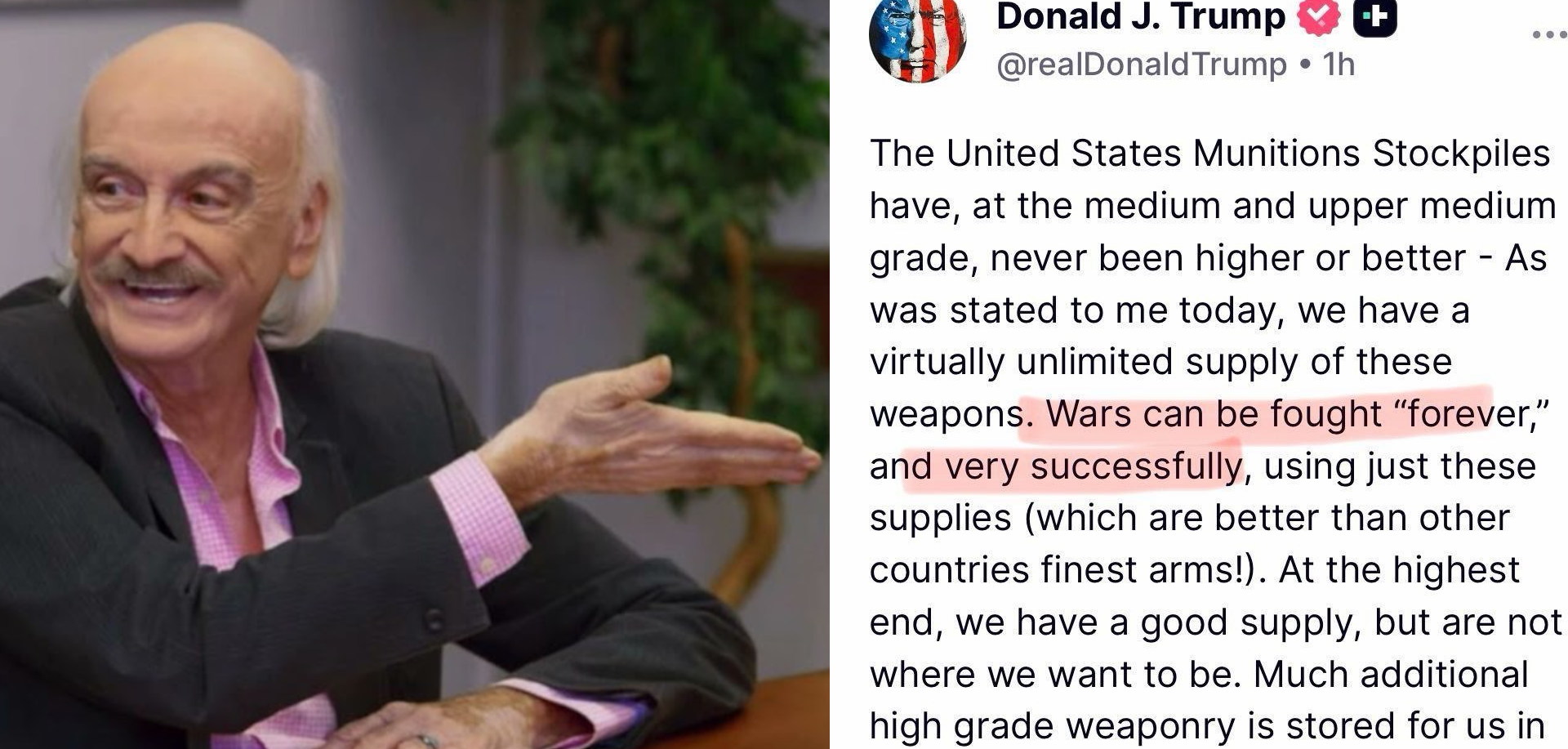
But Iran did not choose a war for its survival. The U.S. and Israel brought it to Teheran. The Iranian regime is of course responding with a familiar willingness to inflict pain widely and not particularly discriminately. While Iran owns that choice, the U.S. and Israel have no excuse for not expecting it or preparing for it, particularly when Washington and Jerusalem put the Iranian regime's survival at risk. The quote above from Trump, about a willingness to fight a new forever war, is a bluff that Iranians like Jabari are calling. Now we await, as soon as next week, what their next phase of the war heralds.
[Couple notes from Sam: I was briefly an embassy brat and lived in Kenya while my dad was stationed there shortly after the embassy was destroyed by Osama bin Laden in a horrific bombing right in the middle of downtown Nairobi. I was in high school. That Trump and Rubio and the rest of these heedless chickenhawks either just forgot about the civilians and foreign nationals staffing their embassies and bases, or worse, wanted to keep the attack a surprise and didn’t tell their ambassadors and other senior personnel on purpose, sickens me utterly. The latter seems more likely to me, since the only embassy in the region closed before the attacks was the one in Israel and the embassy in Riyadh wasn’t closed until today. Like everyone else I’m watching social media too much. For other people curious about authentication of videos of the war circulating on social media, this Bellingcat piece includes some social media videos vetted by their team. Shayan Sardarizadeh, an excellent researcher for the BBC, notes that AI fakes are going around as well, so for your own sake please be judicious about how seriously you take footage if it’s not clearly attributed by a trustworthy source, especially if the footage is shocking.—Sam]
LAST NIGHT I joined Ayman Mohyeldin on Chris Hayes' MS NOW show to discuss Iran. Ayman really steals the show here. His point about the visibility of the Omani foreign minister, whose job has relegated him to the cloakrooms of regional diplomacy, was so crucial that I kicked myself for not thinking of it first. Also, I seem to glitch at the end, unable to remember the word "escalation." That's live TV for you, a high-wire act.
I KEEP MEANING TO WRITE ABOUT the appalling development of predictions markets for war. This is a full-scale social catastrophe. Thanks to the Supreme Court legalizing the casinofication of sports media, and the decimation of well-paying and dignified work, hyper-exploitative and newly respectable app-based bookies have achieved escape velocity from sports and are now offering the chance to microdose war profiteering. This will fleece people, but not before investing them in traveling further down the path of sociopathy. CNN should be ashamed of its deal with Kalshi – it's going to get journalists the sort of death threats that we see athletes and their families get. And can you imagine the fallout when some psycho whose phone addiction prompts him to get five grand in the hole playing armchair general about a real-life war threatens an officer?
"FOR 47 LONG YEARS, the expansionist and Islamist regime in Tehran has waged a savage, one-sided war against America," War Secretary Pete Hegseth asserted yesterday. This is a propagandist's version of history, but I've noticed it becoming a talking point. Like starting history on 9/11, or on October 7, starting history with 1979 overlooks, well, everything relevant about U.S.-Iranian history. The story actually starts in 1953, when the CIA overthrew an Iranian prime minister on behalf of western oil interests, and installed a puppet, Shah Reza Pahlavi, who gave the oil giants substantial concessions, extracting for his team the wealth that was the due right of the Iranian people. Along the way he tortured and killed his people for 25 years, all of it with Washington's indifference and support for the man Jimmy Carter in 1977 called "an island of stability in one of the more troubled areas of the world." That is why they chanted DEATH TO AMERICA when the Iranian Revolution came in 1979. I wrote this when the Twelve Day War broke out last year:
But remember that this war did not start today. It did not start on October 7, it did not start in 2020, it did not start in 2028, it did not start in 2003-11, it did not start in 2001, and it did not start in 1979. It started in 1953. It started when unchecked American aggression, driven by capital's demand for oil and anticommunism, toppled an Iranian government. Remember that in the days ahead, when our leaders seek to topple another.
MY DEAR FRIEND Laura Hudson is a polymath as well as a fantastic writer. Many of you will know her from her time at WIRED, or her contributions to The Verge or Feminist Frequency, or her screenwriting on the HBO adaptation of DMZ. The hardcore among you know Laura as the founder of the greatest-ever site of comic-book criticism, Comics Alliance. The hardest-core among you know her from the Game of Thrones podcast we did together for several years and two news outlets.
What you don't know is that Laura is a tremendous and ambitious comic book writer. You're about to find out.
Along with one of her best friends, Tim Leong—we all worked together at WIRED long ago—Laura is writing a new series for the independent comic book company Mad Cave. It's called Exploit, and it is highly relevant to our interlocking social crises. Laura and Tim create the journalist Kirby Kuo and aim her at the tech oligarch Cole Saxon. (What a name.) I've read the first issue and it's excellent. All I can tell you is that Laura has trained for this her entire life and so her comics debut was always going to be tremendous. Tell your comic-book retailer—you can find them here—that you want Exploit #1 when it hits stores on Wednesday, and you can preorder it and every subsequent issue, as well as the upcoming collected edition, from Mad Cave.
WALLER VS. WILDSTORM, the superhero spy thriller I co-wrote with my friend Evan Narcisse and which the masterful Jesús Merino illustrated, is available for purchase in a hardcover edition! If you don't have single issues of WVW and you want a four-issue set signed by me, they're going fast at Bulletproof Comics! Bulletproof is also selling signed copies of my IRON MAN run with Julius Ohta, so if you want those, buy them from Flatbush's finest! IRON MAN VOL. 1: THE STARK-ROXXON WAR, the first five issues, is now collected in trade paperback! Signed copies of that are at Bulletproof, too! And IRON MAN VOL. 2: THE INSURGENT IRON MAN is available here!
No one is prouder of WVW than her older sibling, REIGN OF TERROR: HOW THE 9/11 ERA DESTABILIZED AMERICA AND PRODUCED TRUMP, which is available now in hardcover, softcover, audiobook and Kindle edition. And on the way is a new addition to the family: THE TORTURE AND DELIVERANCE OF MAJID KHAN.
And you can pre-order Friend of FOREVER WARS Colin Asher's new book, The Midnight Special: The Secret Prison History of American Music!