Beware The "Trump Won't Use Force in Greenland" Headlines
The transatlantic crisis is hardly over. Trump is so psychotic that Mark Carney is telling the truth about the 'rules-based international order.' PLUS: Three podcasts I guested on!

Edited by Sam Thielman
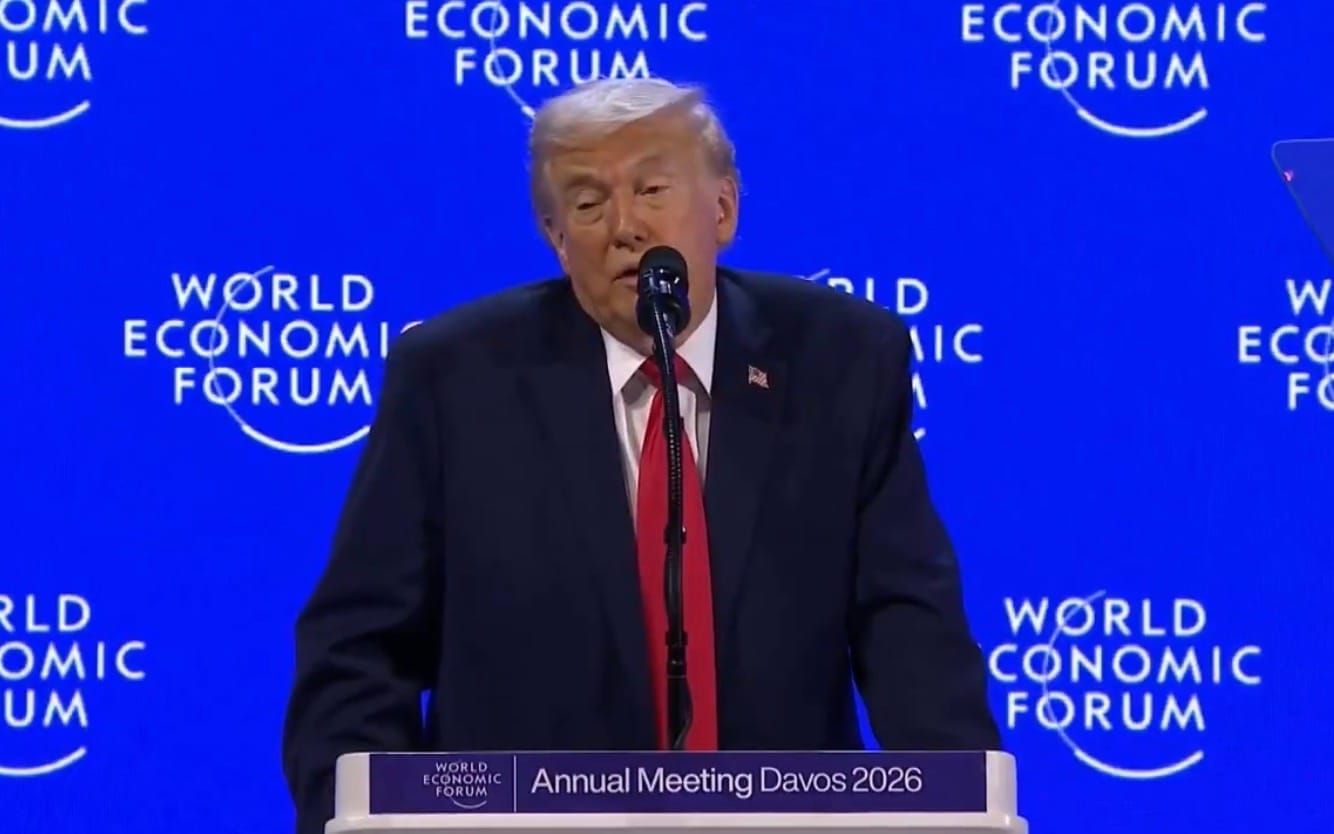
I HAVE TO BE CAREFUL not to step on a forthcoming piece on Trump's foreign policy post-Maduro that you won't read for a couple weeks, but: if you encounter a headline like "Trump Says He Won't Use Force In Greenland," that will leave you with a severe misimpression of Trump's big speech in Davos today.
The last 36 hours in Davos represent a signal moment in the decline and potential fall of the transatlantic alliance, which since 1945 has been a central pillar of American global hegemony. This morning, Trump openly menaced Europe with more than an hour of bellicosity intended to intimidate Denmark and the European Union into surrendering to him, as imperial tribute, what he called, in Trumpian fashion, "a piece of ice, small and poorly located." As Trump repeatedly reminded the World Economic Forum what he just did in Venezuela, it seemed less like he backed off the crisis he manufactured over Greenland and more like that crisis has entered something akin to its "Maduro can surrender" phase. (Even if that phase only existed retroactively.)
First Trump presented a psychedelic version of World War II about the U.S. liberating Greenland from the Nazis, for the purpose of both establishing a claim on the island—"It's the northern frontier of the Western hemisphere. That's our territory"—and a narrative of a beneficent American superpower. [“Without us right now, you would all be speaking German and a little Japanese,” he told the audience in Davos, Switzerland, where the primary of its three official languages is German. Most of the attendees at the WEF probably also speak a little Japanese.—Sam] With the present-day emergence of arctic sea lanes near Greenland, America once again seeks only to defend "the West," this time against Chinese and Russian naval and economic power. But perfidious, sybaritic European elites are standing suicidally in Trump's way. "How ungrateful are they now," he continued.
Trump pointed to Caracas to remind the audience of western capital and governmental powerbrokers that defying him doesn't end well. "We're a great power, even greater than many thought. They found that out two weeks ago in Venezuela," he said.
That is the context in which Trump then said the following lines that the headlines are seizing on: "We probably won't get anything unless I decide to use excessive strength and force, where we would be, frankly, unstoppable. But I won't do that," Trump said, as the room took stock of his declaration. "Now everyone's saying 'Oh, good.' …I won't use force. All the United States is asking for is a place called Greenland."
Does that sound to you like a crisis defused? Or does it sound instead like he's building a narrative around which he can escalate the crisis later? "You can say yes and we can be very appreciative," Trump said, "or you can say no, and we will remember." Gunboat diplomacy, unleashed at the dawn of overseas U.S. empire in Latin America, now sails in its dusk to Europe.
An unmistakable signal of Trump's willingness to escalate came when Trump took a shot at Canadian prime minister Mark Carney. Carney's Tuesday speech, which I'll get to in a second, is the other major historical document emerging from Davos. "Canada lives because of the United States," Trump said. "Remember that, Mark, when you make your statements."
The day before in Davos, transatlantic leaders were trying to gauge the depth of the crisis. Ishaan Tharoor's Washington Post dispatch provides a sense of the hypernormalization shock as elites struggled to understand whether the security and economic scaffolding underlying the post-World War II can be repaired or if Greenland really does represent the beginning of the end of the geopolitically familiar. In that context, Carney, who I've only thought of as a milquetoast politician, delivered the first account from a western leader I've heard that attempted to actually sketch out an alternative, post-American western order.
If that sounds vague, he doesn't totally know what he means yet, either. Carney's point was more that Trump is not the temporary disruption of the 'rules-based international order' that Joe Biden promised, but instead the harbinger of a new geopolitical normal. Canada has to start thinking programmatically about how to secure its interests from America, and Europe probably should as well. And Carney, who won election by campaigning on defying Trump, is so fed up that he didn't mind speaking the dirty truths of the 'rules-based international order'—that it's not international law, but an American carve-out from it:
For decades, countries like Canada prospered under what we called the rules-based international order. We joined its institutions, we praised its principles, we benefited from its predictability. And because of that, we could pursue values-based foreign policies under its protection.
We knew the story of the international rules-based order was partially false—that the strongest would exempt themselves when convenient, that trade rules were enforced asymmetrically. And we knew that international law applied with varying rigour depending on the identity of the accused or the victim.
This fiction was useful, and American hegemony, in particular, helped provide public goods, open sea lanes, a stable financial system, collective security and support for frameworks for resolving disputes.
So, we placed the sign in the window. We participated in the rituals, and we largely avoided calling out the gaps between rhetoric and reality.
This bargain no longer works. Let me be direct. We are in the midst of a rupture, not a transition.
On the one hand, I've never, ever heard a western leader speak with this kind of candor about the difference between American hegemony and the international law it claims to promote. On the other hand: where were you when the Rules-Based International Order disappeared, tortured, starved through sanctions or killed Indonesians, Cubans, Vietnamese, Laotians, Cambodians, Salvadorans, Guatemalans, Iraqis, Afghans, Pakistanis Libyans, Somalis, Syrians, Iranians, Palestinians, and on and on???? Was it all worth it for you to "benefit from [U.S. hegemony's] predictability"? Was the monster only a monster when it bared its teeth at you?
One last thing about Trump's speech. As Trump rambled to its conclusion, he portrayed the wave of ICE violence he unleashed on Minnesota as a blood-and-soil defense of "Western civilization" against the barbarian hordes of an inferior, invading foreign culture, meaning Somali immigrants. He meant to strengthen the nativist parties of Europe against the dominant ones represented at the World Economic Forum. But whether those in the audience care to admit it or not, Trump was presenting himself within the ugly, familiar and recent traditions of European imperialism, as if to tell Davos: I'm just doing what you've always done, what brought Europe "from the depths of the dark ages to the pinnacle of human achievement." Why resist me?
"I am derived from Europe. Scotland and Germany. Hundred percent," Trump assured them. "We want strong allies, not weaker ones."
THREE PODCASTS I've done over the past week that I think you'll enjoy:
Blood Work, a podcast whose mission to examine the economy of violence I fuck with heavily, had me on to talk about REIGN OF TERROR's thesis and its relevance.
Hammi Sylla, a super-smart youth I met at a Costs of War Projects conference, hosted me on Let's Just Talk to discuss Iran and Minnesota.
And keep an eye out for a forthcoming episode of Luke Thomas' podcast in which we talk a lot about the War on Terror roots of ICE's reign of terror in Minnesota. Seems not to be out yet.
Finally, I really liked this essay by Adam Arola and I hope you'll check it out.
WALLER VS. WILDSTORM, the superhero spy thriller I co-wrote with my friend Evan Narcisse and which the masterful Jesús Merino illustrated, is available for purchase in a hardcover edition! If you don't have single issues of WVW and you want a four-issue set signed by me, they're going fast at Bulletproof Comics! Bulletproof is also selling signed copies of my IRON MAN run with Julius Ohta, so if you want those, buy them from Flatbush's finest! IRON MAN VOL. 1: THE STARK-ROXXON WAR, the first five issues, is now collected in trade paperback! Signed copies of that are at Bulletproof, too! And IRON MAN VOL. 2: THE INSURGENT IRON MAN is available here!
No one is prouder of WVW than her older sibling, REIGN OF TERROR: HOW THE 9/11 ERA DESTABILIZED AMERICA AND PRODUCED TRUMP, which is available now in hardcover, softcover, audiobook and Kindle edition. And on the way is a new addition to the family: THE TORTURE AND DELIVERANCE OF MAJID KHAN.